Why so many of America's public university students are not graduating—and what to do about it
The United States has long been a model for accessible, affordable education, as exemplified by the country's public universities. And yet less than 60 percent of the students entering American universities today are graduating. Why is this happening, and what can be done? Crossing the Finish Line provides the most detailed exploration ever of college completion at America's public universities. This groundbreaking book sheds light on such serious issues as dropout rates linked to race, gender, and socioeconomic status.
Probing graduation rates at twenty-one flagship public universities and four statewide systems of public higher education, the authors focus on the progress of students in the entering class of 1999—from entry to graduation, transfer, or withdrawal. They examine the effects of parental education, family income, race and gender, high school grades, test scores, financial aid, and characteristics of universities attended (especially their selectivity). The conclusions are compelling: minority students and students from poor families have markedly lower graduation rates—and take longer to earn degrees—even when other variables are taken into account. Noting the strong performance of transfer students and the effects of financial constraints on student retention, the authors call for improved transfer and financial aid policies, and suggest ways of improving the sorting processes that match students to institutions.
An outstanding combination of evidence and analysis, Crossing the Finish Line should be read by everyone who cares about the nation's higher education system.
eBook - ePub
Crossing the Finish Line
Completing College at America's Public Universities
- 416 pages
- English
- ePUB (mobile friendly)
- Available on iOS & Android
eBook - ePub
Crossing the Finish Line
Completing College at America's Public Universities
About this book
Information
Publisher
Princeton University PressYear
2009Print ISBN
9780691149905
9780691137483
eBook ISBN
9781400831463
Topic
EducationSubtopic
Educational PolicyCHAPTER 1
Educational Attainment: Overall Trends,
Disparities, and the Public Universities We Study
THE SUBJECT OF this book—educational attainment in the United States—could hardly be more timely. Academics, framers of public policy, and journalists are united in bemoaning the failure of the United States in recent years to continue building the human capital it needs to satisfy economic, social, and political needs. In their book The Race Between Education and Technology, Claudia Goldin and Lawrence Katz applaud America’s astonishingly steady and substantial educational progress during the first three quarters of the 20th century—and then are just as emphatic in calling attention to the dramatic falling off in the rate of increase in educational attainment since the mid-1970s.1 The chairman of the Federal Reserve Board, Ben S. Bernanke, in remarks delivered at Harvard on Class Day 2008, told the assembled graduates that “the best way to improve economic opportunity and to reduce inequality is to increase the educational attainment and skills of American workers.”2 The New York Times columnist David Brooks has referred to “the skills slowdown” as “the biggest issue facing the country.”3 In writing about how to increase growth in America, David Leonhardt, also at the New York Times, says simply: “Education—educating more people and educating them better—appears to be the best single bet that a society can make.”4
Bernanke was wise to couch his argument in terms of educational attainment (which we generally equate with earning a degree) rather than just enrollment or years of school completed, for the payoff to completing one’s studies is much higher than the payoff to having “just been there” another year—the so-called “sheepskin” effect.5 In our view, too much discussion has focused on initial access to educational opportunities (“getting started”) rather than on attainment (“finishing”). It is noteworthy that in his first speech to a joint session of Congress (and then in his budget message), President Barack Obama emphasized the importance of graduating from college, not just enrolling.6
In any case, as Bernanke and others have stressed, the key linkage is between the formation of human capital and productivity. In his Class Day remarks, Bernanke observed: “The productivity surge in the decades after World War II corresponded to a period in which educational attainment was increasing rapidly.” Technological change and the breaking down of barriers to the exchange of information and ideas across boundaries of every kind have unquestionably increased the value of brainpower and training in every country. As President Obama has said: “In a global economy where the most valuable skill you can sell is your knowledge, a good education is no longer just a pathway to opportunity—it is a prerequisite.”7 Leonhardt adds: “There really is no mystery about why education would be the lifeblood of economic growth. . . . [Education] helps a society leverage every other investment it makes, be it in medicine, transportation, or alternative energy.”8 Nor are economic gains the only reason to assert the importance of educational attainment. The ability of a democracy to function well depends on a high level of political engagement, which is also tied to the educational level of the citizenry. A high level of educational attainment fosters civic contributions of many kinds.9
Even though our emphasis on “finishing” is meant to be a useful corrective to the sometime tendency to focus simply on “starting,” we hasten to add that there are of course dimensions of college success beyond just graduating that must also be kept in mind. The kind and quality of the undergraduate education obtained are plainly important. It would be a serious mistake to treat all college degrees as the same or to put so much emphasis on earning a degree that other educational objectives are lost from sight. This is why some are skeptical of the weight given by the National Collegiate Athletic Association to graduation rates (whatever the subject studied and whatever the rigor of the graduation requirements) in assessing the academic performance of scholarship athletes. As in platform diving, differences in the “degree of difficulty” of various courses of study deserve to be acknowledged, and considerable weight should be given to academic achievement in assessing educational outcomes. For these reasons, we examine fields of study chosen by students and grades earned, as well as graduation rates. However, much as there is to be said for such finer-grained analyses, we believe it is valuable to place special emphasis on graduation rates as presumptively the single most important indicator of educational attainment—which is what we do in this book.
EDUCATIONAL ATTAINMENT IN THE UNITED STATES
These basic propositions explain why there is reason for serious concern about the slow-down in the rate of increase in the overall level of educational attainment in the United States. The facts are sobering. As Goldin and Katz report on the basis of an exhaustive study of historical records, the achievements of America in the first three quarters of what they call “the Human Capital Century” are impressive indeed. This country’s then unprecedented mass secondary schooling and the concurrent establishment of an extensive and remarkably flexible system of higher education combined to produce gains in educational attainment that were both steady and spectacular (see Figure 1.1, which plots years of schooling by birth cohorts from 1876 to the present). Unfortunately, this truly amazing record of progress came to a halt about the time when members of the 1951 birth cohort (who were 24 years old in 1975) were attending college.10
We see this same “flattening” when we use data from the Current Population Survey to track the educational attainment of 25- to 29-year-olds from 1968 to 2007 (Figure 1.2). Although there was a modest increase in educational attainment in the 1990s, the curve is flat for the years thereafter. The failure of educational attainment to continue to increase steadily is the result of problems at all stages of education, starting with pre-school and then moving through primary and secondary levels of education and on into college (see the discussion in Chapter 2 of “losses” of students at each main stage of the educational process). Our focus on completion rates at the college level should certainly not be read as dismissing the need to make progress at earlier stages. In any case, it is noteworthy that over this 40-year period the completion rate (the fraction of those who started college who eventually earned a bachelor’s degree) changed hardly at all, while time-to-degree increased markedly.11
This is not a pretty picture when looked at through the lens of America’s history of educational accomplishments during the first 75 years of the 20th century. It is an equally disturbing picture when juxtaposed with the remarkable gains in educational attainment in other countries. As is increasingly recognized, the United States can no longer claim that it is “first-in-class” in terms of continuing progress in building human capital. The 2008 annual stock-taking document produced by the Organization for Economic Co-operation and Development (OECD) reported that the 2006 higher education attainment rate for 25- to 34-year-olds in the United States is nearly identical to that of 55- to 64-year-olds, a group 30 years their senior. In 2006, the United States ranked 10th among the members of the OECD in its tertiary attainment rate. This is a large drop from preceding years: the United States ranked 5th in 2001 and 3rd in 1998. Moreover, in the United States only 56 percent of entering students finished college, an outcome that placed this country second to the bottom of the rank-ordering of countries by completion rate.12 In recognition of this reality, President Obama has set an ambitious goal for American higher education: “By 2020, America will once again have the highest proportion of college graduates in the world.”13 And the situation in the United States is even more worrying when the focus is on degrees in the natural sciences and engineering. According to a report published by the National Science Board, “The proportion of the college-age population that earned degrees in NS&E fields was substantially larger in more than 16 countries in Asia and Europe than in the United States in 2000.” In that year, the United States ranked just below Italy and above only four other countries. Twenty-five years earlier, in 1975, the United States was tied with Finland for second place (below only Japan).14
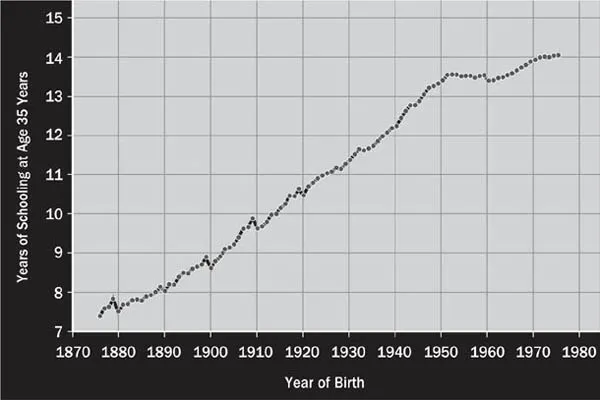
Figure 1.1. Years of Schooling of U.S. Native-Born Citizens by Birth Cohorts, 1876–1975
Source: Goldin and Katz, figure 1.4.
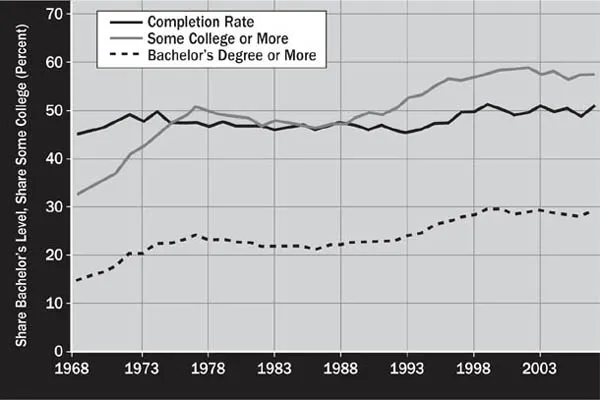
Figure 1.2. Educational Attainment of 25- to 29-Year-Olds, 1968–2007
Source: Current Population Survey.
A central question is why educational attainment in the United States has been on a plateau in recent years. In seeking to answer this question, a key analytical tool is the wage premiums earned by college graduates and high school graduates. Data painstakingly assembled by Goldin and Katz (presented in Figure 1.3) show that both of these premiums fell sharply between 1915 and 1950, moved somewhat erratically between 1950 and 1980, and then increased sharply from 1980 to 2005—with the wage premium for college graduates increasing much faster than the premium for high school graduates. By 2005, the wage premium for college graduates had returned to the high-water mark set in 1915.15
In looking inside these ratios, Goldin and Katz found that the growth rate of demand for more educated workers (relative to less educated workers) was fairly constant over the entire period from 1915 to 2005. It was the pronounced slow-down in the rate of growth in the supply of educated workers (especially native-born workers) that was primarily responsible for the marked increase in the college graduate wage premium. In recent years, growth in the supply of college-educated workers has been sluggish and has not kept up with increases in demand—especially inceases in the demand for individuals with strong problem-solving skills and degrees from the more selective undergraduate programs and leading professional schools.16 The real puzzle is why educational attainment has failed to respond to the powerful economic incentives represented by the high college graduate wage premium. We would have expected rising returns on investments in a college education to have elicited a solid increase in the number of students earning bachelor’s degrees.17 But this has not happened.
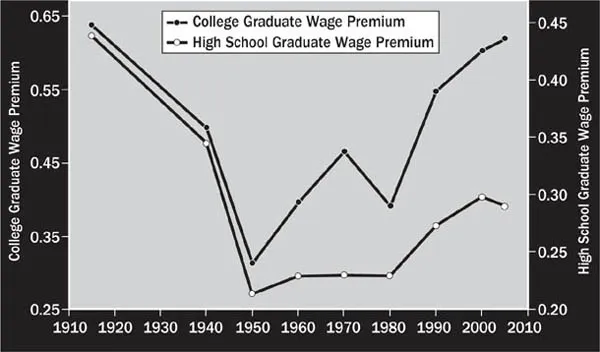
Figure 1.3. Wage Premiums of College Graduates and High School Graduates, 1915–2005
Source: Goldin and Katz, figure 8.1.
To be sure, some commentators have suggested that the perception that there are superior economic returns to investments in higher education is mistaken; however, careful statistical work by several leading economists strongly suggests that these worries are misplaced. Indeed, research reported and reviewed by David Card (among others), suggests that returns for prospective college students who might be added “at the margin” are at least as high as the average for all students.18 As Goldin and Katz put it, there may be some “natural limit” to the share of high school graduates who can benefit from earning a college degree—the optimal graduation rate is surely not 100 percent—but there is no evidence that we are anywhere close to such a limit now.19
Thus, the sluggish response of educational attainment to economic incentives remains puzzling, and we are driven back to the need to understand the forces responsible for what appears to be a “supply-side” block. One possible explanation for the surprisingly stagnant state of overall educational attainment in the United States can be rejected out of hand: the problem is not low aspirations. Students of all family backgrounds have high (and rising) educational aspirations. The Education Longitudinal Study of 2...
Table of contents
- Cover
- Half title
- Title
- Copyright
- Contents
- Acknowledgments
- Preface
- Chapter 1. Educational Attainment: Overall Trends, Disparities, and the Public Universities We Study 1
- Chapter 2. Bachelor’s Degree Attainment on a National Level 20
- Chapter 3. Finishing College at Public Universities
- Chapter 4. Fields of Study, Time-to-Degree, and College Grades
- Chapter 5. High Schools and “Undermatching”
- Chapter 6. Test Scores and High School Grades as Predictors
- Chapter 7. Transfer Students and the Path from Two-Year to Four-Year Colleges
- Chapter 8. Financial Aid and Pricing on a National Level
- Chapter 9. Financial Aid at Public Universities
- Chapter 10. Institutional Selectivity and Institutional Effects
- Chapter 11. Target Populations
- Chapter 12. Looking Ahead
- Appendix A. The Modern Evolution of America’s Flagship Universities
- Notes
- List of Figures
- List of Tables
- List of Appendix Tables
- References
- Index
Trusted by 375,005 students
Access to over 1.5 million titles for a fair monthly price.
Study more efficiently using our study tools.
Frequently asked questions
Yes, you can cancel anytime from the Subscription tab in your account settings on the Perlego website. Your subscription will stay active until the end of your current billing period. Learn how to cancel your subscription
No, books cannot be downloaded as external files, such as PDFs, for use outside of Perlego. However, you can download books within the Perlego app for offline reading on mobile or tablet. Learn how to download books offline
Perlego offers two plans: Essential and Complete
- Essential is ideal for learners and professionals who enjoy exploring a wide range of subjects. Access the Essential Library with 800,000+ trusted titles and best-sellers across business, personal growth, and the humanities. Includes unlimited reading time and Standard Read Aloud voice.
- Complete: Perfect for advanced learners and researchers needing full, unrestricted access. Unlock 1.5M+ books across hundreds of subjects, including academic and specialized titles. The Complete Plan also includes advanced features like Premium Read Aloud and Research Assistant.
We are an online textbook subscription service, where you can get access to an entire online library for less than the price of a single book per month. With over 1.5 million books across 990+ topics, we’ve got you covered! Learn about our mission
Look out for the read-aloud symbol on your next book to see if you can listen to it. The read-aloud tool reads text aloud for you, highlighting the text as it is being read. You can pause it, speed it up and slow it down. Learn more about Read Aloud
Yes! You can use the Perlego app on both iOS and Android devices to read anytime, anywhere — even offline. Perfect for commutes or when you’re on the go.
Please note we cannot support devices running on iOS 13 and Android 7 or earlier. Learn more about using the app
Please note we cannot support devices running on iOS 13 and Android 7 or earlier. Learn more about using the app
Yes, you can access Crossing the Finish Line by William G. Bowen,Matthew M. Chingos,Michael McPherson in PDF and/or ePUB format, as well as other popular books in Education & Educational Policy. We have over 1.5 million books available in our catalogue for you to explore.