A leading historian reveals the radical origins of humanity's most cherished secular values
Democracy, free thought and expression, religious tolerance, individual liberty, political self-determination of peoples, sexual and racial equality—these values have firmly entered the mainstream in the decades since they were enshrined in the 1948 U.N. Declaration of Human Rights. But if these ideals no longer seem radical today, their origin was very radical indeed—far more so than most historians have been willing to recognize. In A Revolution of the Mind, Jonathan Israel, one of the world's leading historians of the Enlightenment, traces the philosophical roots of these ideas to what were the least respectable strata of Enlightenment thought—what he calls the Radical Enlightenment.
Originating as a clandestine movement of ideas that was almost entirely hidden from public view during its earliest phase, the Radical Enlightenment matured in opposition to the moderate mainstream Enlightenment dominant in Europe and America in the eighteenth century. During the revolutionary decades of the 1770s, 1780s, and 1790s, the Radical Enlightenment burst into the open, only to provoke a long and bitter backlash. A Revolution of the Mind shows that this vigorous opposition was mainly due to the powerful impulses in society to defend the principles of monarchy, aristocracy, empire, and racial hierarchy—principles linked to the upholding of censorship, church authority, social inequality, racial segregation, religious discrimination, and far-reaching privilege for ruling groups.
In telling this fascinating history, A Revolution of the Mind reveals the surprising origin of our most cherished values—and helps explain why in certain circles they are frequently disapproved of and attacked even today.
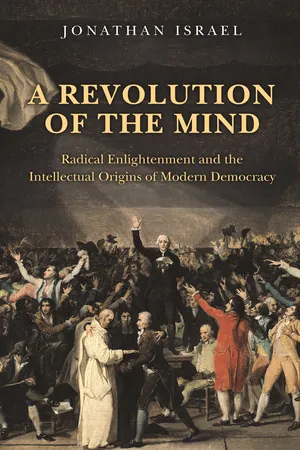
eBook - ePub
A Revolution of the Mind
Radical Enlightenment and the Intellectual Origins of Modern Democracy
- 296 pages
- English
- ePUB (mobile friendly)
- Available on iOS & Android
eBook - ePub
A Revolution of the Mind
Radical Enlightenment and the Intellectual Origins of Modern Democracy
About this book
Information
Publisher
Princeton University PressYear
2009Print ISBN
9780691152608
9780691142005
eBook ISBN
9781400831609
Table of contents
- Cover
- Half title
- Title
- Copyright
- Contents
- Preface
- Chapter I Progress and the Enlightenment’s Two Conflicting Ways of Improving the World
- Chapter II Democracy or Social Hierarchy? The Political Rift
- Chapter III The Problem of Equality and Inequality: The Rise of Economics
- Chapter IV The Enlightenment’s Critique of War and the Quest for “Perpetual Peace”
- Chapter V Two Kinds of Moral Philosophy in Conflict
- Chapter VI Voltaire versus Spinoza: The Enlightenment as a Basic Duality of Philosophical Systems
- Chapter VII Conclusion
- Notes
- Index
Trusted by 375,005 students
Access to over 1.5 million titles for a fair monthly price.
Study more efficiently using our study tools.
Frequently asked questions
Yes, you can cancel anytime from the Subscription tab in your account settings on the Perlego website. Your subscription will stay active until the end of your current billing period. Learn how to cancel your subscription
No, books cannot be downloaded as external files, such as PDFs, for use outside of Perlego. However, you can download books within the Perlego app for offline reading on mobile or tablet. Learn how to download books offline
Perlego offers two plans: Essential and Complete
- Essential is ideal for learners and professionals who enjoy exploring a wide range of subjects. Access the Essential Library with 800,000+ trusted titles and best-sellers across business, personal growth, and the humanities. Includes unlimited reading time and Standard Read Aloud voice.
- Complete: Perfect for advanced learners and researchers needing full, unrestricted access. Unlock 1.5M+ books across hundreds of subjects, including academic and specialized titles. The Complete Plan also includes advanced features like Premium Read Aloud and Research Assistant.
We are an online textbook subscription service, where you can get access to an entire online library for less than the price of a single book per month. With over 1.5 million books across 990+ topics, we’ve got you covered! Learn about our mission
Look out for the read-aloud symbol on your next book to see if you can listen to it. The read-aloud tool reads text aloud for you, highlighting the text as it is being read. You can pause it, speed it up and slow it down. Learn more about Read Aloud
Yes! You can use the Perlego app on both iOS and Android devices to read anytime, anywhere — even offline. Perfect for commutes or when you’re on the go.
Please note we cannot support devices running on iOS 13 and Android 7 or earlier. Learn more about using the app
Please note we cannot support devices running on iOS 13 and Android 7 or earlier. Learn more about using the app
Yes, you can access A Revolution of the Mind by Jonathan Israel in PDF and/or ePUB format, as well as other popular books in History & European History. We have over 1.5 million books available in our catalogue for you to explore.