A riveting history of Russia's crimes in Chechnya
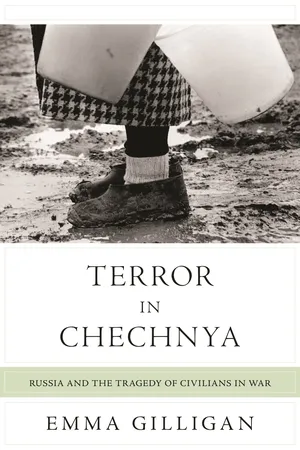
Terror in Chechnya is the definitive account of Russian war crimes in Chechnya. Emma Gilligan provides a comprehensive history of the second Chechen conflict of 1999 to 2005, revealing one of the most appalling human rights catastrophes of the modern era—one that has yet to be fully acknowledged by the international community. Drawing upon eyewitness testimony and interviews with refugees and key political and humanitarian figures, Gilligan tells for the first time the full story of the Russian military's systematic use of torture, disappearances, executions, and other punitive tactics against the Chechen population.
In Terror in Chechnya, Gilligan challenges Russian claims that civilian casualties in Chechnya were an unavoidable consequence of civil war. She argues that racism and nationalism were substantial factors in Russia's second war against the Chechens and the resulting refugee crisis. She does not ignore the war crimes committed by Chechen separatists and pro-Moscow forces. Gilligan traces the radicalization of Chechen fighters and sheds light on the Dubrovka and Beslan hostage crises, demonstrating how they undermined the separatist movement and in turn contributed to racial hatred against Chechens in Moscow.
A haunting testament of modern-day crimes against humanity, Terror in Chechnya also looks at the international response to the conflict, focusing on Europe's humanitarian and human rights efforts inside Chechnya.
- 288 pages
- English
- ePUB (mobile friendly)
- Available on iOS & Android
eBook - ePub
About this book
Information
Publisher
Princeton University PressYear
2009Print ISBN
9780691162041
9780691130798
eBook ISBN
9781400831760
Topic
GeschichteSubtopic
Russische GeschichtePART ONE

THE CRIMES
1
THE BOMBING, 1999–2000
You can see what a mess Russia is in. They can’t bring any order to us. The only thing they bring is war, and I think the fight will last a long time.—Chechen civilian, January 2000I don’t know why the sun comes back here, to a city used to the dark, to a people used to pain. Every night when darkness sets traps in the broken windows of the houses (like the toothless smile of an old woman) I solemnly swear that if the morning returns, I will leave this city forever.—Mainat Abdulaeva, in Novaia Gazeta, September 2002
THE PRELUDE TO WAR
Chechnya was a failing state in the interim period between the first Chechen war (1994–96) and the beginning of the subsequent conflict in September 1999. When Russia’s armed forces entered the small republic for a second time that autumn, they were penetrating a politically fractured and economically deprived region, struggling to overcome its isolation. While the Chechen separatist movement had, for all intents and purposes, won the first Chechen war and elected a new president, Aslan Maskhadov, the question of Chechnya’s status within the Russian Federation was still unresolved. The Khasaviurt Peace Treaty signed by Lieutenant General Alexander Lebed and Maskhadov in Dagestan on August 31, 1996, postponed discussion of this vital issue until 2001. The morass into which the country fell was a tragedy that had resounding consequences.
The new Chechen state of Ickheria struggled for a number of reasons. First, the radical wing of the newly formed separatist government—a faction led by Shamil Basaev, Movladi Udugov, and the ideologist Zelimkhan Yandarbiev—encouraged the adoption of an Islamic front that sought to repackage the political identity of the Chechen state and radicalize dissonant and disenfranchised groups. These groups and their private armies undermined President Maskhadov’s call for a centralized and democratic order. Second, intra-clan (teip) rivalries diminished the effectiveness of the law enforcement agencies, whose officers were expected to respond to crime, regardless of teip allegiances, but who were in many cases frightened of the consequences if they did so. Finally, little international support was provided for the building of bureaucratic and administrative structures capable of providing care and services to the population under the guidance of appropriate specialists. Unlike the significant levels of attention and financial support devoted to Kosovo under the UN protectorate of June 1999, Chechnya was given neither. This was a country, despite its fragile victory, that had suffered a traumatic three years of brutal war. Recovering from this tragedy was a process that required time and support, fiscal as well as psychological. Chechnya was deprived of both.
The roots of Russian violence and Chechen retaliation in the post-Soviet era, however, should first be sought in two key moments: the political turbulence of the period from 1990 to 1994 and the patterns of violent coercion established during the 1994–96 Russo-Chechen war. The emergence of the Chechen separatist movement grew out of the “Popular Fronts” characteristic of the perestroika period. Led by the Vanaikh Democratic Party under Zelimkhan Yandarbiev, the so-called Chechen Revolution that followed in the wake of the “Velvet” Revolution in the Czech Republic in 1989 and the reassertion of independence claims in the Baltic Republics was marked by the first Chechen National Congress (CNC) and a “Declaration of State Sovereignty” in November 1990.1 Chechnya’s claim for inde pen dence was not uncharacteristic of the period. This call for self-determination was supported by Boris Yeltsin on the wave of his victory over former president Gorbachev in the lead-up to the collapse of the Soviet Union in 1991.
That support was short-lived. Internal problems in Chechnya soon grew evident. The Soviet air force major-general Dzhokhar Dudaev was elected chairman of the Executive Committee of the National Congress in 1991. And despite being a charismatic leader, capable of rousing nationalist sentiment, Dudaev soon displayed some problematic character traits. He dissolved the Chechen-Ingush Supreme Soviet under Doku Zavgaev and replaced it with a provisional government led by the Executive Committee of the CNC. He depended greatly on shady opportunists like Beslan Gantemirov and Ruslan Labazanov to provide financial and military support. And after his election as president, he formally declared Chechen independence on November 1, 1991.2 Far from deferential, Dudaev quickly formed a National Armed Guard as the Russian government similarly armed its Chechen proxies. The Chechen president began withholding the payment of federal taxes, and thousands of ethnic Russians were forced to leave as a result of personal threats or blatant attacks on their apartments, or in response to the rapidly failing state sector. In asserting control over both the Baku-Novorississk pipeline and the main train route from Russia to Dagestan and Azerbaijan, Dudaev managed to make his intentions clear.3
Despite the Chechen president’s autocratic tendencies, the evidence strongly suggests that Dudaev’s ultimate aim was a constitutional secular state for Chechnya. The Chechen constitution approved in 1992 was a secular document with none of the Islamic references to Shariah law that would later dominate the political landscape or its attendant iconography.4 His stubbornness in this fragile period from 1990 to 1994, however, proved to be a major contributing factor to the tragic events that followed. He categorically rejected a draft treaty on autonomy on the model proposed for Tartastan5 and insisted that all negotiations be conducted at the executive level with Yeltsin personally.6 On the Russian side, President Yeltsin imposed a cordon sanitaire, hoping to isolate the region economically and force the nationalist movement into submission. This policy was ruinous for the state sector. The Russian government, moreover, wavered dramatically between conciliatory gestures and bouts of arrogance in a negotiation process that could only be characterized as fatal to the future of Chechen life. The reasons were linked, in part, to the rapidly changing political circumstances taking place in the Russian Federation after the 1993 state Duma elections and the personal hubris of both presidents.7 But no substantial negotiations ever took place. No meetings were ever convened between the respective presidents and both sides proved incapable of framing a set of negotiations capable of averting a crisis. By 1994, with the threat of an imminent attack, however, Dudaev did appeal to President Yeltsin on numerous occasions by telephone, letter, and through media interviews calling for negotiations8 and apparently proposed in a meeting with Defense Minister Pavel Grachev that he was prepared to discuss a Tartastan variant.9 His attempts were allegedly shunned.
On November 26, 1994, unmarked Russian tanks advanced to the center of the Chechen capital in the direction of the presidential palace. The Russian tank crews were attacked by forces loyal to Dudaev; some were taken prisoner while others were forced to retreat.10 This set the tone for the following eighteen months. The troops had been hastily gathered together into untrained units. Photographs of eighteen-and nineteen-year-old boys with helmets askew and bewilderment in their eyes covered the front pages of Moscow’s major newspapers. The first war in Chechnya could easily be depicted as a series of bungled errors, if it were not for the catastrophic consequences it produced. By the time of the full-scale bombing campaign against Grozny over the winter of 1994, a fondness for “ultimatums” was clear. And the decision makers in Moscow clearly understood each other. Characteristic leaflets air-dropped by the Russian armed forces on local villages threatened: “If there is open fire from your village, we will retaliate without hesitation with powerful missile strikes!”11 Indiscriminate strikes became the preferred mode of warfare against a ground war the Russian armed forces were unfit to win. Civilians recall being unprepared, shocked by the indiscriminate bombing and the lack of warning to ensure safe evacuation. Thousands of people abandoned the city, but thousands, especially elderly Russians and Chechens, were stranded in Grozny12 either with no relatives to help them move or too impoverished to move themselves. Many left for the mountains of Southern Chechnya or for the neighboring republics of Ingushetia and Dagestan.13
It is all too easy to reduce our memory of the first Chechen war to the incompetence of the Russian armed forces and the final victory of the separatists. Yet the first Chechen war was instrumental in establishing the patterns of violence that were later refined beginning in September 1999. In the aftermath of the indiscriminate airpower that struck Grozny over the winter of 1994, two actualities entered Chechen life. One was random detainment and the filtration point. The other was torture. Both features were soon tragically embedded into the routines of everyday life in the region. And while massive sweep operations were not of the scale later witnessed, the massacre of 103 civilians in the village of Samashki on April 7 and 8, 1995, was symptomatic of Russian privilege and immunity from criminal prosecution. Events like this, which spoke to the brutality of the Russian forces, gave Chechens valid reason not merely to fear the Russian troops but to justify the hatred that accompanied that fear. It only added to the growing sense that the new Yeltsin presidency was something alien and oppressive. As one civilian recalled, “Leaving the village for the hospital in Grozny, I passed a Russian armored personnel carrier with the word SAMASHKI written on its side in bold, black letters. I looked in my rearview mirror and to my horror saw a human skull mounted on the front of the vehicle. The bones were white; someone must have boiled the skull to remove the flesh.”14
Chechen forces under Shamil Basaev and Salman Raduev responded to Samashki with hostage-taking campaigns in Budennovsk and Kizliar illustrating the brutal tactics that they too were prepared to utilize. Yet Chechen men were fighting for disparate reasons in the first Chechen war; some were driven by a strong nationalist sentiment, others were responding to the bombing of Grozny, and many were fighting for the protection of their families and properties. It was this combination of motives that so enhanced the resolve of Chechen troops and explains the national unity that accompanied this first war. Fighting on their own terrain, with a high level of morale, they proved more astute at ground warfare than their Russian counterparts. They deployed strategies quintessential to guerilla warfare—spontaneous ambushes, sniper fire, and the destruction of Russian armored vehicles.
Indeed, it was the surprise assault on the Russian garrison in Grozny, led by Aslan Maskhadov, that finally convinced the Russian government to begin negotiations in August 1996. Other vital factors were the forthcoming presidential elections and the death of President Dudaev on April 21, 1996. Despite the signing of the Khasaviurt Peace Treaty that summer, it is doubtful whether the Russian government ever truly intended to grant Chechnya its independence.15 But the Chechens saw it as their victory and responded by organizing presidential elections. The Russian blockade continued into the postwar period. And attendant economic, social, and political problems grew as a result, because of both the Russian blockade and the failure of President Maskhadov’s government to establish a successful state administration. While de facto independence may have fed a national desire in Chechnya, the new government struggled to control the social changes unleashed by the war.
The hostage trade was a phenomenon that grew steadily in response to the burdens of the postwar period. And the kidnaping of locals...
Table of contents
- Cover
- Title
- Copyright
- Dedication
- Contents
- List of Illustrations
- Acknowledgments
- Introduction
- PART ONE: THE CRIMES
- PART TWO: THE RESPONSE
- Notes
- Bibliography
- Index
Trusted by 375,005 students
Access to over 1.5 million titles for a fair monthly price.
Study more efficiently using our study tools.
Frequently asked questions
Yes, you can cancel anytime from the Subscription tab in your account settings on the Perlego website. Your subscription will stay active until the end of your current billing period. Learn how to cancel your subscription
No, books cannot be downloaded as external files, such as PDFs, for use outside of Perlego. However, you can download books within the Perlego app for offline reading on mobile or tablet. Learn how to download books offline
Perlego offers two plans: Essential and Complete
- Essential is ideal for learners and professionals who enjoy exploring a wide range of subjects. Access the Essential Library with 800,000+ trusted titles and best-sellers across business, personal growth, and the humanities. Includes unlimited reading time and Standard Read Aloud voice.
- Complete: Perfect for advanced learners and researchers needing full, unrestricted access. Unlock 1.5M+ books across hundreds of subjects, including academic and specialized titles. The Complete Plan also includes advanced features like Premium Read Aloud and Research Assistant.
We are an online textbook subscription service, where you can get access to an entire online library for less than the price of a single book per month. With over 1.5 million books across 990+ topics, we’ve got you covered! Learn about our mission
Look out for the read-aloud symbol on your next book to see if you can listen to it. The read-aloud tool reads text aloud for you, highlighting the text as it is being read. You can pause it, speed it up and slow it down. Learn more about Read Aloud
Yes! You can use the Perlego app on both iOS and Android devices to read anytime, anywhere — even offline. Perfect for commutes or when you’re on the go.
Please note we cannot support devices running on iOS 13 and Android 7 or earlier. Learn more about using the app
Please note we cannot support devices running on iOS 13 and Android 7 or earlier. Learn more about using the app
Yes, you can access Terror in Chechnya by Emma Gilligan in PDF and/or ePUB format, as well as other popular books in Geschichte & Russische Geschichte. We have over 1.5 million books available in our catalogue for you to explore.