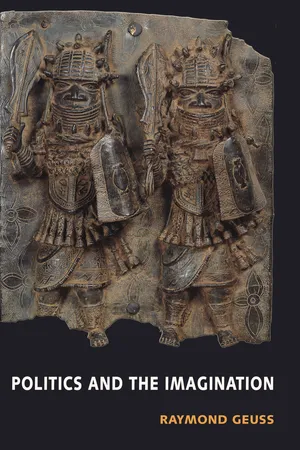
In politics, utopians do not have a monopoly on imagination. Even the most conservative defenses of the status quo, Raymond Geuss argues, require imaginative acts of some kind. In this collection of recent essays, including his most overtly political writing yet, Geuss explores the role of imagination in politics, particularly how imaginative constructs interact with political reality. He uses decisions about the war in Iraq to explore the peculiar ways in which politicians can be deluded and citizens can misunderstand their leaders. He also examines critically what he sees as one of the most serious delusions of western political thinking--the idea that a human society is always best conceived as a closed system obeying fixed rules. And, in essays on Don Quixote, museums, Celan's poetry, Heidegger's brother Fritz, Richard Rorty, and bourgeois philosophy, Geuss reflects on how cultural artifacts can lead us to embrace or reject conventional assumptions about the world. While paying particular attention to the relative political roles played by rule-following, utilitarian calculations of interest, and aspirations to lead a collective life of a certain kind, Geuss discusses a wide range of related issues, including the distance critics need from their political systems, the extent to which history can enlighten politics, and the possibility of utopian thinking in a world in which action retains its urgency.
eBook - PDF
Politics and the Imagination
About this book
Information
Publisher
Princeton University PressYear
2009Print ISBN
9780691142289
9780691142272
eBook ISBN
9781400832132
Topic
PhilosophySubtopic
Political PhilosophyTable of contents
- Cover
- Contents
- Preface
- Acknowledgments
- I: Political Judgment in Its Historical Context
- II: The Politics of Managing Decline
- III: Moralism and Realpolitik
- IV: On the Very Idea of a Metaphysics of Right
- V: The Actual and Another Modernity Order and Imagination in Don Quixote
- VI: Culture as Ideal and as Boundary
- VII: On Museums
- VIII: Celan’s Meridian
- IX: Heidegger and His Brother
- X: Richard Rorty at Princeton Personal Recollections
- XI: Melody as Death
- XII: On Bourgeois Philosophy and the Concept of “Criticism”
- Bibliography
- Index
Trusted by 375,005 students
Access to over 1.5 million titles for a fair monthly price.
Study more efficiently using our study tools.
Frequently asked questions
Yes, you can cancel anytime from the Subscription tab in your account settings on the Perlego website. Your subscription will stay active until the end of your current billing period. Learn how to cancel your subscription
No, books cannot be downloaded as external files, such as PDFs, for use outside of Perlego. However, you can download books within the Perlego app for offline reading on mobile or tablet. Learn how to download books offline
Perlego offers two plans: Essential and Complete
- Essential is ideal for learners and professionals who enjoy exploring a wide range of subjects. Access the Essential Library with 800,000+ trusted titles and best-sellers across business, personal growth, and the humanities. Includes unlimited reading time and Standard Read Aloud voice.
- Complete: Perfect for advanced learners and researchers needing full, unrestricted access. Unlock 1.5M+ books across hundreds of subjects, including academic and specialized titles. The Complete Plan also includes advanced features like Premium Read Aloud and Research Assistant.
We are an online textbook subscription service, where you can get access to an entire online library for less than the price of a single book per month. With over 1.5 million books across 990+ topics, we’ve got you covered! Learn about our mission
Look out for the read-aloud symbol on your next book to see if you can listen to it. The read-aloud tool reads text aloud for you, highlighting the text as it is being read. You can pause it, speed it up and slow it down. Learn more about Read Aloud
Yes! You can use the Perlego app on both iOS and Android devices to read anytime, anywhere — even offline. Perfect for commutes or when you’re on the go.
Please note we cannot support devices running on iOS 13 and Android 7 or earlier. Learn more about using the app
Please note we cannot support devices running on iOS 13 and Android 7 or earlier. Learn more about using the app
Yes, you can access Politics and the Imagination by Raymond Geuss in PDF and/or ePUB format, as well as other popular books in Philosophy & Political Philosophy. We have over 1.5 million books available in our catalogue for you to explore.