A more democratic response to political emergencies
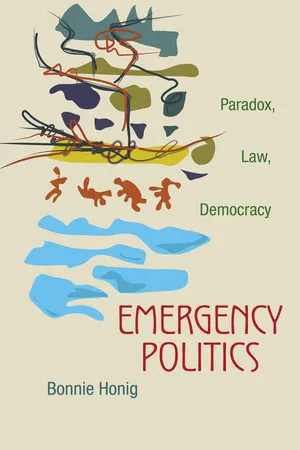
This book intervenes in contemporary debates about the threat posed to democratic life by political emergencies. Must emergency necessarily enhance and centralize top-down forms of sovereignty? Those who oppose executive branch enhancement often turn instead to law, insisting on the sovereignty of the rule of law or demanding that law rather than force be used to resolve conflicts with enemies. But are these the only options? Or are there more democratic ways to respond to invocations of emergency politics? Looking at how emergencies in the past and present have shaped the development of democracy, Bonnie Honig argues that democracies must resist emergency's pull to focus on life's necessities (food, security, and bare essentials) because these tend to privatize and isolate citizens rather than bring us together on behalf of hopeful futures. Emphasizing the connections between mere life and more life, emergence and emergency, Honig argues that emergencies call us to attend anew to a neglected paradox of democratic politics: that we need good citizens with aspirational ideals to make good politics while we need good politics to infuse citizens with idealism.
Honig takes a broad approach to emergency, considering immigration politics, new rights claims, contemporary food politics and the infrastructure of consumption, and the limits of law during the Red Scare of the early twentieth century. Taking its bearings from Moses Mendelssohn, Franz Rosenzweig, and other Jewish thinkers, this is a major contribution to modern thought about the challenges and risks of democratic orientation and action in response to emergency.
- 224 pages
- English
- ePUB (mobile friendly)
- Available on iOS & Android
eBook - ePub
About this book
Information
Publisher
Princeton University PressYear
2009Print ISBN
9780691152592
9780691142982
eBook ISBN
9781400830961
Table of contents
- Cover
- Half title
- Title
- Copyright
- Dedication
- Contents
- Acknowledgments
- Preface
- Introduction Surviving
- Chapter One Beginnings
- Chapter Two Emergence
- Chapter Three Decision
- Chapter Four Orientation
- Chapter Five Proximity
- Aftermath
- Notes
- Bibliography
- Index
Trusted by 375,005 students
Access to over 1.5 million titles for a fair monthly price.
Study more efficiently using our study tools.
Frequently asked questions
Yes, you can cancel anytime from the Subscription tab in your account settings on the Perlego website. Your subscription will stay active until the end of your current billing period. Learn how to cancel your subscription
No, books cannot be downloaded as external files, such as PDFs, for use outside of Perlego. However, you can download books within the Perlego app for offline reading on mobile or tablet. Learn how to download books offline
Perlego offers two plans: Essential and Complete
- Essential is ideal for learners and professionals who enjoy exploring a wide range of subjects. Access the Essential Library with 800,000+ trusted titles and best-sellers across business, personal growth, and the humanities. Includes unlimited reading time and Standard Read Aloud voice.
- Complete: Perfect for advanced learners and researchers needing full, unrestricted access. Unlock 1.5M+ books across hundreds of subjects, including academic and specialized titles. The Complete Plan also includes advanced features like Premium Read Aloud and Research Assistant.
We are an online textbook subscription service, where you can get access to an entire online library for less than the price of a single book per month. With over 1.5 million books across 990+ topics, we’ve got you covered! Learn about our mission
Look out for the read-aloud symbol on your next book to see if you can listen to it. The read-aloud tool reads text aloud for you, highlighting the text as it is being read. You can pause it, speed it up and slow it down. Learn more about Read Aloud
Yes! You can use the Perlego app on both iOS and Android devices to read anytime, anywhere — even offline. Perfect for commutes or when you’re on the go.
Please note we cannot support devices running on iOS 13 and Android 7 or earlier. Learn more about using the app
Please note we cannot support devices running on iOS 13 and Android 7 or earlier. Learn more about using the app
Yes, you can access Emergency Politics by Bonnie Honig in PDF and/or ePUB format, as well as other popular books in Politics & International Relations & International Relations. We have over 1.5 million books available in our catalogue for you to explore.