Where do neighborhoods come from and why do certain resources and effects--such as social capital and collective efficacy--bundle together in some neighborhoods and not in others? From the Ground Up argues that neighborhood communities emerge from neighbor networks, and shows that these social relations are unique because of particular geographic qualities. Highlighting the linked importance of geography and children to the emergence of neighborhood communities, Rick Grannis models how neighboring progresses through four stages: when geography allows individuals to be conveniently available to one another; when they have passive contacts or unintentional encounters; when they actually initiate contact; and when they engage in activities indicating trust or shared norms and values.
Seamlessly integrating discussions of geography, household characteristics, and lifestyle, Grannis demonstrates that neighborhood communities exhibit dynamic processes throughout the different stages. He examines the households that relocate in order to choose their neighbors, the choices of interactions that develop, and the exchange of beliefs and influence that impact neighborhood communities over time. Grannis also introduces and explores two geographic concepts--t-communities and street islands--to capture the subtle features constraining residents' perceptions of their environment and community.
Basing findings on thousands of interviews conducted through door-to-door canvassing in the Los Angeles area as well as other neighborhood communities, From the Ground Up reveals the different ways neighborhoods function and why these differences matter.
eBook - ePub
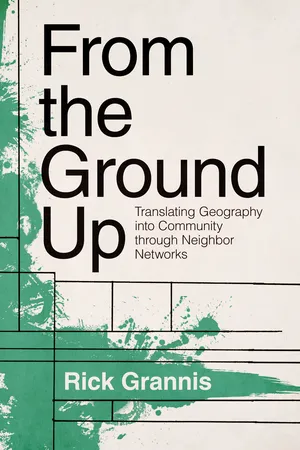
From the Ground Up
Translating Geography into Community through Neighbor Networks
- 288 pages
- English
- ePUB (mobile friendly)
- Available on iOS & Android
eBook - ePub
About this book
Information
Table of contents
- Cover
- Half title
- Title
- Copyright
- Contents
- List of Illustrations and Tables
- Prologue
- Chapter One Neighborhoods and Neighboring
- Chapter Two The Stages of Neighboring
- Chapter Three Reconceptualizing Stage 1 Neighboring
- Chapter Four Reconceptualizing Stage 1 Neighbor Networks
- Chapter Five Selection and Influence
- Chapter Six Respondents, Interviews, and Other Data
- Chapter Seven Selecting Stage 1 Neighbors
- Chapter Eight Unintentional Encounters
- Chapter Nine Stage 3 Neighbors and Tertiary Streets
- Chapter Ten The Importance of Neighbor Networks
- Chapter Eleven Network Influence Theory
- Chapter Twelve Influence Networks in a College Town
- Chapter Thirteen Influence Networks in a Gang Barrio
- Chapter Fourteen Implications
- Appendix Survey Instrument
- Notes
- References
- Index
Trusted by 375,005 students
Access to over 1.5 million titles for a fair monthly price.
Study more efficiently using our study tools.
Frequently asked questions
Yes, you can cancel anytime from the Subscription tab in your account settings on the Perlego website. Your subscription will stay active until the end of your current billing period. Learn how to cancel your subscription
No, books cannot be downloaded as external files, such as PDFs, for use outside of Perlego. However, you can download books within the Perlego app for offline reading on mobile or tablet. Learn how to download books offline
Perlego offers two plans: Essential and Complete
- Essential is ideal for learners and professionals who enjoy exploring a wide range of subjects. Access the Essential Library with 800,000+ trusted titles and best-sellers across business, personal growth, and the humanities. Includes unlimited reading time and Standard Read Aloud voice.
- Complete: Perfect for advanced learners and researchers needing full, unrestricted access. Unlock 1.5M+ books across hundreds of subjects, including academic and specialized titles. The Complete Plan also includes advanced features like Premium Read Aloud and Research Assistant.
We are an online textbook subscription service, where you can get access to an entire online library for less than the price of a single book per month. With over 1.5 million books across 990+ topics, we’ve got you covered! Learn about our mission
Look out for the read-aloud symbol on your next book to see if you can listen to it. The read-aloud tool reads text aloud for you, highlighting the text as it is being read. You can pause it, speed it up and slow it down. Learn more about Read Aloud
Yes! You can use the Perlego app on both iOS and Android devices to read anytime, anywhere — even offline. Perfect for commutes or when you’re on the go.
Please note we cannot support devices running on iOS 13 and Android 7 or earlier. Learn more about using the app
Please note we cannot support devices running on iOS 13 and Android 7 or earlier. Learn more about using the app
Yes, you can access From the Ground Up by Rick Grannis in PDF and/or ePUB format, as well as other popular books in Social Sciences & Sociology. We have over 1.5 million books available in our catalogue for you to explore.