How writers after Adam Smith helped shape our thinking about economics and politics
Few issues are more central to our present predicaments than the relationship between economics and politics. In the century after Adam Smith's Wealth of Nations the British economy was transformed. After Adam Smith looks at how politics and political economy were articulated and altered. It considers how grand ideas about the connections between individual liberty, free markets, and social and economic justice sometimes attributed to Smith are as much the product of gradual modifications and changes wrought by later writers.
Thomas Robert Malthus, David Ricardo, James Mill, John Stuart Mill, and other liberals, radicals, and reformers had a hand in conceptual transformations that culminated in the advent of neoclassical economics. The population problem, the declining importance of agriculture, the consequences of industrialization, the structural characteristics of civil society, the role of the state in economic affairs, and the possible limits to progress were questions that underwent significant readjustments as the thinkers who confronted them in different times and circumstances reworked the framework of ideas advanced by Smith—transforming the dialogue between politics and political economy. By the end of the nineteenth century an industrialized and globalized market economy had firmly established itself. By exploring how questions Smith had originally grappled with were recast as the economy and the principles of political economy altered during the nineteenth century, this book demonstrates that we are as much the heirs of later images of Smith as we are of Smith himself.
Many writers helped shape different ways of thinking about economics and politics after Adam Smith. By ignoring their interventions we risk misreading our past—and also misusing it—when thinking about the choices at the interface of economics and politics that confront us today.
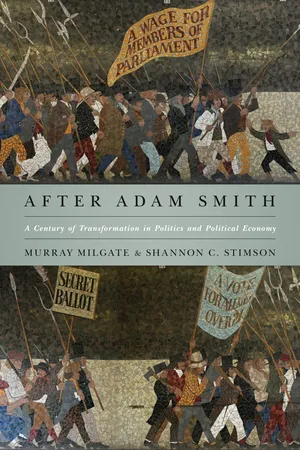
eBook - ePub
After Adam Smith
A Century of Transformation in Politics and Political Economy
- 320 pages
- English
- ePUB (mobile friendly)
- Available on iOS & Android
eBook - ePub
After Adam Smith
A Century of Transformation in Politics and Political Economy
About this book
Information
Publisher
Princeton University PressYear
2011Print ISBN
9780691152349
9780691140377
eBook ISBN
9781400831012
Table of contents
- Cover
- Half title
- Title
- Copyright
- Contents
- Preface
- Chapter One Introduction
- Chapter Two Adam Smith’s Political Odyssey
- Chapter Three The Rise and Fall of Civil Society
- Chapter Four Economic Life and Political Life
- Chapter Five The Economic Machine and the Invisible Hand
- Chapter Six The Figure of Smith
- Chapter Seven Population and Political Economy
- Chapter Eight Utility, Property, and Political Participation
- Chapter Nine Economic Opinion on Parliamentary Reform
- Chapter Ten Utopias and Stationary States
- Chapter Eleven Labour Defended
- Chapter Twelve Individual Liberty and the Liberty of Trade
- Chapter Thirteen Two Critiques of Classical Political Economy
- References
- Index
Trusted by 375,005 students
Access to over 1.5 million titles for a fair monthly price.
Study more efficiently using our study tools.
Frequently asked questions
Yes, you can cancel anytime from the Subscription tab in your account settings on the Perlego website. Your subscription will stay active until the end of your current billing period. Learn how to cancel your subscription
No, books cannot be downloaded as external files, such as PDFs, for use outside of Perlego. However, you can download books within the Perlego app for offline reading on mobile or tablet. Learn how to download books offline
Perlego offers two plans: Essential and Complete
- Essential is ideal for learners and professionals who enjoy exploring a wide range of subjects. Access the Essential Library with 800,000+ trusted titles and best-sellers across business, personal growth, and the humanities. Includes unlimited reading time and Standard Read Aloud voice.
- Complete: Perfect for advanced learners and researchers needing full, unrestricted access. Unlock 1.5M+ books across hundreds of subjects, including academic and specialized titles. The Complete Plan also includes advanced features like Premium Read Aloud and Research Assistant.
We are an online textbook subscription service, where you can get access to an entire online library for less than the price of a single book per month. With over 1.5 million books across 990+ topics, we’ve got you covered! Learn about our mission
Look out for the read-aloud symbol on your next book to see if you can listen to it. The read-aloud tool reads text aloud for you, highlighting the text as it is being read. You can pause it, speed it up and slow it down. Learn more about Read Aloud
Yes! You can use the Perlego app on both iOS and Android devices to read anytime, anywhere — even offline. Perfect for commutes or when you’re on the go.
Please note we cannot support devices running on iOS 13 and Android 7 or earlier. Learn more about using the app
Please note we cannot support devices running on iOS 13 and Android 7 or earlier. Learn more about using the app
Yes, you can access After Adam Smith by Murray Milgate,Shannon C. Stimson in PDF and/or ePUB format, as well as other popular books in Economics & Economic History. We have over 1.5 million books available in our catalogue for you to explore.