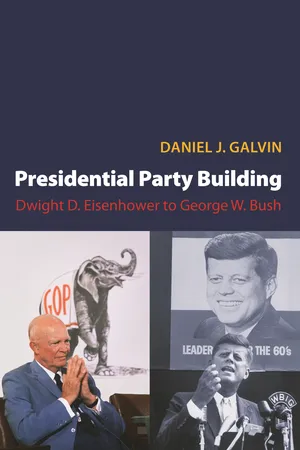
Modern presidents are usually depicted as party "predators" who neglect their parties, exploit them for personal advantage, or undercut their organizational capacities. Challenging this view, Presidential Party Building demonstrates that every Republican president since Dwight D. Eisenhower worked to build his party into a more durable political organization while every Democratic president refused to do the same. Yet whether they supported their party or stood in its way, each president contributed to the distinctive organizational trajectories taken by the two parties in the modern era.
Unearthing new archival evidence, Daniel Galvin reveals that Republican presidents responded to their party's minority status by building its capacities to mobilize voters, recruit candidates, train activists, provide campaign services, and raise funds. From Eisenhower's "Modern Republicanism" to Richard Nixon's "New Majority" to George W. Bush's hopes for a partisan realignment, Republican presidents saw party building as a means of forging a new political majority in their image. Though they usually met with little success, their efforts made important contributions to the GOP's cumulative organizational development. Democratic presidents, in contrast, were primarily interested in exploiting the majority they inherited, not in building a new one. Until their majority disappeared during Bill Clinton's presidency, Democratic presidents eschewed party building and expressed indifference to the long-term effects of their actions.
Bringing these dynamics into sharp relief, Presidential Party Building offers profound new insights into presidential behavior, party organizational change, and modern American political development.
- 368 pages
- English
- ePUB (mobile friendly)
- Available on iOS & Android
eBook - ePub
About this book
Information
Publisher
Princeton University PressYear
2009Print ISBN
9780691136936
9780691136929
eBook ISBN
9781400831173
1
Introduction | A Common Half-Truth
Dramatic differences in the organizational capacities of the Democratic and Republican parties were on full display during George W. Bush’s presidency. The Republican Party was revealed to be a vertically integrated, technologically sophisticated national political machine with impressive capacities to activate local grassroots networks in coordinated, “microtargeted,” get-out-the-vote campaigns.1 This durable, versatile organization was a source of great pride for Republican leaders: irrespective of the ebb and flow of election outcomes, they remained steadfast in their determination to develop and enhance its structures and operations. After he won reelection in 2004, for example, Bush’s deputies at the Republican National Committee (RNC) launched a four-year plan to “internalize the mechanics” of the successful presidential campaign in the formal party apparatus.2 And when Republicans lost control of Congress only two years later, party leaders saw an opportunity to measure the organization’s performance, make incremental improvements to its operations, and rededicate the party to organizational development—to “expand and perfect what we did well, and identify and correct what we didn’t.”3 Bush reminded party leaders that the story remained the same: “You win votes by organizing and turning out the vote.”4 This commitment to GOP party building remained unchanged in the final years of Bush’s presidency.5
The situation on the other side of the aisle could hardly have looked more different. Although the Democratic Party was raising money more efficiently and effectively than ever before over the Internet, its electoral apparatus was seen as “decades behind the Republicans organizationally.”6 Democrats had become accustomed to outsourcing their get-out-the-vote activities to largely uncoordinated advocacy groups, for-profit canvassing firms, tax-exempt 527 organizations, and other allies operating outside the formal party structure.7 Such an approach was not without consequence: “At the end of the campaign,” the Democratic National Committee’s (DNC) field director remarked, “you’re left with nothing, basically.”8 Inside the formal party umbrella, national party leaders played tug-of-war over scarce institutional resources. DNC chairman Howard Dean’s ambitious “fifty-state strategy” to make long-term investments in state parties was met with fierce resistance from a hostile congressional party leadership accustomed to pursuing quick wins in swing districts.9 Dean also faced high start-up costs: state and local parties were in a state of organizational disrepair and required a significant investment of time and resources. Most needed financial resources and more staff, and some also needed legal assistance, technological upgrades, public relations support, and campaign expertise.10
How and why the two parties developed such asymmetrical structures and strategies has become the subject of increasing scrutiny. In most accounts, however, credit and blame are assigned in a seemingly indiscriminate fashion: elite “power brokers,” special interest networks, policy choices, marketing strat egies, rhetorical frames, and even contrasting ideological commitments are offered as explanations for the divergent paths taken by the two parties.11 Undoubtedly, each of these factors played a role. But oddly, American presidents—the party leaders who have had, arguably, the greatest stake in their party’s current and future operations—have not made much of an appearance.
American presidents are perhaps the political actors most closely associated with major historical changes in the parties, but precisely what role they played in pushing these developments along is not at all clear. Six different Republicans occupied the White House for thirty-six of the fifty-six years between 1953 and 2009, yet the extent to which they were involved in building the new Republican Party organization of which we speak is not known. If anything, Republican presidents are seen as the beneficiaries of a party built by others, but are not, themselves, seen as integral to the GOP party-building project. Was this, in fact, how things developed? And did the four Democratic presidents of this period try to build their party organization and simply fail, or were they, too, peripheral to the currents of party change?
Remarkably, most existing scholarship has passed over these questions and focused instead on the characteristic party-building activities of “out parties”—that is, those parties that do not hold the White House. In the wake of defeat in a presidential election, the losing party’s leaders and activists are depicted as the real party builders, the primary actors who build new organizational capacities and develop new methods of reaching out to new groups of voters and recruit new candidates.12 Party building, in this frame, is the work of the underdog, the labor of the losing party. Presidents are nowhere in view.
In fact, when presidents do come into the picture, they are usually depicted as party predators, not party builders. There is a strong consensus in the literature that all modern presidents—Democrats and Republicans alike—view their parties as “at best a drag,” and more commonly as “a nuisance.”13 They are portrayed as agents of party decline, as party antagonists whose approach ranges from “simple neglect” to “outright hostility.”14 Whether they treat their parties “with contempt” or mere indifference, modern presidents are said to “undermine the development and maintenance of a strong national party organization.”15
This prevailing view results from the assumption that all presidents are driven by self-interest and short-term calculations, and are more concerned with their own problems than those of collective leadership. Especially in the modern context of “rampant pluralism,” where presidents face “unnegotiable demands, political stagnation, and stalemate,” they are compelled to break free from the centrifugal force of their traditionally decentralized party organizations and develop their own capacities for independent leadership.16 They are said to have disengaged from their parties, transcended them, subordinated them, exploited them, or ignored them.
Modern presidential practices, we are told, have only made matters worse. By “running alone”—that is, by relying on independent, highly personalized campaign committees whose sole purpose is “to get them into office”—presidents are said to undercut their parties’ core electoral functions.17 Likewise, by creating offices for political affairs and public liaison inside the White House, they build “the equivalent of a presidential party for governing” inside the White House and short-circuit the party as a mechanism for representation.18 And by employing common strategies such as “going public,” presidents push their parties further “to the periphery of national politics.”19 Meanwhile, they “appoint a nonentity” to serve as national committee chairman, “downgrade the job, and humiliate the incumbent.”20 “The development of the modern presidency,” Sidney M. Milkis summarizes, “clearly weakened party organizations by preempting many of the tasks they performed prior to the New Deal.”21
If all modern presidents do indeed adopt a predatory relationship toward their parties, if they seek not to strengthen and expand their organizations but to marginalize or debilitate them, then Howard Dean and the Democrats might have done better simply to save their money and wait for President Bush to sap the strength of the organization that defeated them.
But what if the conventional wisdom is wrong? In my investigation of every presidential administration from Dwight D. Eisenhower to George W. Bush, I find that at best only half the story is in view. Drawing upon a wealth of primary source materials, including internal White House memos, letters, strategy papers, personal notes, party documents and publications, oral histories, memoirs, White House tape recordings, and personal interviews, I find that modern presidents did not act in a uniform manner with respect to their parties; in fact, the full scope of their party interactions reveals striking contrasts between them.22 While it is true that all modern presidents sought to “presidentialize” their parties and use them instrumentally to pursue their independent purposes, Republican presidents did something more. Since Eisenhower, Republican presidents persistently and purposefully worked to build their party, to expand and develop it into a stronger, more durable, and more capable organization. Their instrumental use of the Republican Party organization did not prevent them from simultaneously investing in new organizational capacities to expand the party’s reach and enhance its electoral competitiveness.
The conventional wisdom, it turns out, is more accurate as an exclusively Democratic phenomenon. Democratic presidents worked assiduously to personalize their party, altering and reconfiguring it to maximize the immediate political benefit to their administrations, but took few steps, if any, to leave behind a more robust party organization able to persevere over the long term. Whether they ignored their party, exploited it, or purposefully sought to undercut its organizational capacities, their actions had a debilitating effect on its organizational development. This Democratic pattern of behavior remained remarkably stable until Bill Clinton’s second term. As Clinton’s competitive environment changed, so too did his approach to his party organization; as discussed below, his presidency thus offers critical insights into why Republican and Democratic presidents acted so differently over the course of more than forty years.
But before we get ahead of ourselves, it is worth dwelling a bit more on this variation in presidential behavior. Partly because we have assumed that all presidents act in fundamentally the same ways, and partly because of the methods we have used to research such questions, we have long missed out on this striking pattern. But this has been no minor oversight: the different approaches taken by Republican and Democratic presidents clearly contributed to the divergent historical trajectories taken by the two parties over the course of the modern period and helped to create the uneven—and unsettled—political landscape of the early twenty-first century.
My aim in this book is neither to champion nor indict presidents for how they interact with their parties, nor is it to elevate Republicans for their efforts or denigrate Democrats for theirs. It is to show that the president-party relationship has not been all of a piece. Some modern presidents have acted more constructively with regard to their parties than others; my objective is to consider why this might be so and to bring presidential party building into view as a variable component of modern American political development whose significance is clearly evident in politics today.
I do not go so far as to claim that the lack of presidential party building explains all of the Democrats’ organizational woes over the second half of the twentieth century or that the Republican Party’s organizational strength, as observed in the Bush administration, was only due to presidential party-building efforts. No doubt a host of factors are at work. Nor do I claim that every Republican presidential party-building effort over the past sixty years was pursued with a vision of the contemporary Republican Party in mind. Quite the contrary: each Republican president pursued different visions of what a new Republican majority would look like, and each met with at least as many disappointments as successes. However, I do argue that in the course of pursuing their own distinctive purposes, each Republican president made incremental contributions to his party’s cumulative organizational development. Likewise, I aim to show that the Democrats’ persistent inattention to their party organization and their relative indifference to the long-term impact of their actions prevented the Democratic Party from capitalizing on the potential benefits of presidential power and made cumulative organizational development in their party more difficult.
What Is Presidential Party Building?
Clarifying terms and setting definitions up front is critical, because the heart of the problem, and the objective of this study, is to make precise what has thus far been obscured. While all modern presidents have tried in some way to change their party organizations to better suit their purposes, some have taken additional steps to develop their party’s organizational capacities, strengthen its foundations, and expand its reach. Their party building has not been incompatible with the instrumental party-changing acts all presidents routinely undertake for their own immediate benefit. In fact, I will argue that the very essence of the thing—that which makes it an interesting and significant political phenomenon—is that presidential party building is both instrumental and developmental at the same time.
What it means “to build” is, admittedly, not self-evident. In the first place, presidents never create parties from scratch.23 Even Jefferson, the first and perhaps greatest of presidential party builders, was acting upon an existing organization.24 Presidential party building always entails rebuilding, recasting, or reconstituting an existing structure. Second, presidents frequently work to build electoral coalitions, but often do so without ever interacting with their party apparatus. “Going public,” stumping for fellow partisans, promoting carefully tailored policy programs, staging symbolic spectacles, and other such strategies are often designed to mobilize electoral support for presidents and their fellow partisans, but they are not necessarily meant to “build” the party per se. Third, everything a president does in the course of his official duties—...
Table of contents
- Cover
- Title
- Copyright
- Dedication
- Contents
- Preface
- 1 Introduction: A Common Half-Truth
- 2 A Theory of Presidential Party Building
- Part I: The Republicans
- Part II: The Democrats
- Afterword: George W. Bush and Beyond
- Appendix: Methods and Sources
- Abbreviations
- Notes
- Index
Trusted by 375,005 students
Access to over 1.5 million titles for a fair monthly price.
Study more efficiently using our study tools.
Frequently asked questions
Yes, you can cancel anytime from the Subscription tab in your account settings on the Perlego website. Your subscription will stay active until the end of your current billing period. Learn how to cancel your subscription
No, books cannot be downloaded as external files, such as PDFs, for use outside of Perlego. However, you can download books within the Perlego app for offline reading on mobile or tablet. Learn how to download books offline
Perlego offers two plans: Essential and Complete
- Essential is ideal for learners and professionals who enjoy exploring a wide range of subjects. Access the Essential Library with 800,000+ trusted titles and best-sellers across business, personal growth, and the humanities. Includes unlimited reading time and Standard Read Aloud voice.
- Complete: Perfect for advanced learners and researchers needing full, unrestricted access. Unlock 1.5M+ books across hundreds of subjects, including academic and specialized titles. The Complete Plan also includes advanced features like Premium Read Aloud and Research Assistant.
We are an online textbook subscription service, where you can get access to an entire online library for less than the price of a single book per month. With over 1.5 million books across 990+ topics, we’ve got you covered! Learn about our mission
Look out for the read-aloud symbol on your next book to see if you can listen to it. The read-aloud tool reads text aloud for you, highlighting the text as it is being read. You can pause it, speed it up and slow it down. Learn more about Read Aloud
Yes! You can use the Perlego app on both iOS and Android devices to read anytime, anywhere — even offline. Perfect for commutes or when you’re on the go.
Please note we cannot support devices running on iOS 13 and Android 7 or earlier. Learn more about using the app
Please note we cannot support devices running on iOS 13 and Android 7 or earlier. Learn more about using the app
Yes, you can access Presidential Party Building by Daniel J. Galvin in PDF and/or ePUB format, as well as other popular books in Politics & International Relations & Political History & Theory. We have over 1.5 million books available in our catalogue for you to explore.