How does the American public formulate its opinions about U.S. foreign policy and military engagement abroad? War Stories argues that the media systematically distort the information the public vitally needs to determine whether to support such initiatives, for reasons having more to do with journalists' professional interests than the merits of the policies, and that this has significant consequences for national security. Matthew Baum and Tim Groeling develop a "strategic bias" theory that explains the foreign-policy communication process as a three-way interaction among the press, political elites, and the public, each of which has distinct interests, biases, and incentives.
Do media representations affect public support for the president and faithfully reflect events in times of diplomatic crisis and war? How do new media--especially Internet news and more partisan outlets--shape public opinion, and how will they alter future conflicts? In answering such questions, Baum and Groeling take an in-depth look at media coverage, elite rhetoric, and public opinion during the Iraq war and other U.S. conflicts abroad. They trace how traditional and new media select stories, how elites frame and sometimes even distort events, and how these dynamics shape public opinion over the course of a conflict.
Most of us learn virtually everything we know about foreign policy from media reporting of elite opinions. In War Stories, Baum and Groeling reveal precisely what this means for the future of American foreign policy.
eBook - PDF
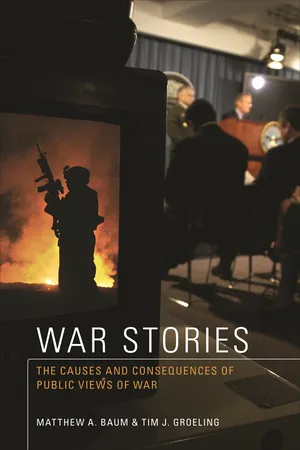
War Stories
The Causes and Consequences of Public Views of War
- 350 pages
- English
- PDF
- Available on iOS & Android
eBook - PDF
About this book
Information
Publisher
Princeton University PressYear
2009Print ISBN
9780691138596
9780691138589
eBook ISBN
9781400832187
Table of contents
- Cover
- Contents
- List of Figures
- List of Tables
- Preface
- Acknowledgments
- Chapter One: News, Opinion, and Foreign Policy
- Chapter Two: Politics across the Water’s Edge
- Chapter Three: Elite Rhetoric, Media Coverage, and Rallying ’Round the Flag
- Chapter Four: War Meets the Press: Strategic Media Bias and Elite Foreign Policy Evaluations
- Chapter Five: Shot by the Messenger: An Experimental Examination of the Effects of Party Cues on Public Opinion Regarding National Security and War
- Chapter Six: Tidings of Battle: Polarizing Media and Public Support for the Iraq War
- Chapter Seven: “Reality Asserted Itself”: The Elasticity of Reality and the War in Iraq
- Chapter Eight: Barbarians inside the Gates: Partisan New Media and the Polarization of American Political Discourse
- Chapter Nine: Back to the Future: Foreign Policy in the Second Era of the Partisan Press
- References
- Index
Trusted by 375,005 students
Access to over 1.5 million titles for a fair monthly price.
Study more efficiently using our study tools.
Frequently asked questions
Yes, you can cancel anytime from the Subscription tab in your account settings on the Perlego website. Your subscription will stay active until the end of your current billing period. Learn how to cancel your subscription
No, books cannot be downloaded as external files, such as PDFs, for use outside of Perlego. However, you can download books within the Perlego app for offline reading on mobile or tablet. Learn how to download books offline
Perlego offers two plans: Essential and Complete
- Essential is ideal for learners and professionals who enjoy exploring a wide range of subjects. Access the Essential Library with 800,000+ trusted titles and best-sellers across business, personal growth, and the humanities. Includes unlimited reading time and Standard Read Aloud voice.
- Complete: Perfect for advanced learners and researchers needing full, unrestricted access. Unlock 1.5M+ books across hundreds of subjects, including academic and specialized titles. The Complete Plan also includes advanced features like Premium Read Aloud and Research Assistant.
We are an online textbook subscription service, where you can get access to an entire online library for less than the price of a single book per month. With over 1.5 million books across 990+ topics, we’ve got you covered! Learn about our mission
Look out for the read-aloud symbol on your next book to see if you can listen to it. The read-aloud tool reads text aloud for you, highlighting the text as it is being read. You can pause it, speed it up and slow it down. Learn more about Read Aloud
Yes! You can use the Perlego app on both iOS and Android devices to read anytime, anywhere — even offline. Perfect for commutes or when you’re on the go.
Please note we cannot support devices running on iOS 13 and Android 7 or earlier. Learn more about using the app
Please note we cannot support devices running on iOS 13 and Android 7 or earlier. Learn more about using the app
Yes, you can access War Stories by Matthew A. Baum,Tim J. Groeling in PDF and/or ePUB format, as well as other popular books in Politics & International Relations & Political Process. We have over 1.5 million books available in our catalogue for you to explore.