How America can achieve greater racial equality in the post–civil rights era
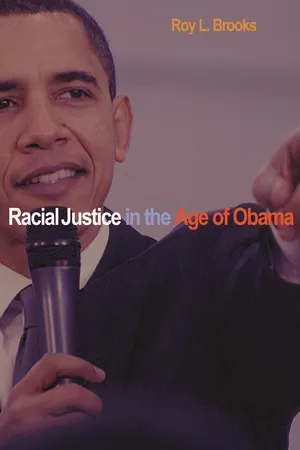
With the election of Barack Obama as the first black president of the United States, the issue of racial justice in America occupies center stage. Have black Americans finally achieved racial justice? Is government intervention no longer required? Racial Justice in the Age of Obama considers contemporary civil rights questions and theories, and offers fresh insights and effective remedies for race issues in America today.
While there are now unprecedented opportunities for talented African Americans, Roy Brooks shows that lingering deficiencies remain within the black community. Exploring solutions to these social ills, Brooks identifies competing civil rights theories and perspectives, organizing them into four distinct categories—traditionalism, reformism, limited separation, and critical race theory. After examining each approach, Brooks constructs the best civil rights theory for the Obama phase of the post–civil rights era. Brooks supports his theoretical model with strong statistics that break down the major racial groups along such demographics as income and education. He factors in the cultural and structural explanations for the nation's racial divisions, and he addresses affirmative action, the failures of integration, the negative aspects of black urban culture, and the black community's limited access to resources. The book focuses on African Americans, but its lessons are relevant for other groups, including Latinos, Asians, women, and gays and lesbians.
Racial Justice in the Age of Obama maps out today's civil rights questions so that all groups can achieve equality at a time of unprecedented historical change.
- 264 pages
- English
- ePUB (mobile friendly)
- Available on iOS & Android
eBook - ePub
Racial Justice in the Age of Obama
About this book
Information
Chapter 1
INTRODUCTION
IDEOLOGICAL DIVISIONS in civil rights theory too often form along politically partisan lines. Facts are cherry-picked, and formal analyses are shaped to fit preordained political perspectives. Yet, when one steps away from the politics, when one pursues the unvarnished truth, one is humbled by the enormous complexity of the subject matter. Nowhere is this more evident than in the area of race, especially the problems of African Americans. The end of government-sanctioned racial oppression, fading historical memory, the emergence of genuine class stratification within black society—especially the rise of the black upper and middle classes—the concomitant influx of poor immigrants of color, and the inertia of structural barriers that limit opportunities as well as the grudging recognition of dysfunctional behaviors within the black community have converged to make civil rights theory an extremely complex enterprise today. Inclined to provide facile answers to complex problems, political partisanship is very seductive in this climate. But the price of the ticket is quite high: we settle for comfortable positions over painful truths.
This book attempts to provide a nonpartisan approach to civil rights theory. My ambition is to facilitate penetrating and productive discussions about civil rights theory, particularly as it pertains to African Americans. (I shall in due course explain my reasons for limiting my inquiry to blacks.) To achieve this objective, I have created a rhetorical device called the “theory of completeness.” This is a theory about modern civil rights theory. It holds that civil rights theory today, in the Age of Obama, must be complete if it is to be taken seriously; that is, it must put forth an external and internal diagnosis of and prescription for the civil rights problem it seeks to address, be it civil rights pertaining to blacks, browns, women, or other groups. To suggest that there is an internal, or cultural, side to the race problem pertaining to blacks may seem like blaming the victim. That certainly is not the case. All I am saying is that given the death of Jim Crow and the concomitant increase in racial opportunities, it is now possible that cultural factors may offer some explanation as to why African Americans continue to face serious racial problems so long after the civil rights movement. Thus, in post–civil rights America—the decades since circa 1972, the end of the civil rights movement and Jim Crow—and most especially with the election of the first black president of the United States, internal factors must be considered along with external, or structural, conditions.
There are several reasons why this book focuses on African Americans. Limiting the focus to a single racial group certainly simplifies the presentation and application of a new theory, the theory of completeness. Also, there is simply more demographic information on African Americans than on any other racial group with the exception of whites. The data on some groups do not even cover the entire post–civil rights period. In contrast, blacks have been studied and recorded since the nation’s first census in 1790.1 Furthermore, even though the number of civil rights groups, or “protected classes,” has expanded during the post–civil rights years (now including, inter alia, the disabled and the elderly), the concern for racial justice remains the central preoccupation in civil rights theory. Indeed, most of the major civil rights theorists in the country, academicians as well as public pundits, focus on the question of race and, more particularly, the plight of African Americans, the nation’s oldest civil rights group. “If we can address the problems between black and white Americans,” former president Bill Clinton insists, “then we will be better equipped to deal with discrimination in other areas.”2 At the other end of the ideological spectrum, conservative James Q. Wilson comes to a similar conclusion: “The main domestic concern of policy-engaged intellectuals, liberal and conservative, ought to be to think hard about how to change these social weaknesses. Lower-class blacks are numerous and fill our prisons, and among all blacks the level of financial assets is lower than it is for whites. Many blacks have made rapid progress, but we are not certain how.”3 Thus, within the civil rights cosmos, concerns about racial disadvantage form the primary galaxy. And within the racial galaxy, black/white relations, which coexist with other racial relations (such as Latino/white, Asian/white, Native American/white, black/Latino, black/Asian, and black/Native American), form the primary constellation. It is foundational, having provided the seed from which theories about other racial relations have developed in the post–civil rights era.
The fact that the civil rights problems of racial groups are sufficiently distinct to warrant separate treatment is yet another reason for limiting my inquiry to blacks. Immigration is a case in point. As I explain at the end of this chapter, immigration has a different effect on the quantum of resources available in Latino and African American communities. The former effect is negative while the latter is largely positive due to the arrival of West Indian blacks. Also, African Americans have an emotional and material connection to slavery and Jim Crow that other racial minorities simply do not and cannot have. Blacks were the main targets of slavery and Jim Crow. It simply cannot be gainsaid that they alone were stolen from their homelands and subsequently persecuted through the Middle Passage. All other racial minorities were either already here or came here willingly. It is factually wrong to say that all racial minorities went through the peculiar institution and Jim Crow together. It is even worse to claim, as some pundits have, that all Americans, including whites, “overcame slavery together.” The psychological connection blacks have to slavery and Jim Crow is unique, just as the emotional connection Jews have to the Holocaust is unique, even though other groups, including Africans, were put to death in Nazi concentration camps. Similarly, Latinos have a special relationship to the southwestern portion of the United States not only because the land used to be part of Mexico but also because Latinos were the main targets of racial violence and disadvantage in this territory. Blacks were not. For these reasons, I am not in favor of aggregating all racial minorities under a single conceptual umbrella, whether it is called “people of color” or something else. I am, in fact, a proponent of disaggregation. To me, the black/white binary (which focuses on the relationship between blacks and whites) makes sense, as do other binaries, including the Latino/white and Asian/white binaries. Each civil rights group deserves special attention. Each deserves book-length treatment. This book deals with African Americans, although it certainly provides information that can be used to discuss other civil rights groups.4
Focusing on African Americans, this book identifies, synthesizes, and organizes the myriad civil rights theories, half theories, and suppositions articulated during this post–civil rights era. The assembled information is molded into four distinct theories—traditionalism, reformism, limited separation, and critical race theory. Each theory, or, more precisely, post–civil rights theory, is presented along the coordinates of the theory of completeness. Hence, I tease out each theory’s external and internal diagnosis of and prescription for the American race problem as it relates to black Americans.
To prepare for this discussion, the remaining sections of this chapter will unpack the book’s conceptual tools. Terms like “civil rights” and “race” will be clarified, and the basis for extending civil rights to some groups but not to others will also be discussed. I will end the chapter with a definition of the race problem blacks have encountered since the end of the civil rights movement. The appendix delineates the facts and figures that give content to this definition.
A. WHAT IS “CIVIL RIGHTS” OR A “CIVIL RIGHTS GROUP”?
The term “civil rights” is used in this book in its conventional conceptualization. It refers to the congeries of government-enforced (i.e., legal) freedoms and privileges accorded to a person or group in furtherance of the equality principle enshrined in the Declaration of Independence.5 This notion of “equality,” as has been noted, “does not require that things different in fact be treated in law as though they were the same. But it does require . . . that those who are similarly situated be similarly treated. The measure of the reasonableness of the classification is the degree of its success in treating similarly those similarly situated.”6 In its conventional sense, then, the term “equality” in the context of civil rights means equal treatment or, more precisely, similar treatment for similarly situated individuals or groups.7 Thus, civil rights are governmentenforced freedoms and privileges designed to ensure that our society accords similarly situated groups similar treatment, especially “equal opportunity.”
The ideal of equality embedded in this definition—similar treatment for similarly situated groups—reflects a classical liberal view of the world that seems intuitively fair. Although I certainly embrace the liberal notion of similar treatment for similarly situated individuals and groups, I wish to make the logical point that where it can be shown that blacks and whites are not similarly situated in society because of historical forces, blacks must be treated differently if they are to be accorded equal opportunity, or similar treatment. My argument—equal opportunity requires different treatment for differently situated groups—is conceptually consistent with the liberal edict of similar treatment for similarly situated folks. I would hope, then, that those proceeding under the liberal view would accept the fairness of different treatment if it could be shown empirically, as the appendix seems to indicate, that blacks and whites are not similarly situated.
In light of this discussion we can remove the “similarly situated” language from the conventional definition of civil rights. That is, we can now say that the goal of civil rights is equal opportunity, and that this goal can be achieved either by treating similarly situated groups similarly or by treating differently situated groups differently. Civil rights, in a word, can be defined as government-sanctioned freedoms and privileges designed to promote equal opportunity. So defined, civil rights has several features that should be noted.
Although first enshrined in the Declaration of Independence, civil rights are now codified in federal and state constitutions, statutes, and case law. The U.S. Constitution, for example, delineates several basic freedoms and privileges: “ . . . nor shall any State deprive any person of life, liberty, or property, without due process of law; nor deny any person within its jurisdiction the equal protection of the laws.”8 Freedoms and privileges provided by federal statutes include the right to be free from discrimination based on race, color, sex, national origin, age, disability, or religion in education, employment, the electoral process, public places, and other areas of American life.9 Judges often discover civil rights through their interpretation of constitutional and statutory law, especially the former. Brown v. Board of Education (1954),10 for example, found in the Constitution the right to attend public schools without regard to race or color. The Supreme Court has discovered other civil rights, including affirmative action and the right of alien children to receive a free public education.11
Civil rights have certain peculiarities that often seem surprising. For example, citizenship is not a prerequisite for civil rights. Some civil rights extend to any person or group merely physically present within the jurisdictional reach of the United States. The due process and equal protection rights quoted here apply to every “person,” meaning citizens and noncitizens alike, and, as just mentioned, alien children have a civil right to receive a free public education. In addition, although civil rights primarily protect the individual or group from governmental transgressions, they also protect against private wrong-doing under certain conditions (such as private parties who burden interstate commerce,12 receive federal funds,13 or act under the authority of state law).14 Finally, civil rights operate both substantively and procedurally. Substantive rights, such as the right to be free from racial discrimination,15 are what we normally think of when we think about the term “civil rights.” Procedural rights, however, are just as important. These rights, such as the right to be heard in a timely fashion before suffering legal action or the right to a trial by jury, prescribe the rules by which substantive freedoms and privileges are initially established and subsequently enforced.16
Another peculiarity about civil rights is that not all similarly situated groups receive the same level of opportunities created by civil rights. Citizens have more government-enforced freedoms and privileges than noncitizens, who nonetheless receive some level of protection. Aliens have civil rights, to be sure, as mentioned earlier, but they do not have the same level of civil rights opportunities as do U.S. citizens. Native-born citizens, for instance, have the right to be elected the president of the United States, but foreign-born citizens as well as noncitizens in the country do not. The Constitution expressly states: “No person, except a natural born citizen, . . . shall be eligible to the office of president.”17 Civil rights, then, do not necessarily mean equal treatment, or opportunities, even for similarly situated groups.
Likewise, for most of this country’s history, whites received far more opportunities created by civil rights than did blacks. This infamous example of the unequal quality of civil rights occurred under the government’s “separate-and-unequal” and “separate-but-equal” civil rights policies. These policies predate the nation’s current official civil rights policy of formal equal opportunity.18 Under the separate-and-unequal civil rights policy, blacks “had no rights which the white man was bound to respect,” to quote the Supreme Court.19 Blacks did not ha...
Table of contents
- Cover
- Title
- Copyright
- Dedication
- Contents
- Preface: The Age of Obama
- Acknowledgments
- Chapter 1: Introduction
- Chapter 2: Traditionalism
- Chapter 3: Reformism
- Chapter 4: Limited Separation
- Chapter 5: Critical Race Theory
- Epilogue: Toward the “Best” Post–Civil Rights Theory
- Appendix
- Notes
- Bibliography
- Index
Trusted by 375,005 students
Access to over 1.5 million titles for a fair monthly price.
Study more efficiently using our study tools.
Frequently asked questions
Yes, you can cancel anytime from the Subscription tab in your account settings on the Perlego website. Your subscription will stay active until the end of your current billing period. Learn how to cancel your subscription
No, books cannot be downloaded as external files, such as PDFs, for use outside of Perlego. However, you can download books within the Perlego app for offline reading on mobile or tablet. Learn how to download books offline
Perlego offers two plans: Essential and Complete
- Essential is ideal for learners and professionals who enjoy exploring a wide range of subjects. Access the Essential Library with 800,000+ trusted titles and best-sellers across business, personal growth, and the humanities. Includes unlimited reading time and Standard Read Aloud voice.
- Complete: Perfect for advanced learners and researchers needing full, unrestricted access. Unlock 1.5M+ books across hundreds of subjects, including academic and specialized titles. The Complete Plan also includes advanced features like Premium Read Aloud and Research Assistant.
We are an online textbook subscription service, where you can get access to an entire online library for less than the price of a single book per month. With over 1.5 million books across 990+ topics, we’ve got you covered! Learn about our mission
Look out for the read-aloud symbol on your next book to see if you can listen to it. The read-aloud tool reads text aloud for you, highlighting the text as it is being read. You can pause it, speed it up and slow it down. Learn more about Read Aloud
Yes! You can use the Perlego app on both iOS and Android devices to read anytime, anywhere — even offline. Perfect for commutes or when you’re on the go.
Please note we cannot support devices running on iOS 13 and Android 7 or earlier. Learn more about using the app
Please note we cannot support devices running on iOS 13 and Android 7 or earlier. Learn more about using the app
Yes, you can access Racial Justice in the Age of Obama by Roy L. Brooks in PDF and/or ePUB format, as well as other popular books in Política y relaciones internacionales & Derechos civiles en política. We have over 1.5 million books available in our catalogue for you to explore.