Timeless lessons from the military strategies of the ancient Greeks and Romans
In this prequel to the now-classic Makers of Modern Strategy, Victor Davis Hanson, a leading scholar of ancient military history, gathers prominent thinkers to explore key facets of warfare, strategy, and foreign policy in the Greco-Roman world. From the Persian Wars to the final defense of the Roman Empire, Makers of Ancient Strategy demonstrates that the military thinking and policies of the ancient Greeks and Romans remain surprisingly relevant for understanding conflict in the modern world.
The book reveals that much of the organized violence witnessed today—such as counterterrorism, urban fighting, insurgencies, preemptive war, and ethnic cleansing—has ample precedent in the classical era. The book examines the preemption and unilateralism used to instill democracy during Epaminondas's great invasion of the Peloponnesus in 369 BC, as well as the counterinsurgency and terrorism that characterized Rome's battles with insurgents such as Spartacus, Mithridates, and the Cilician pirates. The collection looks at the urban warfare that became increasingly common as more battles were fought within city walls, and follows the careful tactical strategies of statesmen as diverse as Pericles, Demosthenes, Alexander, Pyrrhus, Caesar, and Augustus. Makers of Ancient Strategy shows how Greco-Roman history sheds light on wars of every age. In addition to the editor, the contributors are David L. Berkey, Adrian Goldsworthy, Peter J. Heather, Tom Holland, Donald Kagan, John W. I. Lee, Susan Mattern, Barry Strauss, and Ian Worthington.
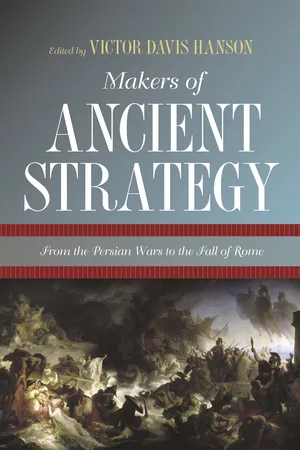
eBook - ePub
Makers of Ancient Strategy
From the Persian Wars to the Fall of Rome
- 256 pages
- English
- ePUB (mobile friendly)
- Available on iOS & Android
eBook - ePub
Makers of Ancient Strategy
From the Persian Wars to the Fall of Rome
About this book
Information
Publisher
Princeton University PressYear
2010Print ISBN
9780691156361
9780691137902
eBook ISBN
9781400834259
1. From Persia with Love
Propaganda and Imperial Overreach
in the Greco-Persian Wars
TOM HOLLAND
THE INVASION OF IRAQ, when it finally came, was merely the climax of an ongoing period of crisis and upheaval in the international order. The stand-off between the two sides had been a geopolitical fixture for years. Both had surely long suspected that open conflict was inevitable. As the invaders crossed into Iraqi territory, they would have known that they faced a regime that was hardly unprepared for war. It had been assiduous in stockpiling reserves of weaponry and provisions; its troops, massed along the border, blocked all the roads that led to the capital; the capital itself, an intimidating blend of grandiose prestige projects and warren-like slums, was darkly rumored to be capable of swallowing up a whole army. Yet all the regime’s defenses, in the final reckoning, might as well have been made of sand. What it confronted in its adversary was nothing less than a superpower, the most formidable on the planet. The task force brought to bear by the invaders was a quite devastating display of shock and awe. Those of the defenders who were not left corpses by the first deadly impact of the enemy onslaught simply melted away. Even in the capital itself, the population proved signally unwilling to die for the sake of their beleaguered leader. A bare few weeks after hostilities had begun, the war was effectively over. So it was, on October 12, 539 BC, that the gates of Babylon were flung open “without a battle,”1 and the greatest city in the world fell into the hands of Cyrus, the king of Persia.
To the Babylonians themselves, the capture of their metropolis by a foreign warlord was only readily explicable as the doing of Marduk, the king of their gods. Over the centuries, Babylon’s peerless glamour and pedigree had served to burnish the conceit of its inhabitants to a truly lustrous sheen. Although long subject to the rule of Assyria, a rival kingdom to the north, Babylon had always chafed at its subordination, and in 612 BC, when its armies took the lead in sacking the Assyrian capital of Nineveh, the city had exacted a splendid and bloody revenge. From that moment on, it had found itself positioned to play the role that its people had always seen as its right: as the very fulcrum of world affairs. Although the collapse of the Assyrian Empire had left the Near East divided between Babylon itself and three other kingdoms—Media in northern Iran, Lydia in Anatolia, and Egypt—there had been little doubt as to which among these four great powers ranked as primus inter pares. Over the wreckage of Assyrian power the kings of Babylon had soon succeeded in raising their own far-spreading dominion. Upon their lesser neighbors they had imposed “an iron yoke of servitude.”2 Typical of the fate meted out to those who presumed to stand on their independence had been the crushing, in 586, of the valiant but foolhardy little kingdom of Judah. Two years after staging a revolt against Babylonian rule, the Judaeans had been left to mourn their temerity amid the wreckage of all that had previously served to define them. Jerusalem and its Temple had been reduced to a pile of blackened ruins, its king had been obliged to watch the murder of his sons before himself being blinded, and the Judaean elite had been hauled off into exile. There, weeping by the rivers of Babylon, it had seemed to one of their number, a prophet by the name of Ezekiel, that the shadows of Sheol were closing in on the entire global order. Not a great power, but it had been dispatched to the underworld by the king of Babylon: “all of them slain, fallen by the sword, who spread terror in the land of the living.”3
But now Babylonian supremacy itself was a dead thing. The fall of the great city appeared to contemporaries a veritable earthquake. What rendered it all the more seismic, however, was the identity of its conqueror: for if Babylon could lay claim to a history that stretched back to the very beginnings of time, when the gods had first begun to build cities from the world’s primal mud, then the Persians, by contrast, appeared to have come almost from nowhere. Two decades earlier, when Cyrus had ascended to the throne, his kingdom had been not merely inconsequential but politically subordinate, for he had ranked as the vassal of the king of Media. In a world dominated by four great powers, there was little scope, it might have been thought, for any outsider to make his way. Cyrus, however, over the course of his reign had demonstrated the very opposite. The muscle-bound character of the global order confronting him had been turned dazzlingly to his own advantage. Decapitate an empire, he had demonstrated, and all its provinces might be seized as collateral. First to go had been his erstwhile overlord, the king of Media: toppled in 550. Four years later it was the turn of Lydia. By 539, when Babylon too was added to Cyrus’s bag of scalps, he was the master of a dominion that stretched from the Aegean to the Hindu Kush, the largest agglomeration of territory the world had ever seen. Well might Cyrus have described his own rule in totalizing, indeed nakedly cosmic terms: he was the King of Kings, the Great King, “the King of the Universe.”4
How had he pulled it off? It goes without saying, of course, that the building of an empire is rarely achieved without the spilling of a great deal of blood. The Persians, as tough and unyielding as the mountains of their homeland and raised from childhood to an awesome degree of military proficiency, were formidable warriors. Just like the Assyrians and the Babylonians before them, they had brought to the Near East “the tearing down of walls, the tumult of cavalry charges and the overthrow of cities.”5 During the invasion of Babylonia, for instance, all the characteristics of Cyrus’s generalship had been on devastating display: the ability to marshal “numbers as immeasurable as the waters of a river,”6 to crush all those who thought to oppose him, and to move with an utterly disconcerting speed. Certainly, the sword of such a conqueror did not sleep easily in its scabbard. A decade after his triumphant entry into the capital of the world the by now aged Cyrus was still in his saddle, leading his horsemen ever onward. Various stories are told of his end, but most agree that he died in Central Asia, far beyond the bounds of any previous Near Eastern empire. Even though it is evident that his corpse was transported back with full honors to Persia, for burial in a splendid tomb, numerous eerie stories gave a different account. According to one of them, for instance, the queen of the tribe that had killed Cyrus ordered his corpse to be decapitated, then dropped the severed head into a blood-filled wineskin, so that his thirst for slaughter might be glutted at last.7 Such a tale powerfully suggests the terror that the great conqueror was capable of inspiring in his adversaries, for vampires, demons hungry for human flesh, had long haunted the nightmares of the peoples of the Near East.
Yet a very different tradition also served to keep alive the memory of Cyrus the Great. He had not merely conquered his enemies, he had assiduously wooed them as well. Brutal though he could certainly be in the cause of securing an enemy’s speedy surrender, his preference, by and large, had been to live up to the irenic claims of his own brilliantly crafted propaganda. His mastery once established over the corpses of shattered armies, further bloodshed had tended to be kept to the barest minimum. If the Babylonians chose to attribute his conquest of their city to the will of Marduk, then Cyrus was perfectly content to play along. Invading Iraq, he had made sure to proclaim himself the favorite of his enemies’ greatest divinity; toppling its native dynasty, he had posed as the heir of its most venerable traditions. Not only in Babylon but in cities and kingdoms across his vast empire he had presented himself as a model of righteousness and his rule as payback from his various subjects’ gods. The very peoples he had conquered had duly scrabbled to take him at his own estimation and to hail him as their own. With a brilliant and calculating subtlety, Cyrus had succeeded in demonstrating to his heirs that mercilessness and repression, the keynotes of all previous imperialisms in the region, might be blended with a no less imperious show of graciousness, emancipation, and patronage. War on its own, Cyrus’s career appeared to imply, could take an empire only so far. Guarantee peace and order to the dutifully submissive, however, and the world itself might prove the limit.
So it was, for instance, that Cyrus, even as he flattered the Babylonians with the attentions he paid to Marduk, had not ignored the yearnings of the city’s deportees—exiles such as the Judaeans. The Persian high command had recognized in these homesick captives a resource of great potential. Judaea was the pivot between the Fertile Crescent and the as yet unconquered kingdom of Egypt; a land of such strategic significance might certainly be considered worth a small investment. Not only had Cyrus permitted the Judaeans to return to the weed-covered rubble of their homeland but funds had even been made available for the rebuilding in Jerusalem of their obliterated Temple. The exiles themselves had responded with undiluted enthusiasm and gratitude. Whereas Ezekiel had portrayed Babylon as merely the agent of Yahweh, the Judaeans’ prickly and boastful god, the prophet who wrote under the name of Isaiah cast the Persian king in an altogether more brilliant light. “Thus says the LORD to his anointed, to Cyrus, whose right hand I have grasped, to subdue nations before him and ungird the loins of kings, to open doors before him, that gates may not be closed: ‘I will go before you and level the mountains, I will break in pieces the doors of bronze and cut asunder the bars of iron, I will give you the treasures of darkness and the hoards in secret places, that you may know that it is I, the LORD, the god of Israel, who call you by your name.’ ”8
Cyrus himself, had he ever been made aware of this extraordinary brag, would surely have marked it down as what it so clearly was: a signal triumph for his policy of governing through willing collaborators. While the Persians’ tolerance of foreigners and their peculiar customs in no way implied respect, their genius as world conquerors was to indulge the instinctive longing of any slave to believe himself the favorite of his master, and to turn it to their own advantage. What greater source of self-contentment for a peripheral and insignificant subject people such as the Judaeans, after all, than to imagine themselves graced by a special relationship with the far-off King of Kings? Cyrus and his successors had grasped a bleak yet strategically momentous truth: the traditions that define a community, that afford it a sense of self-worth and a yearning for independence, can also, if sensitively exploited by a conqueror, serve to reconcile that community to its very subordination. This maxim, applied by the Persians across the vast range of all their many provinces, was one that underpinned their entire philosophy of empire. No ruling class anywhere, they liked to think, could not somehow be seduced into submission.
True, this did presuppose that the ruling classes themselves could all be trusted to stay in power. Fortunately, in regimes such as were to be found across most of the Near East, with their priesthoods, their bureaucracies, and their cadres of the superrich, it took more than a change of overlord to upset the smooth functioning of the elites. Even at the very limits of the empire, where the gravitational pull of the center was naturally at its weakest, there might often be considerable enthusiasm for the undoubted fruits of the Pax Persica. In Sardis, for instance, the capital of Lydia, and so far distant from Persia that it was only a few days’ journey from the “bitter sea,” as the Persians termed the Aegean, initial teething problems had not prevented collaboration from soon becoming an accepted way of life. Lydian functionaries still dutifully ran the province for their masters, just as they had done under their native kings. Their language, their customs, their gods—all were scrupulously tolerated. Even their taxes, though certainly high, were not set so high as to bleed them dry. Indeed, of one Lydian, a mine owner by the name of Pythius, it would be claimed that only the Great King outranked him on the empire’s rich list. Men such as this, to whom Persian rule had opened up unprecedented opportunities, certainly had not the remotest interest in agitating for liberty.
Nevertheless, not everything was quiet on the western front. Beyond Sardis, dotted along the Aegean coastline, were the gleaming cities of a people known to the Persians as the Yauna. Originally from Greece, the Ionians, as they called themselves, remained quite as determinedly and defiantly Greek as any of their countrymen back in the motherland across the Aegean—which meant that, to their masters, they represented both an enigma and a challenge. All the Yauna ever did, it seemed to the Persians, was quarrel. Even when the various cities were not squabbling with one another they were likely to be embroiled in civil strife. This interminable feuding, which had contributed enormously to the initial ease of their conquest back in the time of Cyrus, also made the Ionians a uniquely wearisome people to rule. Where civilized peoples—the Babylonians, the Lydians, even the Judaeans—had their functionaries and priests, the Greeks seemed to have only treacherous and ever-splintering factions.
As a result, despite their genius for psychological profiling, the Persians found it a challenge to get a handle on their Ionian subjects. Whereas in Babylon or Sardis they could raise their administration on the bedrock provided by an efficient and dutiful bureaucracy, in Ionia they had to base it instead on their own talent for intrigue and espionage. The challenge for any Persian governor was to pick winners among the various Ionian power players, back them until they had outgrown their usefulness, and then dispose of them with a minimum of fuss. Such a policy, however, could hardly help but be a treacherous one. By favoring one faction over another, the Persians were inevitably themselves sucked into the swirl of backstabbing and class warfare that constituted Ionian politics. A frustrating and disconcerting experience, and one that appeared to lend credence to a theory much favored by certain Ionians, wise men known as “philosophers,” to whom it appeared simply an observable fact of nature that everything in the universe was conflict and tension and change. “All things are constituted from fire,” as one of them put it, “and all things will melt back into fire.”9
Here, to the Ionians’ masters, was a truly shocking notion. Fire, in the opinion of the Persians, was the manifestation not of a ceaseless flux but rather of the very opposite, of the immanence of an unchanging principle of righteousness and justice. Promiscuous in their sponsorship of foreign gods they might have been, yet they knew in their hearts—as lesser peoples did not—that without such a principle, the universe would be undone and lost to perpetual night. This was why, so they believed, when Ahura Mazda, the greatest of all the gods, had summoned creation into being at the beginning of time, he had engendered Arta, who was Truth, to give form and order to the cosmos. Nevertheless, chaos had never ceased to threaten the world with ruin, for just as fire cannot burn without the accompaniment of smoke, so Arta, the Persians knew, was inevitably shadowed by Drauga, the Lie. These two principles—the one embodying perfection, the other falsehood—were coiled, so the Persians believed, in a conflict that was ultimately as ancient as time. What should responsible mortals do, then, but take the side of Arta against Drauga, Truth against the Lie, Light against Darkness, lest the universe itself totter and fall?
This was a question that, in 522, would prove to have implications far beyond the dimensions of priestcraft or theodicy, for it had come to affect the very future of the Persian monarchy itself. First Cambyses, the eldest son and heir of Cyrus and the king who had finally succeeded in conquering Egypt, died in mysterious circumstances on the highroad back from the Nile. Then, in the early autumn, his brother, the new king, Bardiya, was ambushed and hacked down amid the mountains of western Iran. Taking his place on the blood-spattered throne was his assassin, a man blatantly guilty of usurpation, and yet Darius I, with a display of nerve so breathtaking that it served to mark him out as a politician of quite spectacular creativity and ruthlessness, claimed that it was Bardiya and not himself who had been the fraud, the fake, the liar.10 Everything he had done, he claimed, everything he had achieved, was due to the favor of Ahura Mazda. “He bore me aid, the other gods too, because I was not faithless, ...
Table of contents
- Cover
- Title
- Copyright
- Contents
- List of Contributors
- Introduction: Makers of Ancient Strategy
- Chapter 1. From Persia with Love
- Chapter 2. Pericles, Thucydides, and the Defense of Empire
- Chapter 3. Why Fortifications Endure
- Chapter 4. Epaminondas the Theban and the Doctrine of Preemptive War
- Chapter 5. Alexander the Great, Nation Building, and the Creation and Maintenance of Empire
- Chapter 6. Urban Warfare in the Classical Greek World
- Chapter 7. Counterinsurgency and the Enemies of Rome
- Chapter 8. Slave Wars of Greece and Rome
- Chapter 9. Julius Caesar and the General as State
- Chapter 10. Holding the Line
- Acknowledgments
- Index
Trusted by 375,005 students
Access to over 1.5 million titles for a fair monthly price.
Study more efficiently using our study tools.
Frequently asked questions
Yes, you can cancel anytime from the Subscription tab in your account settings on the Perlego website. Your subscription will stay active until the end of your current billing period. Learn how to cancel your subscription
No, books cannot be downloaded as external files, such as PDFs, for use outside of Perlego. However, you can download books within the Perlego app for offline reading on mobile or tablet. Learn how to download books offline
Perlego offers two plans: Essential and Complete
- Essential is ideal for learners and professionals who enjoy exploring a wide range of subjects. Access the Essential Library with 800,000+ trusted titles and best-sellers across business, personal growth, and the humanities. Includes unlimited reading time and Standard Read Aloud voice.
- Complete: Perfect for advanced learners and researchers needing full, unrestricted access. Unlock 1.5M+ books across hundreds of subjects, including academic and specialized titles. The Complete Plan also includes advanced features like Premium Read Aloud and Research Assistant.
We are an online textbook subscription service, where you can get access to an entire online library for less than the price of a single book per month. With over 1.5 million books across 990+ topics, we’ve got you covered! Learn about our mission
Look out for the read-aloud symbol on your next book to see if you can listen to it. The read-aloud tool reads text aloud for you, highlighting the text as it is being read. You can pause it, speed it up and slow it down. Learn more about Read Aloud
Yes! You can use the Perlego app on both iOS and Android devices to read anytime, anywhere — even offline. Perfect for commutes or when you’re on the go.
Please note we cannot support devices running on iOS 13 and Android 7 or earlier. Learn more about using the app
Please note we cannot support devices running on iOS 13 and Android 7 or earlier. Learn more about using the app
Yes, you can access Makers of Ancient Strategy by Victor Davis Hanson, Victor Hanson in PDF and/or ePUB format, as well as other popular books in History & Ancient History. We have over 1.5 million books available in our catalogue for you to explore.