Why supernatural beliefs are at odds with a true understanding of the afterlife
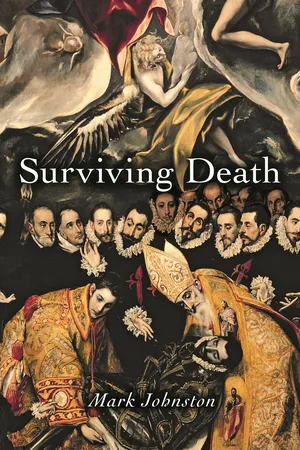
In this extraordinary book, Mark Johnston sets out a new understanding of personal identity and the self, thereby providing a purely naturalistic account of surviving death.
Death threatens our sense of the importance of goodness. The threat can be met if there is, as Socrates said, "something in death that is better for the good than for the bad." Yet, as Johnston shows, all existing theological conceptions of the afterlife are either incoherent or at odds with the workings of nature. These supernaturalist pictures of the rewards for goodness also obscure a striking consilience between the philosophical study of the self and an account of goodness common to Judaism, Christianity, Hinduism, and Buddhism: the good person is one who has undergone a kind of death of the self and who lives a life transformed by entering imaginatively into the lives of others, anticipating their needs and true interests. As a caretaker of humanity who finds his or her own death comparatively unimportant, the good person can see through death.
But this is not all. Johnston's closely argued claims that there is no persisting self and that our identities are in a particular way "Protean" imply that the good survive death. Given the future-directed concern that defines true goodness, the good quite literally live on in the onward rush of humankind. Every time a baby is born a good person acquires a new face.
- 408 pages
- English
- ePUB (mobile friendly)
- Available on iOS & Android
eBook - ePub
Surviving Death
About this book
Information
Publisher
Princeton University PressYear
2010Print ISBN
9780691130132
9780691130125
eBook ISBN
9781400834600
Topic
Theology & ReligionSubtopic
TheologyChapter One
Is Heaven a Place We Can Get To?
Having shaken off the yoke of being chair of the department (after seven years) it is a great honor to be invited by my colleagues to give these lectures. It is also a particular delight. For this lecture series celebrates the memory of our wonderful former colleague, Carl Gustav “Peter” Hempel.
Like all those who knew him, I remember Peter as a very good and kind man. To mention just one small kindness—a single example among so many—one Princeton summer, long ago, Peter offered his magnificent office in McCosh to my then fellow graduate student Alison Mc-Intyre and me, with the encouragement that we look into his library. It provided a great education in the long history of positivism, especially in the often unnoticed practical idealism of that movement, which appeared so forcefully in the many early pamphlets associated with its formation, pamphlets that Peter still kept on hand. One of those pamphlets contained a partial translation of August Comte’s Système de politique positive, in which I found an idea that I shall return to in the last lecture. I wonder what Peter would have made of it.
So now to begin on the lectures, I should say that I am very conscious of the awkwardness of my topic. To speak in this kind of academic context about whether we survive death is widely regarded as a form of bad taste. When I first announced the topic of these lectures, many of my friends in the department visibly flinched. And I believe that they are still a little nervous on my behalf. Why is this? Perhaps it is because there seem to be only two ways of proceeding, both bad ones at that. You either rehearse a scientifically established materialism about life and death, or you preach.
To do the first, to rehearse materialism, roughly the claim that the mind is merely the functioning of the brain and nervous system, so that a mind cannot survive the death of its brain, is just to insult peoples’ cherished religious beliefs, and their consequent hopes that they and their loved ones are not obliterated by death. And that is not very helpful, is it?
Besides rehearsing the consequences of materialism, the only other option may seem to be apologetics or preaching; in effect, special pleading on behalf of particular religious beliefs. That is obviously out of court in an academic context. So how can you decently talk, in an academic context, about whether or not we survive death?
Well, we don’t talk about it, or if we do, we talk about it under the arcane guise of what is called the philosophy of personal identity. This academic reticence on the question of life after death has at least two bad effects.
One effect is on the culture at large. Because there is something of a taboo on serious discussion of the topic, many people suppose that they have the right to believe anything they like about death and survival. So we get a good deal of second-or third-hand religiosity, mixed in with the whims of New Age wishful thought. Here as elsewhere, freedom of thought is confused with a license to believe anything. Philosophy is one of the few things that still enforces that disappearing distinction.
Another effect is to be found in the intellectual content of a major idée fixe of the day, namely the incessant discussion of the alleged compatibility or, as it might be, incompatibility of something called “religion” and something called “science.” (As if Spiritualism and neurophysiology stood in the same relation as Unitarianism and, say, cosmology.) One reason why such discussions often seem like so much shadowboxing is that the crux of supernaturalist religious belief, the status of the afterlife, is not taken up in any detailed and concerted way.
One upshot of these lectures will be that dwelling on the generic motif of science versus religion misses something crucial. As we shall see, various supernaturalisms, particularly the Protestant and the exoteric Catholic theologies of death, have obscured a striking consilience between certain implications of the naturalistic philosophical study of the self and a central salvific doctrine found in Judaism, Christianity, Buddhism, and Vedanta.
THE POPULARITY OF THE OTHER WORLD
In 2003, the Barna Research Group conducted an extensive survey of the attitudes of Americans on the question of surviving death. Here is their own “executive summary” of their findings.
• Belief in life after death, like belief in God, is widely embraced. Not only do 81 percent of Americans believe in an afterlife of some sort, but another 9 percent said life after death may exist, but they were not certain.
• Moreover, a large majority of Americans (79 percent) agreed with the statement “Every person has a soul that will live forever, either in God’s presence or absence.”
• In fact, belief in the afterlife seems to be more popular than belief in the existence of God. Half of all self-described atheists and agnostics say that every person has a soul, that heaven and hell exist, and that there is life after death.
The Barna survey also explored Americans’ particular conceptions of heaven and hell.
• In all, 76 percent believe that heaven exists, while nearly the same proportion said that there is such a thing as hell (71 percent).
While there is no dominant view of hell, two particular opinions seem widespread.
• Four out of ten adults believe that hell is “a state of eternal separation from God’s presence” (39 percent) and one-third (32 percent) says it is “an actual place of torment and suffering where people’s souls go after death” A third proposition, which one in eight adults will assent to, is that “hell is just a symbol of an unknown bad outcome after death”
The popular view of where we are going after death appears to ignore, even to reverse, the consistent and ominous biblical warning: “Narrow is the gate to salvation, but wide is the road that leads to perdition.” For just one-half of 1 percent of Americans think that they will go to hell upon their death.
By the way, this is roughly the proportion of Americans who in other surveys are prepared to avow Satanism, or report that Satan is likely to be the highest power. So the level of anticipation of effective damnation, in the sense of ending up in the wrong place, may be considerably lower than half of 1 percent.
WHAT DOES DEATH THREATEN?
It is the kind of survey of American attitudes that shows that we need to significantly amend Nietzsche’s best-known aphorism. God is dead; but only in Australia, Scandinavia, and parts of Western Europe! In these “godless” countries, and the old country, Australia, it seems, is one of the more godless, much lower levels of belief in the afterlife are found.
These stark differences in levels of professed belief in an afterlife persist, even when we statistically correct for the difference in churchgoing as between, say, the United States and Australia. Here is a tempting speculation about the persistent difference between Americans and Australians. In Australia, for whatever reason, saying that you believe in God and the afterlife is not a speech act required of you in order to count as a conventionally good person. By contrast, one of the things American respondents are doing in announcing their beliefs in God and the afterlife is declaring themselves on the side of the good. (If that is right, then we should not expect that a significant increase in scientific literacy would automatically alter the rate of such avowals.) Like it or not, in this country, the present conventions are such that to openly avow atheism and materialism is thereby to create the presumption that you are a reprobate, a morally unprincipled person. You will then have, for example, little chance of being elected sheriff, let alone congressman, senator, or president.
Is this why atheists are now “coming out”—in part to erode these conventions?
Convention aside, is there any intelligible connection between allegiance to the good and belief in life after death? I think there is. Death confronts us with a threefold threat. For the person who is dying death threatens the loss of life with others, as well as the end of presence, the end of conscious awareness. As a generic phenomenon, death also threatens what we might call the importance of goodness. Belief in a life after death, where people get their just deserts, explicitly addresses this last threat. (Of course, it also promises the restoration of life with others and the persistence of conscious awareness.)
DEATH AND THE IMPORTANCE OF GOODNESS
How does death threaten the importance of goodness? To start with the more inchoate versions of the thought: Death is the great leveler; if the good and the bad alike go down into oblivion, if there is nothing about reality itself that shores up this basic moral difference between their lives, say by providing what the good deserve, then the distinction between the good and the bad is less important. So goodness is less important.
It is an argument with an ancient pedigree. Qoheleth, perhaps better known as Ecclesiastes, the “one who has gathered many things,” writing sometime after 450 BCE, famously makes this argument in the case of one prized form of goodness, namely wisdom.
So I turned to consider wisdom and folly. . . . Then I saw that wisdom excels over folly as light excels over darkness. The wise have eyes in their heads, but the fools walk in darkness. But then I remembered that the same fate befalls us all, wise and foolish alike. And I said to myself, “What happens to the fool will happen to me also. Why then have I been so very wise?” And I came to see that this wisdom also is vanity. There is no enduring remembrance of the wise or of the fools, for in the days to come all will have been long forgotten. The wise die just like the fools. . . .
So I hated life, because what is done under the sun was grievous to me; for all is vanity and a chasing after wind. (Eccl. 2:12–17)
And again:
Everything that confronts them is vanity, for the same fate comes to them all, to the just and the unjust, to the good and the evil, to the clean and the unclean, to those who sacrifice and to those who do not sacrifice. (Eccl. 9:2–3)
The argument is not (or not yet) that the distinctions between the wise and the foolish, the just and the unjust, and the clean and the unclean are obliterated by the fact that they all face the same fate, the supposed nothingness of the grave. Rather it is that the distinctions lose their importance. The struggle to be wise, or just, or good, or clean is so much vain effort, given what death is.
This is not an isolated thought in the Jewish tradition.1 The Wisdom of Solomon, written by a Hellenized Jew probably at the end of the first century BCE, rather than promoting Qoheleth’s argument directly, offers a more telling conceit. The author has the wicked or “the ungodly” invoke their ally Death to vindicate their wickedness, by what is in effect a radicalized version of Qoheleth’s argument.
The ungodly by their words and deeds summoned Death;
considering him a friend, they pined away
and made a covenant with him,
because they are fit to belong to his company.
For they reasoned unsoundly, saying to themselves,
“Short and sorrowful is our life,
and there is no remedy when a life comes to its end,
and no one has been known to return from Death.
For we were born by mere chance,
and hereafter we shall be as though we had never been,
for the breath in our nostrils is smoke,
and reason is a spark kindled by the beating of our hearts;
when it is extinguished, the body will turn to ashes,
and the spirit will dissolve like empty air.
Come, therefore, let us enjoy the good things that exist,
and make use of creation to the full, as in youth.
Let us take our fill of costly wine and perfumes,
and let no flower of spring pass us by.
Let us crown ourselves with rosebuds before they wither.
Let none of us fail to share in revelry.”
So far, so good; we seem to have a sensible Epicurianism; there is nothing in itself wicked here. But now the reasoning of the wicked takes a nasty turn.
“Let us oppress the righteous poor man;
let us not spare the widow
or regard the gray hairs of the aged.
But let our might be our law of right,
for what is weak proves itself to be useless.”
In so reasoning, the wicked “reason unsoundly,” as the New Revised Standard Version of the Apocrypha has it; and it is clear from the surrounding text that the argument of the wicked is explicitly presented by the author as unsound, but not invalid. The author of the Wisdom of Solomon is telling us that if it were the case that the righteous and the wicked alike go down into the nothingness of Death...
Table of contents
- Cover
- Title
- Copyright
- Contents
- Preface
- Chapter One - Is Heaven A Place We Can Get To?
- Chapter Two - On The Impossibility Of My Own Death
- Chapter Three - From Anatta To Agape
- Chapter Four - What Is Found At The Center?
- Chapter Five - A New Refutation Of Death
- Index
Trusted by 375,005 students
Access to over 1.5 million titles for a fair monthly price.
Study more efficiently using our study tools.
Frequently asked questions
Yes, you can cancel anytime from the Subscription tab in your account settings on the Perlego website. Your subscription will stay active until the end of your current billing period. Learn how to cancel your subscription
No, books cannot be downloaded as external files, such as PDFs, for use outside of Perlego. However, you can download books within the Perlego app for offline reading on mobile or tablet. Learn how to download books offline
Perlego offers two plans: Essential and Complete
- Essential is ideal for learners and professionals who enjoy exploring a wide range of subjects. Access the Essential Library with 800,000+ trusted titles and best-sellers across business, personal growth, and the humanities. Includes unlimited reading time and Standard Read Aloud voice.
- Complete: Perfect for advanced learners and researchers needing full, unrestricted access. Unlock 1.5M+ books across hundreds of subjects, including academic and specialized titles. The Complete Plan also includes advanced features like Premium Read Aloud and Research Assistant.
We are an online textbook subscription service, where you can get access to an entire online library for less than the price of a single book per month. With over 1.5 million books across 990+ topics, we’ve got you covered! Learn about our mission
Look out for the read-aloud symbol on your next book to see if you can listen to it. The read-aloud tool reads text aloud for you, highlighting the text as it is being read. You can pause it, speed it up and slow it down. Learn more about Read Aloud
Yes! You can use the Perlego app on both iOS and Android devices to read anytime, anywhere — even offline. Perfect for commutes or when you’re on the go.
Please note we cannot support devices running on iOS 13 and Android 7 or earlier. Learn more about using the app
Please note we cannot support devices running on iOS 13 and Android 7 or earlier. Learn more about using the app
Yes, you can access Surviving Death by Mark Johnston in PDF and/or ePUB format, as well as other popular books in Theology & Religion & Theology. We have over 1.5 million books available in our catalogue for you to explore.