Why major changes to America's social safety net have always required bold presidential leadership
Americans like to think that they look after their own, especially in times of hardship. Particularly for the Great Depression and the Great Society eras, the collective memory is one of solidarity and compassion for the less fortunate. Who Cares? challenges this story by examining opinion polls and letters to presidents from average citizens. This evidence, some of it little known, reveals a much darker, more impatient attitude toward the poor, the unemployed, and the dispossessed during the 1930s and 1960s. Katherine Newman and Elisabeth Jacobs show that some of the social policies that Americans take for granted today suffered from declining public support just a few years after their inception. Yet Americans have been equally unenthusiastic about efforts to dismantle social programs once they are well established. Again contrary to popular belief, conservative Republicans had little public support in the 1980s and 1990s for their efforts to unravel the progressive heritage of the New Deal and the Great Society. Whether creating or rolling back such programs, leaders like Roosevelt, Johnson, Nixon, and Reagan often found themselves working against public opposition, and they left lasting legacies only by persevering despite it.
Timely and surprising, Who Cares? demonstrates not that Americans are callous but that they are frequently ambivalent about public support for the poor. It also suggests that presidential leadership requires bold action, regardless of opinion polls.
eBook - ePub
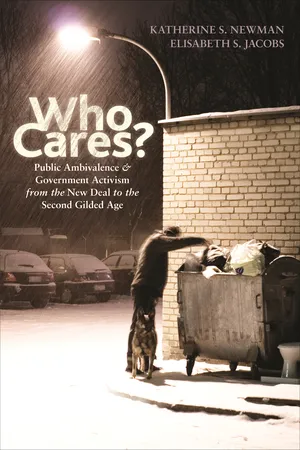
Who Cares?
Public Ambivalence and Government Activism from the New Deal to the Second Gilded Age
- 240 pages
- English
- ePUB (mobile friendly)
- Available on iOS & Android
eBook - ePub
Who Cares?
Public Ambivalence and Government Activism from the New Deal to the Second Gilded Age
About this book
Information
1
Dissent and the New Deal
In the ranks of quite a few of the middle class white collar people and upwards, the mental havoc is pretty bad. Nobody really seems to feel that he is actually going to get an honest-to-goodness job or work in a hurry.
—Julian Claff, writing from Philadelphia
There is an increasing feeling of despair—the feeling that they will never get their jobs back. . . . The winter shut-down of so many of these [work relief] projects brings men into headquarters begging that the county road work be continued through this winter.
—Martha B. Bruere and Ernestine Ball,
writing from Schenectady, N.Y.
writing from Schenectady, N.Y.
I think there is a terrible problem here of salvaging human material; or letting it permanently rot. . . . Present relief is a kind of hypodermic; it doesn’t take long to realize that this ailment is chronic and needs long-time constructive planning to retrain these people and re-establish them.
—Martha Gellhorn, writing from South Carolina
The president of the Braddock National Bank said that if relief were withdrawn before work comes to the steel towns there would be rioting. I believe there would be in Duquense.
—Hazel Reavis, writing from Braddock-Duquense, Pa.
The morale of the jobless, generally, is bad. . . . It is my conviction that any drastic curtailment of relief in Chicago in the face of continued unemployment would provoke demonstrations of a violent nature.
—Thomas Steep, writing from Chicago1
In March 1935, Franklin D. Roosevelt hired a group of journalists to provide him with firsthand impressions of the toll the Great Depression was taking on the country and the impact of his New Deal programs on the lives of ordinary people. Stationed in small towns and big cities in every region of the country, the reporters wrote back with these discouraging accounts. Hopelessness, despair, and anger threatened to metastasize into widespread disorder.
As historian Irving Bernstein notes in his study of American workers, in the 1920s and 1930s, “unrest, frequently under Communist leadership, erupt[ed] into violence and rootless veterans [of the First World War] in quest of government handouts.”2 This social disorder led many to believe that the United States was on the brink of a revolt not unlike the Russian Revolution (then less than twenty years in the past). Looking back from the vantage point of the late 1950s, Arthur Schlesinger Jr. deemed the period leading up to the New Deal the “valley of darkness” and argued that the nation was prone to a violent upheaval.3 In letters ordinary citizens sent to FDR, we see why Schlesinger came to this dire prediction. “It is now nearly two years since you pledged yourself to an attempt at bettering the lot of the ‘forgotten man,’ ” Mrs. Carl Brenden of Laurel, Montana, reminded the president in her letter of 1934:
As far as I can see the “forgotten man” is as forgotten as he ever was during the previous administrations. It is becoming increasingly apparent that slow starvation and attendant degradation is to be the lot of millions of forgotten men under either of the major parties and that we must look to the more radical groups for any relief.4
Why were ordinary people suffering? Views on this question divided the nation. For those on the right, Depression “losers” were experiencing the natural consequences of their own moral collapse and a decline in the work ethic, and were developing an unholy expectation for handouts at taxpayers’ expense. For those at the other end of the ideological spectrum, the Depression was caused by the excessive, concentrated power of elites who were looking out for their own interests, ready to crush the common man if he got in the way. The Left urged Roosevelt to take radical action to curb the control of employers and redistribute wealth; the Right looked to Roosevelt to let the market exert its discipline. While millions of desperate families in the middle deemed the president a secular savior, and reelected him four times to underline the point, in its day the Roosevelt administration was pounded by critics on all sides. The dissension comes through in the opinion polls and letters to FDR on which we rely here.
Historian Lizbeth Cohen’s study of Chicago’s working class in the 1930s provides a vivid portrait of the turmoil that spread throughout the country as the crisis deepened.5 In Making a New Deal, she notes that the rising tide of unemployment soon overwhelmed the traditional ethnic charities and the institutions of welfare capitalism as firms buckled under the pressure of bankruptcy.6 Local organizations that had been able to cope with previous downturns watched helplessly as their constituents were evicted, the ranks of the “Hoover Hobos” swelled, and fathers were thrown out of work, only to find themselves dependent on the meager wages of their wives and children.7
The breakdown of the usual mechanisms for coping with economic downturns gave way to increasing expectations for federal assistance and spurred the creation of Roosevelt’s New Deal, an unprecedented intervention by the federal government in labor markets, factory production, credit, construction, and housing. Money flowed into an alphabet soup of relief agencies that assumed unprecedented regulatory authority and organized agencies that did everything from build roads and schools to sew clothing and distribute food. In no other period of American history did the role of the state grow as fast as it did in the dark days of the 1930s.8
The Federal Emergency Relief Act, enacted in 1933, forked over $3.1 billion to states and localities to develop public works during the two years it was in operation. The Civil Works Administration (CWA) was one of its first programs and, although short-lived, the $400 million it spent put more than four million unemployed workers back on the job in the space of nine months. Men employed through the largesse of this and related programs, including the Civilian Conservation Corps (CCC), understood full well whom they had to thank for the opportunity:
Personally, you have made it possible, for me, through the CWA to get steady work for nine weeks, through the toughest time in the year, when I am practically at wits’ end. I, my family, my immediate neighbors, stand fully behind your program, the NRA [National Recovery Administration], and anything that you may sponsor.9 (Max Baron, Cleveland, Ohio, Dec. 11, 1933)Yesterday I celebrated my thirty-second birthday. It was the happiest birthday I have had for many years. I had been out of work for a long time. But now I have work through the CWA. I have two little children to take care of. . . . I am not an educated man but you do not think only of that class. You have been a blessing to the American people every where.10 (John Binkley, Nashville, Tenn., Jan. 31, 1934)All of the projects you have sponsored have been a blessing to our people. The CCC and the NIRA [National Industrial Recovery Act] . . . have proven master strokes in keeping the people steady. The SERA [State Emergency Relief Administration] project has been the most wonderful of all. I know some people have not kept faith with you in aiding the people of this nation but that in no way detracts from the purpose of real relief.11 (Rovaida T. Murray, San Diego, Calif., Mar. 17, 1935)
Others were not quite as appreciative. From the left, FDR was hit with the critique that he was too easy on business, too compliant in the face of demands to keep the wages of public workers low. Derogatory terms like “wage slavery” were thrown at relief work, which was in full swing by the time these letters from 1934 were placed in the White House mailbox. “You come along with this works relief bill and . . . demand that every man live on $50 a month,” one writer from Henrickson, Indiana, complained. Another wrote,
There is a widespread public opinion, especially among the 12,000 unemployed and their dependents that this Administration may go the way that Hoover’s battalions went . . . [if it doesn’t do more to help the] 30,000,000 people, after five years, are still struggling with unemployment, starvation, and industrial bondage.12 (B. A. Bonte, Bellevue, Ky., May 8, 1934)What has, and what is, the administration and a democratic Congress doing to give reemployment to nearly a million men and their NOW POVERTY STRICKEN families who have been forced to wander in the valley of darkness and despair for going on four years?13 (O. Caswell, Kansas City, Mo., Apr. 18, 1934; emphasis in original)
Though we remember Roosevelt today as the man who did more for the poor and dispossessed than any president before, and arguably anyone since, in his own day leftists and labor liberals often complained that Roosevelt’s actions were too little, too late, and too tepid:
Your promise to limit i...
Table of contents
- Cover
- Title
- Copyright
- Dedication
- Contents
- List of Illustrations
- Acknowledgments
- Introduction Devoted to the Common Good?
- 1 Dissent and the New Deal
- 2 Warring over the War on Poverty
- 3 Economic Anxiety in the New Gilded Age
- 4 Searching for “the Better Angels of Our Nature”
- Notes
- Bibliography
- Index
Trusted by 375,005 students
Access to over 1.5 million titles for a fair monthly price.
Study more efficiently using our study tools.
Frequently asked questions
Yes, you can cancel anytime from the Subscription tab in your account settings on the Perlego website. Your subscription will stay active until the end of your current billing period. Learn how to cancel your subscription
No, books cannot be downloaded as external files, such as PDFs, for use outside of Perlego. However, you can download books within the Perlego app for offline reading on mobile or tablet. Learn how to download books offline
Perlego offers two plans: Essential and Complete
- Essential is ideal for learners and professionals who enjoy exploring a wide range of subjects. Access the Essential Library with 800,000+ trusted titles and best-sellers across business, personal growth, and the humanities. Includes unlimited reading time and Standard Read Aloud voice.
- Complete: Perfect for advanced learners and researchers needing full, unrestricted access. Unlock 1.5M+ books across hundreds of subjects, including academic and specialized titles. The Complete Plan also includes advanced features like Premium Read Aloud and Research Assistant.
We are an online textbook subscription service, where you can get access to an entire online library for less than the price of a single book per month. With over 1.5 million books across 990+ topics, we’ve got you covered! Learn about our mission
Look out for the read-aloud symbol on your next book to see if you can listen to it. The read-aloud tool reads text aloud for you, highlighting the text as it is being read. You can pause it, speed it up and slow it down. Learn more about Read Aloud
Yes! You can use the Perlego app on both iOS and Android devices to read anytime, anywhere — even offline. Perfect for commutes or when you’re on the go.
Please note we cannot support devices running on iOS 13 and Android 7 or earlier. Learn more about using the app
Please note we cannot support devices running on iOS 13 and Android 7 or earlier. Learn more about using the app
Yes, you can access Who Cares? by Katherine S. Newman,Elisabeth S. Jacobs in PDF and/or ePUB format, as well as other popular books in Politics & International Relations & North American History. We have over 1.5 million books available in our catalogue for you to explore.