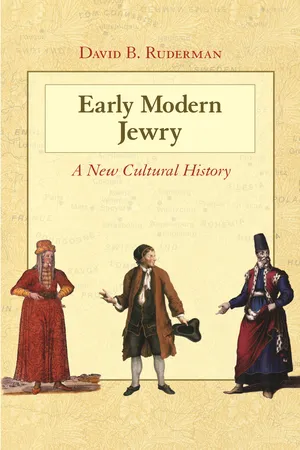
A compelling history of the early modern Jewish experience
Early Modern Jewry boldly offers a new history of the early modern Jewish experience. From Krakow and Venice to Amsterdam and Smyrna, David Ruderman examines the historical and cultural factors unique to Jewish communities throughout Europe, and how these distinctions played out amidst the rest of society. Looking at how Jewish settlements in the early modern period were linked to one another in fascinating ways, he shows how Jews were communicating with each other and were more aware of their economic, social, and religious connections than ever before.
Ruderman explores five crucial and powerful characteristics uniting Jewish communities: a mobility leading to enhanced contacts between Jews of differing backgrounds, traditions, and languages, as well as between Jews and non-Jews; a heightened sense of communal cohesion throughout all Jewish settlements that revealed the rising power of lay oligarchies; a knowledge explosion brought about by the printing press, the growing interest in Jewish books by Christian readers, an expanded curriculum of Jewish learning, and the entrance of Jewish elites into universities; a crisis of rabbinic authority expressed through active messianism, mystical prophecy, radical enthusiasm, and heresy; and the blurring of religious identities, impacting such groups as conversos, Sabbateans, individual converts to Christianity, and Christian Hebraists.
In describing an early modern Jewish culture, Early Modern Jewry reconstructs a distinct epoch in history and provides essential background for understanding the modern Jewish experience.
1. On Modena, see Robert Davis and Benjamin Ravid, eds., The Jews of Early Modem Venice (Baltimore, 2001); Talya Fishman, Shaking the Pillars of Exile: “Voice of a Fool,” an Early Modern Jewish Critique of Rabbinic Culture (Stanford, CA, 1997); David Malkiel, ed., The Lion Shall Roar: Leon Modena and His World (Jerusalem, 2003); and Leon Modena, The Autobiography of a Seventeenth-Century Venetian Rabbi: Leon Modena’s Life of Judah, ed. and trans. Mark R. Cohen (Princeton, NJ, 1988).
2. On Luzzatto, see especially Benjamin Ravid, Economics and Toleration in Seventeenth Century Venice (New York, 1978), and David Ruderman, Jewish Thought and Scientific Discovery in Early Modern Europe (Detroit, 2001), index.
3. On Delmedigo, see especially Isaac Barzilay, Yoseph Shlomo Delmedigo, Yashar of Candia: His Life, Works and Times (Leiden, Netherlands, 1974); Ruderman, Jewish Thought and Scientific Discovery in Early Modern Europe, index.
4. Leo Strauss, Persecution and the Art of Writing (Chicago, 1988). See also Perez Zagorin, Ways of Lying: Dissimulation, Persecution, and Conformity in Early Modern Europe (Cambridge, MA, 1990).
5. I offer only a sampling of the work of these authors in their first or early editions. For central and eastern Europe, see Israel Halperin, Yehudim ve-Yahadut be-Mizra
Eropah (Jerusalem, 1968);
ayyim Hillel Ben Sasson, Hagut ve-Hanhagah: Hashkefoteihem ha
evratiyot shel Yehudei Polin be-Shalhei Yemei ha-Beinayim (Jerusalem, 1959); and Jacob Katz, Masoret u-Mashber: Ha-
evra ha-Yehudit be-Mo
ei Yemei ha-Beinayim (Jerusalem, 1963). For Spain, see Yi
ak Baer, A History of the Jews of Christian Spain, 2. vols. (Philadelphia, 1961–66); and
aim Beinart, Anusim be-Din ha-Inquisi
iah (Tel Aviv, 1965). For Italy, see Shlomo Simonsohn, History of the Jews in the Duchy of Mantua (Jerusalem, 1977); Moses Avigdor Shulvass,
ayyei ha-Yehudim be-Italyah bi-Tekufat ha-Renesans (New York, 1955); and Cecil Roth, The History of the Jews of Italy (Philadelphia, 1946). On Lurianic kabbalah and Sabbateanism, see Gershom Scholem, Sabbatai Sevi: The Mystical Messiah 1626–1676 (Princeton, NJ, 1973); and Isaiah Tishbi, Netivei Emunah ve-Minut (Ramat Gan, Israel, 1964).
6. On the conversos, see Yosef Hayim Yerushalmi, From Spanish Court to Italian Ghetto: Isaac Cardoso: A Study in Seventeenth-Century Marranism and Jewish Apologetics (New York, 1971); and Yosef Kaplan, Mi-Na
rut le-Yahadut:
ayyav u-Fo’olo shel ha-Anus Yi
ak Orobio de Castro (Jerusalem, 1982). On the revision of Scholem’s work, see Moshe Idel, Kabbalah: New Perspectives (New Haven, 1988); and Yehudah Liebes, Sod ha-Emunah ha-Shabta’it (Jerusalem, 1995); On eastern European Jewry, see Murray Rosman, The Lord’s Jews: Magnate-Jewish Relations in the Polish-Lithuanian Commonwealth during the Eighteenth Century (Cambridge, MA, 1990); Gershon Hundert, The Jews in a Polish Private Town: The Case of Opatów in the Eighteenth Century (Baltimore, 1992.); and Israel Bartal, Me-Umah le-Le’om: Yehudei Mizra
Eropah 1772–1881 (Jerusalem, 2002). On Anglo-Jewry, see Todd Endelman, The Jews of Georgian England 1714–1830: Tradition and Change in a Liberal Society (Ann Arbor, 1999). On Italian Jewry, see David B. Ruderman, The World of a Renaissance Jew: The Life and Thought of Abraham B. Mordecai Farissol (Cincinnati, 1981); and Reuven [Robert] Bonfil, Ha-Rabbanut be-Italyah bi-Tekufat ha-Renesans (Jerusalem, 1979). On Ottoman Jewry, see Joseph Hacker, Megorashei Sefarad (Jerusalem, 1966); and Amnon Cohen, Jewish Life under Islam: Jerusalem in the Sixteenth Century (Cambridge, MA, 1984). On the work of Richard Popkin, see, for example, his The Third Force in Seventeenth-Century Thought (Leiden, Netherlands, 1992).
7. See, for example, on eastern Europe, Elhanan Reiner, “Transformations in the Polish and Ashkenazic Yeshivot during the Sixteenth and Seventeenth Centuries and the Dispute over Pilpul” (in Hebrew), In Ke-Minhag Ashkenaz ve-Polin: Sefer Yovel le-Chone Shmeruk, ed. Israel Bartal, Chava Turniansky, and Ezra Mendelsohn (Jerusalem, 1989): 9–80; and Adam Teller,
ayyim be-
avta: Ha-Rova ha-Yehudi shel Poznan ba-Ma
a
it ha-Rishonah shel ha-Meah ha-17 (Jerusalem, 2003). On Italy, see Elliott Horowitz, “The Eve of the Circumcision: A Chapter in the History of Jewish Nightlife,” Journal of Social History 23 (1989): 45–69; Azariah de’ Rossi, The Light of the Eyes, ed. and trans. Joanna Weinberg (New Haven, CT, 2001); and Ariel Toaff, Love, Work, and Death: Jewish Life in Medieval Umbria (London, 1996). On Amsterdam, see Yosef Kaplan, An Alternative Path to Modernity: The Sephardi Diaspora in Western Europe (Leiden, Netherlands, 2000); Miriam Bodian, Hebrews of the Portuguese Nation: Conversos and Community in Early Modern Amsterdam (Bloomington, IN, 1997); and Daniel Swetschinski, Reluctant Cosmopolitans: The Portuguese Jews of Seventeenth-Century Amsterdam (London, 2000). On Lurianic kabbalah and Sabbateanism, see Ronit Meroz, “Geulah Be-Torat ha-Ari,” PhD diss., Hebrew University, 1988; Abraham Elkayam, “Sod ha-Emunah be-Kitvei Natan ha-Azati,” PhD diss., Hebrew University, 1993; Matt Goldish, The Sabbatean Prophets (Cambridge, MA, 2004); Jacob Barnai, Shabta’ut: Hebetim
evrati’im (Jerusalem, 2000); and Ada Rappaport-Albert, “On the Position of Women in Sabbateanism” (in Hebrew), in Ha-
8. On print, see Elhanan Reiner, “The Ashkenazic Elite at the Beginning of the Modern Era: Manuscript versus Printed Text,” Jews in Early Modern Poland-Polin 10 (1997): 85–98: Zeev Gries, Sifrut ha-Hanhagot:Toledoteha u-Mekoma be-
ayyei
asidov shel ha-Besht (Jerusalem, 1989); and Amnon Raz-Krakotzkin. The Censor, the Editor, and the Text: The Catholic Church and the Shaping of the Jewish Canon in the Sixteenth Century (Philadelphia, 2007). On Christian Hebraism, see Stephen Burnett, From Christian Hebraism to Jewish Studies: Johannes Buxtorf (1564–1629) and Hebrew Teaming in the Seventeenth Century (Leiden, Netherlands, 1996); Dean Phillip Bell and Stephen Burnett, eds., Jews, Judaism, and the Reformation in Sixteenth-Century Germany (Leiden, Netherlands, 2006); Chaim Wirszubski, Pico della Mirandola’s Encounter with Jewish Mysticism (Cambridge, MA, 1989); Matt Goldish, Judaism in the Theology of Sir Isaac Newton (Dordrecht, Netherlands, 1998); and Allison Coudert and Jeffrey Shoulson, eds., Hebraica Veritas? Christian Hebraists, Jews, and the Study of Judaism in Early Modern Europe (Philadelphia, 2004); On antiquarianism and scholarship, see Azariah de’ Rossi, The Tight of the Eyes. On women and gender, see Moshe Rosman, “To Be a Jewish Woman in Poland-Lithuania at the Beginning of the Modern Era” (in Hebrew), in Kiyyum ve-Shever: Yehudei Polin Le-Dorotehem, ed. Israel Bartal and Israel Gutmann (Jerusalem, 2001), 2:415–34; Chava Weissler, Voices of the Matriarchs (Boston, 1998); and Renée Levine Melammed, Heretics or Daughters of Israel? The Crypto-Jewish Women of Castille (New York, 1998).
9. I have offered an extended treatment of Israel’s book in the appendix to the present volume. Besides addressing the challenge offered by Israel’s work, I also present there a more detailed discussion of the regional studies of other historians of the Jewish experience in early modern Europe as well as that of European and world historians on early modernity in general.
10. While my understanding of cultural history includes a consideration of social and political life, ...
Table of contents
Cover
Title
Copyright
Dedication
Contents
Maps
Introduction
One: Jews on the Move
Two: Communal Cohesion
Three: Knowledge Explosion
Four: Crisis of Rabbinic Authority
Five: Mingled Identities
Six: Toward Modernity: Some Final Thoughts
Appendix: Historiographical Reflections
Acknowledgments
Notes
Bibliography of Secondary Works
Index
Trusted by 375,005 students
Access to over 1.5 million titles for a fair monthly price.
Study more efficiently using our study tools.
Frequently asked questions
Yes, you can cancel anytime from the Subscription tab in your account settings on the Perlego website. Your subscription will stay active until the end of your current billing period. Learn how to cancel your subscription
No, books cannot be downloaded as external files, such as PDFs, for use outside of Perlego. However, you can download books within the Perlego app for offline reading on mobile or tablet. Learn how to download books offline
Perlego offers two plans: Essential and Complete
Essential is ideal for learners and professionals who enjoy exploring a wide range of subjects. Access the Essential Library with 800,000+ trusted titles and best-sellers across business, personal growth, and the humanities. Includes unlimited reading time and Standard Read Aloud voice.
Complete: Perfect for advanced learners and researchers needing full, unrestricted access. Unlock 1.5M+ books across hundreds of subjects, including academic and specialized titles. The Complete Plan also includes advanced features like Premium Read Aloud and Research Assistant.
Both plans are available with monthly, semester, or annual billing cycles.
We are an online textbook subscription service, where you can get access to an entire online library for less than the price of a single book per month. With over 1.5 million books across 990+ topics, we’ve got you covered! Learn about our mission
Look out for the read-aloud symbol on your next book to see if you can listen to it. The read-aloud tool reads text aloud for you, highlighting the text as it is being read. You can pause it, speed it up and slow it down. Learn more about Read Aloud
Yes! You can use the Perlego app on both iOS and Android devices to read anytime, anywhere — even offline. Perfect for commutes or when you’re on the go. Please note we cannot support devices running on iOS 13 and Android 7 or earlier. Learn more about using the app
Yes, you can access Early Modern Jewry by David B. Ruderman in PDF and/or ePUB format, as well as other popular books in Historia & Historia europea. We have over 1.5 million books available in our catalogue for you to explore.