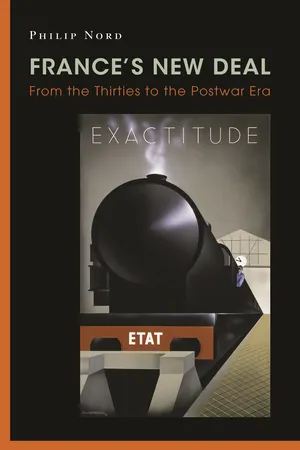
France's New Deal is an in-depth and important look at the remaking of the French state after World War II, a time when the nation was endowed with brand-new institutions for managing its economy and culture. Yet, as Philip Nord reveals, the significant process of state rebuilding did not begin at the Liberation. Rather, it got started earlier, in the waning years of the Third Republic and under the Vichy regime. Tracking the nation's evolution from the 1930s through the postwar years, Nord describes how a variety of political actors--socialists, Christian democrats, technocrats, and Gaullists--had a hand in the construction of modern France.
Nord examines the French development of economic planning and a cradle-to-grave social security system; and he explores the nationalization of radio, the creation of a national cinema, and the funding of regional theaters. Nord shows that many of the policymakers of the Liberation era had also served under the Vichy regime, and that a number of postwar institutions and policies were actually holdovers from the Vichy era--minus the authoritarianism and racism of those years. From this perspective, the French state after the war was neither entirely new nor purely social-democratic in inspiration. The state's complex political pedigree appealed to a range of constituencies and made possible the building of a wide base of support that remained in place for decades to come.
A nuanced perspective on the French state's postwar origins, France's New Deal chronicles how one modern nation came into being.
- 480 pages
- English
- ePUB (mobile friendly)
- Available on iOS & Android
eBook - ePub
About this book
Information
Publisher
Princeton University PressYear
2012Print ISBN
9780691156118
9780691142975
eBook ISBN
9781400834969
Part 1
THE FRENCH MODEL
The word “liberalism” does not have strong positive connotations in French public discourse. It is associated with the individualist, free- marketeering ways of the Thatcher/Reagan years, with an Anglo-Saxon model that celebrates the growth-creating potential of unbridled en- trepreneurship. No, the French have a model of their own, a third way between the savage capitalism of the English-speaking peoples and the command economies of the now defunct East bloc.
The state stands front and center in the French model. It is the owner of a vast nationalized sector. It invests. It plans. The plan, however, is not a diktat but a blueprint of goals and targets worked out in concert between civil servants and private interests, both business and trade union. And there is a similar mix of top-down and bottom- up elements in the design of France's welfare state. The system, which provides a full battery of benefits from health care to pensions, operates under the state's general tutelage, but it is made up of numerous caisses or funds, financed by a mix of employer and employee contributions and managed by representatives of the contributing parties themselves. A whole separate apparatus exists to disburse family-support payments, allocations familiales in French, but it is similar in constitution to the health-care and retirement programs and, in its postwar heyday, of equal weight in the overall structure of the welfare system. In 1946, an estimated half of all Social Security benefits took the form of family allocation payments.1 The range of the state's activities, however tempered by interest-group representation and participation, is impressive indeed. All this, of course, requires bureaucratic manpower, a first-rate senior civil service; and France in factboasts just such an elite, the graduates of the state-run Ecole natio- nale d'administration.
The French model—part “concerted economy,” part “parental welfare state” part “technocracy”—has come under intense pressure in recent decades. Portions of the nationalized sector have been sold off; the plan is but a shadow of what it once was; an aging population threatens the fiscal viability of the welfare state; and public complaints about the castelike character and aloofness of the nation's bureaucratic elite have multiplied. Yet, despite all such strains, the French model has remained intact in its general outlines.
Attached as the French are to this model, it has not existed from time immemorial but was put together, as we have seen, in a burst of institutional creativityjust after the Second World War. Now, it is tempting to look on the Liberation moment as one of dramatic rupture. The war and Occupation had created a breach that allowed a new generation of decision makers—men like Debré, Laroque, Sauvy, and Monnet-to rise to positions of power. They brought with them a youthful energy and a forward—looking élan that to date had been lacking in French public life. France had grown old and cautious in the thirties; the national economy had flagged; and the Third Republic, reliant on peasant and small-owning constituencies resistant to change, lacked the dynamism to jump-start a stalemated public life. But come the postwar moment, the stalemate was broken open, clearing the way for fresh faces and fresh ways of thinking.2
Yet how new were the new men? Laroque in 1934 wrote a regular column for L'Homme nouveau, a short-lived journal of corporatist opinion, which debated schemes for a reorganization of French social and political life. It turns out that Debré, a recent graduate of France's premier policy-training institute, Sciences Po, also wrote for the paper, though just an article or two. He is better remembered for his role in the Daladier administration of 1938. In the face of a looming Nazi menace, Prime Minister Edouard Daladier had committed himself to a crash program of rearmament whatever the cost. To this end, he set about diluting existing legislation that limited the wage- earning week to forty hours. Debré, in tandem with Sauvy, helped to draft the relevant decree-laws. Daladier also had occasion to call onMonnet's expertise. Monnet was an international financier with invaluable contacts in the Anglo-American world. France needed weaponry, and in 1938 Daladier dispatched Monnet to Washington to purchase aircraft from the Americans. The movers and shakers at the Liberation were often young men (not Monnet, however, who was born in 1888), but that did not mean they were without pasts.
The same may be said of the institutions they created. From a certain angle, the new order at the Liberation appears a direct working out of Resistance plans. The Conseil national de la Résistance had envisioned a state takeover of critical industries in the name of the public good; it had made an explicit pledge to insure all French citizens against the vicissitudes of modern life; and then these commitments were made good once France was restored to itself. Yet not all the institutional innovations of the Liberation era were de novo inventions. Monnet's plan was not the first of its kind. The wartime Vichy regime had generated two such projects of its own, a ten-year plan conceived in 1941 and the so-called tranche de demarrage of 1944, which began to imagine how a postwar France might set about relaunching its economy. Sauvy's INED had antecedents in a Vichy institution as well, the Fondation Carrel, a state-funded population- research institute. Sauvy, in fact, had a passing connection himself to the Fondation Carrel, and he recruited a substantial chunk of INED's senior staff from Fondation Carrel ranks.
The mixed ancestry of the postwar order raises the vexed question of how its political significance is to be understood. It is tempting, once again, to interpret the Liberation makeover as a Left triumph. In 1936, France had experienced a Popular Front government, an administration of Socialists and Radicals who, with Communist backing, pledged themselves to a democratization of public life in the name of antifascism and a new deal for working people. The CNR's program resurrected this vision, and, from this perspective, the Resistance's triumph at the Liberation represented a kind of second coming of the Popular Front. On this account, the Liberation looks like a social democratic moment, and that is how many historians have understood the postwar order, not just in France, but in much of Western Europe as well.3
But there are problems with this way of looking at things. At the level of party politics, the Resistance coalition was not quite the same in composition as its Popular Front predecessor. In 1944, Socialists and Communists stood at the forefront, but not the Radicals, now replaced by an altogether new partner, the christian democrats (as represented by the Mouvement republicain populaire), who had been a marginal presence on the political scene in 1936. And just below the partisan surface, at the administrative level where institutional architects like Monnet, Laroque, Sauvy, and Debré went about their business, the classic Left was much less in evidence. Indeed, not one of the four—neither Monnet the businessman, nor any of the technocrats in waiting (Laroque, Sauvy, and Debré)—was a leftist stalwart. The same observation, of course, applies to General de Gaulle himself, until the war a career officer, who harbored a lifelong suspicion of party men of all colorations. The French model was in part the product of social democratic aspiration, but other forces were at work as well whose identifying characteristics remain to be sorted out.
A trio of arguments will be spun out in the text that follows, which will address the issues raised above. The new elite at the Liberation was not so new. In the 1930s, these individuals can already be found at work, networking, editing little reviews, forming associations, all aimed at devising alternatives to the existing institutional order, judged too parliamentarist in political constitution and too laissez- faire in economic policy. Socialists played a part in these imaginings, but even more so competing currents that are not so easy to situate on the Left/Right spectrum. They are sometimes described as nonconformist, articulating an above-party critique of the “established disorder” which pinned hopes for a national renaissance on various third-way schemes that would enable France to blaze a path to a brighter future, neither capitalist nor communist in design.4 The “nonconformist” label, however, does not do justice to the full range of critical activity in the thirties, which encompassed an important technocratic wing composed of engineers and enlightened businessmen and a less well-known Catholic subculture anchored in an awakening laity intent on a re-Christianization of public life. The debatethat these various currents engaged in, moreover, was not just idle chatter but had an impact on policy, not just in the Popular Front era, but above all in the run-up to the war.5 The Republic, decadent as it was supposed to be, had a capacity for reform, although in certain aspects the reform in question anticipated Vichy as much as what came after.
Vichy, indeed, will play a major part in this story. Nonconformists, technocrats, and lay Catholics poured into Vichy service and there set to work—in an authoritarian context shadowed by an exigent occupying power—building the new France they dreamed of. They had some success at the enterprise, and a portion of what they built was preserved at the Liberation. But it also began to dawn on many (in fact, most of these third-way hopefuls) that Vichy was not in the end the vehicle of national redemption they had anticipated. They began to peel away, switching allegiance from Petain's regime to the Resistance. The phenomenon casts an interesting light on the light on the Resistance itself. In the popular American imagination, Free France appears the natural reflex of a freedom-loving people in the face of a vicious Occupation. But it is worth remembering just how variegated the Resistance phenomenon was. The movement contained elements that, however anti-German, were more ambivalent about Petain himself, objecting not to Petain's National Revolution per se but to the attempt to make it happen in an Occupation context. The Resistance contained elements, however anti-Vichy, that espoused an elite-led, technocratic vision of national regeneration, which echoed certain themes of Vichyite rhetoric. And the Resistance contained as well a Christian component that reviled Vichyite racism but aspired to a moralization, a purification of public life that resonated with many Catholics at first drawn to Vichy. The sometime proximity between Vichy and the Resistance vanished during 1942–1944, as Pétain's regime degenerated into fascist squalor and as the Resistance itself clarified its democratic commitments. But it was a proximity that, while it lasted, permitted crossovers and that stands as a reminder, if one is needed, that the Resistance was a house of many mansions, anchored on the Left but home as well to dissidents of various stripes, some of them ex-Vichyites.6
The variegated composition of the Resistance is critical to keep in mind when looking at the political struggles of the Liberation era. The Left was very much a presence in postwar councils, pressing a vision of its own centered around nationalizations, economic diri- gisme, a unitary welfare system (with family allocation funds not separate but rolled in), and the replacement of established institutions like Sciences Po with a new school of public administration. The Left push was powerful, and pieces of its agenda were enacted, but just pieces, and the reason why is plain enough. The Left met with opposition—from entrenched interests, from Vichy holdovers who dodged the postwar purges, and, of paramount importance, from fellow resis- tants. Gaullist loyalists, christian democrats, and ex-Vichyites turned resistants did not share in the Left's understanding of what the postwar order ought to look like, and they maneuvered with increasing success to thwart the Left's project, substituting one of their own—less dirigiste, more familist, and more elitist in construction.
Little wonder that left-leaning veterans of the era remember it as a moment of “restoration.”7 Yet the word is not an apt one, for the postwar order did represent a new departure. The “newness” of it all was in part a rhetorical gesture, the self-mythologizing gambit of a postwar elite bent on legitimating itself and its “modernizing” project. But there was truth to the claim as well, for that elite did lay the institutional groundwork for an astonishing economic burst, the so-called trente glorieuses, which propelled France out of its peasant and small- owning past into a twentieth century of planning, welfare, and technocratic management.8 Perhaps it is best then to speak, not of a restoration, but of a conservative, state-centered modernization, so successful in execution, it might be added, that there are few in France today who want to see the “French model” undone.
CHAPTER 1
The Crisis of the Thirties
Technocrats in Waiting
Depression-era France seems to have little to recommend it. There was to be sure the bright spot of the Popular Front, but the Blum experiment did not last long, and its successes were partial at best. It is rather France’s failures that stand out. The Third Republic, to all appearances, proved incapable of generating an effective response to the critical challenges of the day: at home, a deepening economic slump that sharpened class tensions; abroad, the rise of an aggressive Germany intent upon a radical revision of the international order. But the idea of French paralysis, or “immobilism” as it has sometimes been called, does not tell the whole story.
Critiques of prevailing economic policy proliferated in the thirties. They came, of course, from socialists and trade unionists who had little use for a laissez-faire liberalism, which, so far as they could see, had landed France in a depression. And liberal orthodoxy, it seemed evident enough, had no answer to the crisis, save a budget-cutting mania, which, killing demand, just made matters worse. No, what France needed was a plan: to iron out the irrationalities inherent in a market system driven by egotistical profi t-seeking and to guarantee the working man a fair share in an economy geared to the interests of capital. But the Left was not alone in voicing complaint. Maréchal Lyautey, a career military offi cer and onetime resident-general of Morocco, gathered around himself a circle of protégés in the early thirties. Here, the accent was on the redemptive potential of energeticleadership. The standard-issue French businessman-prudent and risk-averse-lacked the firmness of purpose to right a foundering economy. A new generation of executives, men of action with the moral wherewithal to bring subordinates along, was the “one thing needful” in a France grown slack in purpose. Nonconformist opinion, sometimes Catholic in coloration, did not disagree but placed greater emphasis on organization. The anarchy of the laissez-faire economy set employer against employee. A corporatist system, on the other hand, held out the promise of restoring a modicum of order to the marketplace. Workers and managers, brought together by a tutelary state, would hash out wages and prices, creating as they did so a harmonizing bond among the producing classes, a “community of labor,” which would inject a note of humanity into an otherwise cold and indifferent system. More technocratic-minded critics of liberal orthodoxy worried no less about labor relations; they too spoke of humanizing the economy. But there was less hostility to the market and the individual entrepreneur. The problem was to manage irrational behavior: to foresee economic calamities before they occurred and then correct for them. This required planning, a capacity for economic forecasting, which in turn presumed an adequate statistical grasp of the economy’s ups and downs. It is not surprising then that so many proponents of the technocratic critique were graduates of France’s preeminent engineering school, the Ecole Polytechnique, which boasted a curriculum that placed a premium on mathematical facility. Indeed, the principal locus of technocratic thinking in the thirties was an association nicknamed X-Crise, so called because students matriculated at the Polytechnique-polytechniciens-were known familiarly as “les X.”
Liberal orthodoxy came in for withering criticism from multiple directions. Among the critics numbered socialists of various stripes, but there were others as well: self-styled leaders of men, nonconformists, Catholic corporatists, technocrats, all of whom came eager and credentialed. They were not figures of power, but they would become so, and their rise dates, not from the war or the postwar years, but from the thirties. It may just be that the Third Republic, for better or for worse, was not so blocked as sometimes supposed.
The French socialist party, the SFIO, had long confronted an ideological dilemma. It imagined itself a revolutionary body, the vanguard organization of a radiant socialist future, yet it at the same time went about the more mundane business of running candidates for parliament and sponsoring reform legislation. A minority within the party latched on to planning as an avenue out of the reform versus revolution conundrum. A planned economy was a concrete project that might be realized in the here and now through practical political activity, but it also represented an advance on the existing order, a step toward the socialist utopia of tomorrow. Would-be socialist planners crystallized into a formal tendency in 1931, taking the name Revolution constructive. Georges and Emilie Lefranc were the animating spirits of the group, which attracted just a handful of adherents, not more than a dozen at first, but they made up in quality for what they lacked in number. Claude Levi-Strauss, just getting started as an ethnologist, belonged, and so did Robert Marjolin, an up-and-coming economist with good connections outside socialist circles. As a student, Marjolin had done a year’s training in economics at Yale University. On return to France, the patronage of a teacher, sociologist Celestin Bougle, got him a posting at the Centre de documentation sociale. The Centre was lodged at the Ecole normale superieure, and there Marjolin worked alongside star normaliens, among them Raymond Aron and Jean Stoetzel, who, like Marjolin himself, were thinking their way toward a more social-scientific understanding of how th...
Table of contents
- Cover Page
- Title Page
- Copyright Page
- Dedication Page
- Contents
- Acknowledgments
- List of Abbreviations
- Introduction. Postwar Stories
- Part I. The French Model
- Part II. A Culture of Quality
- Conclusion
- Notes
- Index
Trusted by 375,005 students
Access to over 1.5 million titles for a fair monthly price.
Study more efficiently using our study tools.
Frequently asked questions
Yes, you can cancel anytime from the Subscription tab in your account settings on the Perlego website. Your subscription will stay active until the end of your current billing period. Learn how to cancel your subscription
No, books cannot be downloaded as external files, such as PDFs, for use outside of Perlego. However, you can download books within the Perlego app for offline reading on mobile or tablet. Learn how to download books offline
Perlego offers two plans: Essential and Complete
- Essential is ideal for learners and professionals who enjoy exploring a wide range of subjects. Access the Essential Library with 800,000+ trusted titles and best-sellers across business, personal growth, and the humanities. Includes unlimited reading time and Standard Read Aloud voice.
- Complete: Perfect for advanced learners and researchers needing full, unrestricted access. Unlock 1.5M+ books across hundreds of subjects, including academic and specialized titles. The Complete Plan also includes advanced features like Premium Read Aloud and Research Assistant.
We are an online textbook subscription service, where you can get access to an entire online library for less than the price of a single book per month. With over 1.5 million books across 990+ topics, we’ve got you covered! Learn about our mission
Look out for the read-aloud symbol on your next book to see if you can listen to it. The read-aloud tool reads text aloud for you, highlighting the text as it is being read. You can pause it, speed it up and slow it down. Learn more about Read Aloud
Yes! You can use the Perlego app on both iOS and Android devices to read anytime, anywhere — even offline. Perfect for commutes or when you’re on the go.
Please note we cannot support devices running on iOS 13 and Android 7 or earlier. Learn more about using the app
Please note we cannot support devices running on iOS 13 and Android 7 or earlier. Learn more about using the app
Yes, you can access France's New Deal by Philip Nord in PDF and/or ePUB format, as well as other popular books in History & 20th Century History. We have over 1.5 million books available in our catalogue for you to explore.