In recent years, most political theorists have agreed that shame shouldn't play any role in democratic politics because it threatens the mutual respect necessary for participation and deliberation. But Christina Tarnopolsky argues that not every kind of shame hurts democracy. In fact, she makes a powerful case that there is a form of shame essential to any critical, moderate, and self-reflexive democratic practice.
Through a careful study of Plato's Gorgias, Tarnopolsky shows that contemporary conceptions of shame are far too narrow. For Plato, three kinds of shame and shaming practices were possible in democracies, and only one of these is similar to the form condemned by contemporary thinkers. Following Plato, Tarnopolsky develops an account of a different kind of shame, which she calls "respectful shame." This practice involves the painful but beneficial shaming of one's fellow citizens as part of the ongoing process of collective deliberation. And, as Tarnopolsky argues, this type of shame is just as important to contemporary democracy as it was to its ancient form.
Tarnopolsky also challenges the view that the Gorgias inaugurates the problematic oppositions between emotion and reason, and rhetoric and philosophy. Instead, she shows that, for Plato, rationality and emotion belong together, and she argues that political science and democratic theory are impoverished when they relegate the study of emotions such as shame to other disciplines.
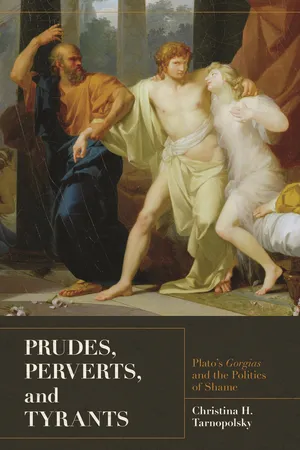
eBook - ePub
Prudes, Perverts, and Tyrants
Plato's Gorgias and the Politics of Shame
- 240 pages
- English
- ePUB (mobile friendly)
- Available on iOS & Android
eBook - ePub
About this book
Information
Publisher
Princeton University PressYear
2010Print ISBN
9780691163420
9780691128566
eBook ISBN
9781400835065
Topic
PhilosophySubtopic
Ancient & Classical PhilosophyPART ONE
Plato’s Gorgias and the Athenian Politics of Shame
Chapter One
SHAME AND RHETORIC IN PLATO’S GORGIAS
PLATO’S GORGIAS has long been recognized as the most political of all of his dialogues prior to the Republic because it contains an explicit discussion of a number of Athenian democratic practices and leaders, and because each of the characters in the dialogue highlights the importance of rhetoric, either by professing to teach it or by wishing to learn it so as to advance his career.1 In the dialogue Socrates speaks with one of the most renowned practitioners and teachers of rhetoric in the late fifth century BC, Gorgias of Sicily, then with Gorgias’ Sicilian student Polus, and finally with the potential Athenian statesman Callicles.2 Socrates’ faithful companion and supporter of the Athenian democracy, Chaerophon, completes the cast of five characters.3 He briefly enters the dialogue to begin questioning Gorgias about rhetoric (Gorg. 447d–448c), but his characteristic ineptitude prompts Socrates to take over as the principal interlocutor for the rest of the dialogue. It is also important to note that the dialogue takes place in front of the audience who had initially come to hear Gorgias’ display (epideixis) speech.4 This audience intervenes in the dialogue with a roar of approval (thorubos) in order to get Gorgias to continue speaking with Socrates about rhetoric (458c), thus mimicking the kind of up-roars that would have been heard in the mass deliberations characteristic of Athenian assembly debates and trials.5 In a certain sense, then, the dialogue actually enacts the experience of being under the eyes of one’s fellow citizens, which is so important to the phenomenon of shame, both for the Greeks and for ourselves.6 Finally, at other times in the dialogue Socrates introduces the views of the imaginary audience of democratic Athens (452a–d, 461b–c, 474c, 482d–e, 494e) to get each of his interlocutors to consider how their remarks would be viewed by this imaginary yet still forceful and collective other.
The topics touched upon in the dialogue range from the character and function of rhetoric in democratic assemblies and law courts (Gorgias section); to the differences between democratic and tyrannical rule (Polus and Callicles sections); to lengthy discussions of the democratic virtues of justice (dikaiosunē) (Polus section) and moderation (sōphrosunē) (Callicles section). More specifically, the dialogue moves from Gorgias’ initial profession of the power and moral neutrality of his rhetoric to Socrates’ criticism of one type of rhetoric as a form of flattery (kolakeia). Polus and Callicles then successively enter the discussion both explicitly espousing the life of the tyrant (turannos) as the best life to live. In each shaming refutation (elenchos) Socrates attempts to wean them from this problematic love of tyranny by showing them that their own views about the best life for human beings actually fail to conform to their image of the tyrant, and instead fit better with a number of Athenian democratic ideals and practices. During the course of the discussion, Socrates makes a number of specific remarks about, and criticisms of, the Athenian democratic practices of delivering speeches before a mass audience (455a), calling witnesses to one’s character (471e–472a), voting and electing officials by lot (473e), payment for service on juries and the council (515e), and ostracism (516d). Finally, he gives a lengthy critique of the careers of the famed Athenian political figures Pericles, Themistocles, Cimon, and Miltiades (515d–519b), many of whom were responsible for expanding the Athenian democracy and building the Athenian empire that eventually led to Athens’ war with Sparta (the Peloponnesian War).7
The importance of all of these political themes is further supported by the dramatic date of the dialogue. Although this date is difficult to fix conclusively, certain indications or allusions in the dialogue suggest a range of dates between 429 and 404 BC.8 The recent death of Pericles (in 429 BC) is mentioned at 503c; Gorgias’ first attested visit to Athens was 427 BC; Socrates makes a prediction about Alcibiades at 519a–b which would be most appropriate for 415 BC; Archelaus (a Macedonian tyrant who came to power in 413 BC) is said to have come to power “just yesterday or the day before” at 470d; Euripides’ play Antiope (which was probably produced around 408 BC and which contained a well-known comparison between the active and the contemplative life), is mentioned at 485e and 506b; and, finally, Socrates’ behavior at the trial of the generals at Arginusae (in 405 BC) is mentioned as happening “last year” at 473e.
During the time period in which Plato sets the dialogue Athens experienced a dangerous vacuum in political leadership. Pericles had recently died from the plague that had devastated Athens in 429 BC and Athens was still engaged in a lengthy and costly war with Sparta. Wealthy elites like Cleon and Alcibiades, exposed to the education offered by both Gorgias and Socrates, competed to become leaders of Athens by utilizing different rhetorical strategies in various assembly debates that followed Pericles’ death.9 Cleon based his career on maintaining the support of the masses, and was mocked in Aristophanes’ Knights for being a lover of Demos.10 In contrast to this, Alcibiades openly flaunted his wealth and ancestry and was successful at both winning over the votes of many Athenians and also of plotting and successfully launching an oligarchic coup in 411 BC.11 In the Gorgias, Plato masterfully weaves together both of these aristocratic tendencies in his fictional character Callicles.12 Callicles contains within himself the contradictory elitist impulses of both Cleon and Alcibiades, at one point telling Socrates that one must trample on the laws of the many (484a), and yet at other points telling Socrates that one must learn the ways and customs of the many and even flatter them to preserve oneself in a democracy like Athens (484d, 521a).13
All of these historical allusions point to the central themes of the dialogue: what kinds of rhetoric (rhētorikē), teachers of rhetoric, and political rhētores (speakers) does a democracy in Athens’ situation require?14 What life is the best for human beings: action or contemplation; and what kind of political life is best for the great individual: tyranny or democratic rule? What kind of democracy should Athens aspire to: the imperial one that led to the Peloponnesian War or the more moderate one of the recent past?15
Moreover, these issues facing Plato and his fellow Athenians should not be seen as obscure or obsolete problems obsessing a bunch of weird men in togas. The rhetoricians in democratic Athens played many of the same roles now played by our “spin doctors,” campaign managers, institutions of higher education, informed and educated citizens, and even political leaders. So if it is true that today “politicians are taunted by their opponents and exhorted by political commentators to cut out the rhetoric and tell us what they would really do to deal with our problems,” the same was no less true of democratic Athens.16 The orator who displayed too much skill or specialized knowledge left himself open to the charge of elitism or of trying to deceive his audience.17 In order to avoid this charge a number of orators developed the “my opponent is a skilled speaker but I am just like you” strategy and put it to use 2400 years before both George W. Bush and John McCain used it in their debates against Senator Kerry and Senator Obama in the 2004 and 2008 presidential debates.18 Finally, if the Athenians felt a dangerous vacuum in their leadership, a need to rethink their imperialistic and economic policies and the ways in which citizens and leaders collectively decided upon the fate of their city, it is safe to say that most modern democratic polities are now finding themselves in a very similar situation.
In response to such problems, Plato’s Gorgias examines the different types of rhetoric and the different ways in which many emotions, but especially the emotion of shame (aischunē), can facilitate or endanger the kinds of collective deliberations necessary to cope with these sorts of problems. There are, however, two prominent interpretations of the political character of the Gorgias that pose a significant threat to my own project of utilizing it to understand the pernicious and salutary roles of shame in contemporary democratic theory and practice. First, because it contains Plato’s most direct criticisms of democratic Athens (472a–c, 515e–519d), the Gorgias has been interpreted as Plato’s own “Apology” in which he sets out his reasons for forgoing a career in Athenian democratic politics in favor of opening his Academy.19 Second, it is often considered to be the dialogue that inaugurates the problematic binaries between rhetoric and philosophy, emotion and reason, and persuasion and argumentation, which have plagued Western philosophy and political theory ever since the fateful encounter between Socrates and the two rhetoricians Gorgias and Polus that opens the dialogue.20 In fact, the history of rhetoric has even been characterized as a response to Plato’s attack upon it in the Gorgias.21 In chapter 3, I will show precisely why Plato’s criticisms of democratic Athens do not make his teaching in the Gorgias inherently anti-democratic or irrelevant for contemporary democratic theory and practice; however, in this chapter I want to deal with the second interpretation: Plato’s alleged attack on all forms of emotion, rhetoric, and persuasion.
Such an interpretation obviously poses a significant threat to my own project of utilizing Plato’s teaching about the nature of shame (aischunē) to help us think about the salutary and pernicious roles it can play in contemporary democratic politics. Even more importantly, I think elements of this position continue to linger in certain contemporary theories about the emotions generally, and shame in particular. (I address this problem extensively in chapter 6.) Instead of targeting all emotions as irrational, it has been very tempting to target shame and other emotions, like disgust, jealousy, or humiliation, as either inherently irrational, unreasonable, or anti-democratic.22 According to such an interpretation, shame is pernicious for politics because it is an emotion that the rhetorician cleverly uses to stigmatize, silence, or exclude certain parties from the debate, or to get other parties to make insincere assertions that mask their real thoughts or preferences. By producing either silence or insincerity, the rhetorician’s use of shame actually forecloses any kind of real deliberation.
While it is certainly true that this is part of what Plato wants to show us about a certain form of shame and a certain kind of rhetoric in the Gorgias, this is by no means the whole teaching on shame or rhetoric in this dialogue. In this chapter, I will show that these misinterpretations, or, more accurately, partial interpretations of shame and rhetoric arise out of an inadequate understanding of the full drama of the dialogue and a misunderstanding of the centrality of shame to all of the different forms of rhetoric that are examined or exemplified in the dialogue, including the rhetoric of both Socrates and Plato.23 In fact, only when the dramatic context is understood in all of its complexity can the centrality of shame (aischunē) to the other two themes of the dialogue—the character of rhetoric (rhētorikē) and the best way of life for human beings (eudaimonia)—be fully appreciated.24 Far from banishing all rhetoric from the best type of polis or confining philosophers to the Academy, Plato is concerned to distinguish his noble (kalon) and true (alēthes) brand of rhetoric from the rhetoric involved in fl...
Table of contents
- Cover Page
- Title Page
- Copyright Page
- Dedication Page
- Contents
- List of Tables
- Acknowledgments
- Introduction
- Part One: Plato’s Gorgias and the Athenian Politics of Shame
- Part Two: Plato’s Gorgias and the Contemporary Politics of Shame
- Bibliography
- Index
Trusted by 375,005 students
Access to over 1.5 million titles for a fair monthly price.
Study more efficiently using our study tools.
Frequently asked questions
Yes, you can cancel anytime from the Subscription tab in your account settings on the Perlego website. Your subscription will stay active until the end of your current billing period. Learn how to cancel your subscription
No, books cannot be downloaded as external files, such as PDFs, for use outside of Perlego. However, you can download books within the Perlego app for offline reading on mobile or tablet. Learn how to download books offline
Perlego offers two plans: Essential and Complete
- Essential is ideal for learners and professionals who enjoy exploring a wide range of subjects. Access the Essential Library with 800,000+ trusted titles and best-sellers across business, personal growth, and the humanities. Includes unlimited reading time and Standard Read Aloud voice.
- Complete: Perfect for advanced learners and researchers needing full, unrestricted access. Unlock 1.5M+ books across hundreds of subjects, including academic and specialized titles. The Complete Plan also includes advanced features like Premium Read Aloud and Research Assistant.
We are an online textbook subscription service, where you can get access to an entire online library for less than the price of a single book per month. With over 1.5 million books across 990+ topics, we’ve got you covered! Learn about our mission
Look out for the read-aloud symbol on your next book to see if you can listen to it. The read-aloud tool reads text aloud for you, highlighting the text as it is being read. You can pause it, speed it up and slow it down. Learn more about Read Aloud
Yes! You can use the Perlego app on both iOS and Android devices to read anytime, anywhere — even offline. Perfect for commutes or when you’re on the go.
Please note we cannot support devices running on iOS 13 and Android 7 or earlier. Learn more about using the app
Please note we cannot support devices running on iOS 13 and Android 7 or earlier. Learn more about using the app
Yes, you can access Prudes, Perverts, and Tyrants by Christina H. Tarnopolsky in PDF and/or ePUB format, as well as other popular books in Philosophy & Ancient & Classical Philosophy. We have over 1.5 million books available in our catalogue for you to explore.