How happiness became mandatory—and why we should reject the demand to "be happy"
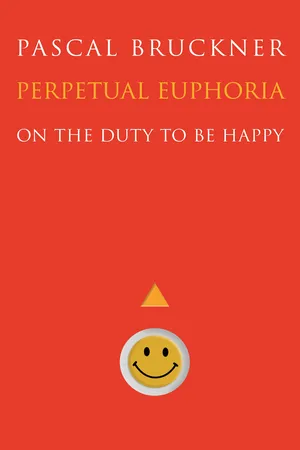
Happiness today is not just a possibility or an option but a requirement and a duty. To fail to be happy is to fail utterly. Happiness has become a religion—one whose smiley-faced god looks down in rebuke upon everyone who hasn't yet attained the blessed state of perpetual euphoria. How has a liberating principle of the Enlightenment—the right to pursue happiness—become the unavoidable and burdensome responsibility to be happy? How did we become unhappy about not being happy—and what might we do to escape this predicament? In Perpetual Euphoria, Pascal Bruckner takes up these questions with all his unconventional wit, force, and brilliance, arguing that we might be happier if we simply abandoned our mad pursuit of happiness.
Gripped by the twin illusions that we are responsible for being happy or unhappy and that happiness can be produced by effort, many of us are now martyring ourselves—sacrificing our time, fortunes, health, and peace of mind—in the hope of entering an earthly paradise. Much better, Bruckner argues, would be to accept that happiness is an unbidden and fragile gift that arrives only by grace and luck.
A stimulating and entertaining meditation on the unhappiness at the heart of the modern cult of happiness, Perpetual Euphoria is a book for everyone who has ever bristled at the command to "be happy."
- 256 pages
- English
- ePUB (mobile friendly)
- Available on iOS & Android
eBook - ePub
About this book
Information
Publisher
Princeton University PressYear
2011Print ISBN
9780691204031
9780691143736
eBook ISBN
9781400835973
PART I
Paradise Is Where I Am

CHAPTER ONE
Life as a Dream and a Lie
This world is only a bridge. Cross it,
but don’t build your house on it.
but don’t build your house on it.
–Henn. Apocrypha, 35
Blessed are those who mourn,
for they shall be comforted.
for they shall be comforted.
–Beatitudes (Matthew 5:4)
“A Christian Is a Man of the Other World” (Bossuet)
In sixteenth-century France and Italy, there were collective autos-da-fé or “bonfires of the vanities,” in which, as a sign of their renunciation of the trifles of the world, men and women threw into the flames playing cards, books, jewels, wigs, and perfumes.1 During this period at the end of the Middle Ages, which was tormented by a strong passion for life, doubt was not permitted: full satisfaction was to be had only in God, and everything outside God was mere trickery and dissimulation. Thus it was necessary constantly to remind mortals of the insignificance of human pleasures in comparison with those awaiting them in Paradise.
Contrary to Saint-Just’s famous aphorism, happiness has never been a new idea in Europe, and from the outset Christianity, loyal to its Greek heritage, recognized the aspiration to happiness. But it put happiness beyond man’s reach, in Eden or in heaven (the eighteenth century limited itself to bringing it into the secular world). We all recall having been happy before the Fall, St. Augustine said; and there is no happiness except in reminiscence, since in the depths of memory it is the living spring of God that we rediscover. Writing about our futile means of gaining access to the supreme good, Pascal wrote: “What is it that arouses in us this avidity and impotence if it is not that there was once in man a genuine happiness of which only the mark and the empty trace now remain to us?”
This Christian temporal trinity was later adopted by both religious and agnostic authors: happiness existed yesterday or will exist tomorrow, in nostalgia or in hope, but it never exists today. Although it is legitimate to tend toward that condition, it would be madness to try to accomplish it in this world. As a fallen creature, man must first redeem the sin of existing, he must work on his salvation. And salvation is all the more anguishing because it is gained or lost once and for all, as Georges Dumézil pointed out: for the Christian, there are no second chances, in contrast to Hindus and Buddhists, who are caught up in the cycle of reincarnations until they finally gain deliverance. It is during my brief residence on Earth that my eternal fate is decided, and this perspective gives the temporal accident I represent the appearance of a genuine challenge. It is typical of Christianity to have overdramatized our existence by subjecting it to the alternative between hell and paradise. The life of the believer is a trial that takes place entirely before the divine Judge. “All the evil done by the wicked is recorded, and they do not know it,” says the psalmist. Our sins and our merits are inscribed one by one in the great account book, with a credit or a debit balance. Even if sinners, unfaithful women and corrupt men, “take cover in all the darkness of the night, they shall be discovered and judged” (Bossuet). A terrible disproportion: a tiny human error can lead to eternal punishment, but inversely, all our sufferings can find their reward in the beyond if we have led lives pleasing to God. Pass or fail: paradise is structured like a school.
The itinerary of salvation, although it postulates a relative freedom for the believer, who can perfect himself or succumb to worldly passions, is far from straight. It moves in a world of chiaroscuro, and the sincerest of the faithful see their faith as a pilgrimage into a labyrinth. Because He is both very close and infinitely distant, the path to God is full of ambushes and pitfalls. “God is properly known only when he is known as an unknown,” said St. Thomas. Thus we have to sojourn in this world in accord with the laws of another, and the world that dazzles us with its countless enchantments is both the enemy and the ally of salvation. That is why although this life cannot usurp the dignity that belongs to God alone, it nonetheless has a sacred character; we have to pass through it because it is the first step toward eternal life. For a Christian, time is not a guarantee of the beyond but a tension filled with fears, doubts, and heartbreaks. The hope of redemption is thus inseparable from a fundamental worry. “We understand nothing of God’s works if we do not take as our principle that he wanted to blind some and enlighten others…. There is always enough darkness to blind the outcast and enough light to condemn them and make them inexcusable” (Pascal). And when Luther substitutes salvation through works for salvation through faith–God alone makes the sovereign decision whether we will be saved or damned, whatever we do or wish–he maintains a certain degree of uncertainty in the elect. The latter are never sure that they have been chosen, even if they show their fervor through pious acts. Whatever the sinner’s behavior, he can never redeem his debt to God; he can only count on God’s infinite mercy. In other words, salvation is a narrow gate whereas the way that leads to perdition is “wide and easy”2(Matthew 7:13).
Given this terrible requirement of either gaining eternity or sinking into sin, what importance can the little happinesses of life have? None! They are not only ephemeral and deceptive–“The world, poor in results, is always magnificent in promises” (Bossuet)–but also draw us away from the true path, throw us into a lamentable enslavement to earthly goods. “All opulence that does not come from my God is poverty to me,” St. Augustine splendidly wrote. A double anathema is cast upon pleasures: they are ridiculous in comparison to the beatitude that awaits us in heaven and are mere reflections of a permanence and solidity that belong to the divine order alone. They represent the bad infinity of concupiscence, which is an inverted image of celestial bliss. In this case, mortals’ error is to take nonbeing for being. Worldly joys are pulverized in the terrible perspective of death, whose shadow, Bossuet tells us, “darkens everything.”3 It is death that makes health a mere reprieve, glory a chimera, pleasures an infamy, and life a dream combined with a lie. Death does not come from afar but is right next to us, it insinuates itself into the very air we breathe, into the food we eat, into the remedies with which we try to protect ourselves. Pascal comments: “Death, which threatens us at every moment, must before long inevitably confront us with the terrible necessity of being either annihilated or unhappy.” To disqualify all of our existence in light of the tomb is to emphasize that from the day of our birth we are plunged into a torpor to which our death agony puts an end. Life is a slumber from which we must awaken: this metaphor, borrowed from Antiquity and omnipresent in Christian thought, makes death a fatal moment in every sense of the term. There are, in a sense, three deaths: physical death; death in life for those who live in a state of sin, that is, in disunion with God, in spiritual mourning (in some Breton churches hell is represented as a cold, icy place of separation); and finally, for the righteous, death as liberation and transition. In the latter case, death is not an abyss but a gateway leading to the Kingdom of God, and it makes the soul “capable of enjoying an infinity of satisfactions not to be found in this life.”4 It is absurd to fear annihilation because by freeing us from the body and its turmoil, death constitutes the beginning of an unprecedented adventure, that of the Last Judgment and eternal Resurrection.
This, then, is the Christian calculus: it opposes to the very natural fear of suffering and death the still greater fear of perdition. And it promises that the wretched of this world will be rewarded in the next, the only way to put an end to the scandal of the prosperity of the wicked and the misery of the righteous. It urges us to put our faith in an immaterial good or evil–paradise or hell–so as to throw a chaste veil over the very real ordeals we face today. To renounce the false prestige of this world is to have a right to an enormous reward in heaven. This is a subtle calculus that clothes resignation in a luminous garment: since “no one can serve two masters … God and Mammon” (Matthew 6:24), I abandon concrete, immediate joys for a hypothetical future pleasure. Why should we cling to a few instants of joy on Earth at the risk of frying forever in Satan’s realm? The major crime, on which all churchmen insist, is not being tempted by earthly fruits but being attached to them, being so enslaved to them that we forget the fundamental bond with God. If we don’t want to fail this test, it is “the matter of eternity to which all our efforts must be directed” (Bossuet), because “the only good thing in this life is the hope of another” (Pascal). In any case, the pathos of salvation must win out over the desire for happiness.
Fortunately, this process has not always been put under the sign of an inflexible “either/or.” It is the function of the sacraments, and in particular that of penitence, to relieve the man of faith from a terrible tension and allow him to alternate sin with repentance and absolution in an oscillation that scandalized Calvin and Freud as well.5 Above all, in the eleventh century the Catholic Church had the brilliant idea of inventing, under popular pressure and in response to millenarianism, the notion of purgatory, an enormous waiting room, a third position located between heaven and hell that allowed those whose lives had been mediocre, neither completely good nor completely bad, to erase their debt to God. This posthumous make-up class also gave the living a way of acting on the dead and communicating with them through their prayers. Purgatory not only alleviated the Church’s terrible blackmail of the faithful that consisted in subjecting them to a choice between freedom and damnation (we have to remember that hell, in its terrifying, incandescent version, was an invention of the Renaissance and not the Middle Ages6). It also set up a whole system for “mitigating punishment,”7 thus introducing into religion the notion of negotiation, which led to all the excesses we know about and provoked the ire of reformers scandalized to see Rome selling indulgences, that is, to see a human institution issuing drafts on eternity and thus, as it were, forcing God’s hand.8 Thanks to purgatory, life on Earth becomes sweeter, more lovable. The idea of the irreversible fades; a sin limited in time ceases to entail an infinite loss. By changing the “geography of the beyond,” purgatory leaves a door open on the future and avoids discouragement, it “cools down” human history. As a result of this tranquilizing psychology, the sinner no longer feels hellfire licking at his heels as soon as he does something that is forbidden. Expiation remains possible, and salvation loses the inhumanity given it by dogma. The Reformation itself, despite its doctrinal intransigence, had the paradoxical effect of rehabilitating life on Earth by its effort to incarnate the values of the other world in the here and now. Luther demanded that people foreswear idleness and act in order to please God, arguing that “a good, righteous man does good works”9 and thus confirms his chances of being saved.
In the same way, in the seventeenth century there developed an accommodating Christianity that did not want to choose heaven over Earth, but rather to couple the two. Far from being incompatible, one follows the other, and Malebranche, rejecting the terms of Pascal’s wager, showed that happiness was an ascent from worldly pleasures to celestial joys, in which the soul moves steadily toward final illumination. Whereas others emphasized a rupture, he reestablished a continuity and in a very modern view of religion described man as driven by the same impulse toward eternity and the quest for temporal goods. Now nature and grace collaborate harmoniously in shaping human destinies: a Christian can be a gentleman, combining politeness with piety,”10 and busy himself with everyday tasks without losing sight of the perspective of redemption. Immortality is democratized; it becomes accessible to the multitude. Thus Christianity remains the doctrine of a relative and reasoned devaluation of the world: by considering this life as the site of perdition and salvation, it makes it both an obstacle to and a condition for deliverance and thereby raises it to the status of the sovereign good; it frees us from the body but restores the latter’s rights through the doctrine of incarnation. In short, it affirms human autonomy even as it subordinates it to divine transcendence. In both cases, it asks the believer, who is caught between “the perils of enjoyment” and the rejection of “the enchanting and dangerous sweetness of life” (St. Augustine), to accept the world of the senses without idolizing it, without raising mundane things to the rank of absolutes.
On the Formula “How’s It Going?”
“How’s it going?” People have not always greeted each other in this way: they invoked divine protection for themselves, and they did not bow before a commoner the way they bowed before a nobleman. In order for the formula “How’s it going?” to appear, we had to leave the feudal world and enter the democratic era, which presupposes a minimal degree of equality between individuals, subject to oscillations in their moods. According to one legend, the French expression “ça va?” is of medical origin: how do you defecate? A vestige of a time when intestinal regularity was seen as a sign of good health.
This lapidary, standardized formality corresponds to the principle of economy and constitutes the minimal social bond in a mass society that seeks to include people from all over. But it is sometimes less a routine than a way of intimating something: we want to force the person met to situate himself, we want to petrify him, subject him to a detailed examination. What are you up to? What’s happened to you? A discreet summons that commands everyone to expose himself for what he really is. In a world that makes movement a canonical value, there is an interest in how things are going, even if we don’t know where. That’s why a “how’s it going?” that expects no answer is more human than one that is full of concern but wants to strip you bare and force you to give a moral accounting for yourself. This is because the fact of being is no longer taken for granted, and we have to pay permanent attention to our internal barometers. Are things going as well as I say, or am I embellishing them? That is why many people evade the question and move to another topic, assuming that the interlocutor is perceptive enough to discern in their “fine” a discreet depression. Then there is this terrible expression of renunciation: “Okay, I guess,” as if one had to let the days and hours pass without taking part in them. But why, after all, do things have to be going well? Asked daily to justify ourselves, it often happens that we are so opaque to ourselves that the answer no longer has any meaning other than as a formality.
“You’re looking good today.” Flowing over us like honey, this compliment has the effect of a kind of consecration: in the confr...
Table of contents
- Cover
- Title Page
- Copyright
- Dedication
- Contents
- Introduction - Invisible Penitence
- Part I - Paradise Is Where I Am
- Part II - The Kingdom of the Lukewarm, or the Invention of Banality
- Part III - The Bourgeoisie, or the Abjection of Well-Being
- Part IV - Unhappiness Outlawed?
- Conclusion - Madame Verdurin’s Croissant
- Index
Trusted by 375,005 students
Access to over 1.5 million titles for a fair monthly price.
Study more efficiently using our study tools.
Frequently asked questions
Yes, you can cancel anytime from the Subscription tab in your account settings on the Perlego website. Your subscription will stay active until the end of your current billing period. Learn how to cancel your subscription
No, books cannot be downloaded as external files, such as PDFs, for use outside of Perlego. However, you can download books within the Perlego app for offline reading on mobile or tablet. Learn how to download books offline
Perlego offers two plans: Essential and Complete
- Essential is ideal for learners and professionals who enjoy exploring a wide range of subjects. Access the Essential Library with 800,000+ trusted titles and best-sellers across business, personal growth, and the humanities. Includes unlimited reading time and Standard Read Aloud voice.
- Complete: Perfect for advanced learners and researchers needing full, unrestricted access. Unlock 1.5M+ books across hundreds of subjects, including academic and specialized titles. The Complete Plan also includes advanced features like Premium Read Aloud and Research Assistant.
We are an online textbook subscription service, where you can get access to an entire online library for less than the price of a single book per month. With over 1.5 million books across 990+ topics, we’ve got you covered! Learn about our mission
Look out for the read-aloud symbol on your next book to see if you can listen to it. The read-aloud tool reads text aloud for you, highlighting the text as it is being read. You can pause it, speed it up and slow it down. Learn more about Read Aloud
Yes! You can use the Perlego app on both iOS and Android devices to read anytime, anywhere — even offline. Perfect for commutes or when you’re on the go.
Please note we cannot support devices running on iOS 13 and Android 7 or earlier. Learn more about using the app
Please note we cannot support devices running on iOS 13 and Android 7 or earlier. Learn more about using the app
Yes, you can access Perpetual Euphoria by Pascal Bruckner, Steven Rendall in PDF and/or ePUB format, as well as other popular books in Politics & International Relations & Political Philosophy. We have over 1.5 million books available in our catalogue for you to explore.