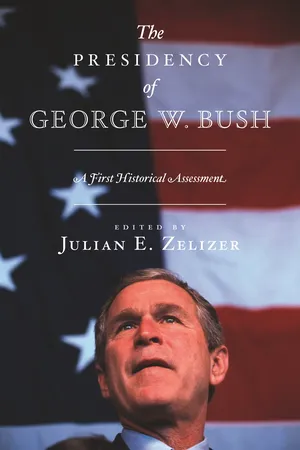
An in-depth look at Bush's presidency by some of America's top historians
The Presidency of George W. Bush brings together some of today's top American historians to offer the first in-depth look at one of the most controversial U.S. presidencies. Emotions surrounding the Bush presidency continue to run high—conservatives steadfastly defend its achievements, liberals call it a disgrace. This book examines the successes as well as the failures, covering every major aspect of Bush's two terms in office. It puts issues in broad historical context to reveal the forces that shaped and constrained Bush's presidency—and the ways his presidency reshaped the nation.
The Presidency of George W. Bush features contributions by Mary L. Dudziak, Gary Gerstle, David Greenberg, Meg Jacobs, Michael Kazin, Kevin M. Kruse, Nelson Lichtenstein, Fredrik Logevall, Timothy Naftali, James T. Patterson, and the book's editor, Julian E. Zelizer. Each chapter tackles some important aspect of Bush's administration—such as presidential power, law, the war on terror, the Iraq invasion, economic policy, and religion—and helps readers understand why Bush made the decisions he did. Taking readers behind the headlines of momentous events, the contributors show how the quandaries of the Bush presidency were essentially those of conservatism itself, which was confronted by the hard realities of governance. They demonstrate how in fact Bush frequently disappointed the Right, and how Barack Obama's 2008 election victory cast the very tenets of conservatism in doubt.
History will be the ultimate judge of Bush's legacy, and the assessment begins with this book.
- 408 pages
- English
- ePUB (mobile friendly)
- Available on iOS & Android
eBook - ePub
About this book
Information
Publisher
Princeton University PressYear
2010Print ISBN
9780691149011
9780691134857
eBook ISBN
9781400836307
Topic
StoriaSubtopic
Storia nordamericana1
ESTABLISHMENT CONSERVATIVE
The Presidency of George W. Bush
FOLLOWING THE TRAGIC EVENTS OF 9/11, WHEN AL QAEDA TERrorists crashed three airplanes into the World Trade Center and the Pentagon, Americans turned their frightened eyes toward George W. Bush to see just what kind of president he would be.
Most people weren’t sure what they would find. The new president was still hard to define. His campaign in 2000 had sent mixed signals on a variety of issues. Bush, the son of former president George H. W. Bush (1989–93), had run as a “compassionate conservative” who understood that in certain areas the federal government was necessary. He assured supporters he would use the power of the federal government to ameliorate problems such as inadequate primary education programs. “Big government is not the answer,” Bush told Republicans at his acceptance speech at the Philadelphia convention. “But the alternative to bureaucracy is not indifference. It is to put conservative values and conservative ideas into the thick of the fight for justice and opportunity.”
At the same time, Bush remained loyal to the Reagan Revolution by assuring voters he would pursue tax cuts, deregulation, and reduced spending. He was determined to avoid the fate of his father, who had accepted a tax increase in 1990, contradicting his famous campaign pledge, “Read my lips: no new taxes,” and had thus alienated conservatives from his administration. On foreign policy, Bush criticized President Bill Clinton and his opponent, Vice President Al Gore Jr., for having deployed troops on international peacekeeping missions that were not vital to the national interest. Yet at the same time, Bush called for a tougher posture against rogue states such as Iraq and North Korea and supported increased funding for the Pentagon.
Further complicating Bush’s presidency was the fact that he had been elected in an extraordinarily close and contested election. Problems with the ballots in Florida had resulted in a recount, court battles, and a controversial Supreme Court decision in December in Bush v. Gore that was needed to cement his victory. As a result, some Americans did not accept his presidency as legitimate, feeling that the election had literally been stolen from Gore. Many others who accepted the outcome of the judicial process, including some Republicans, remained skeptical that Bush had the skills and gravitas to succeed.
In his first few months in the White House, Bush did not fully reveal what his agenda would be. In some cases he appeared to be exactly the conservative that the right wing had hoped for. The president started his term with an executive order that weakened clean water standards. He then pushed a regressive tax cut through Congress by employing a highly partisan strategy. Pleasing the right wing of the GOP, Bush announced in August that he was sharply curtailing embryonic stem-cell research. But the administration was not entirely predictable. In his first year, Bush worked with Senate Democrats to enact the No Child Left Behind law, legislation that extended the role of the federal government in education. Bush also made a number of high-level cabinet appointments of African Americans and Latino Americans, moves that Gary Gerstle in chapter eleven demonstrates reflected a genuine commitment to pursue ethnic and racial diversity.
Nor was there a clear trajectory on foreign policy before 9/11. The administration had rejected multilateralism when it aggressively pushed to reinvigorate the missile shield program and withdrew from several international agreements. Bush talked tough against the Chinese government but walked away from a military confrontation after the Chinese captured a downed U.S. spy plane and the pilots on board.
While questions about Bush’s core agenda lingered throughout his eight years in the White House, what did become clear, to the surprise of many of his opponents, was that the administration developed four relatively coherent objectives, some of which they arrived in Washington ready to pursue and others that evolved only after they had control of the White House and lived through the crisis of 9/11, in an effort to bring to fruition the battles conservatives had been waging since the 1940s.
The administration’s first objective was to craft federal policies that facilitated the economic and demographic shift that had been taking place since the 1970s, with the transfer of economic and political power to the service-, high-tech-, and oil-based economic sectors of the Sun Belt. The shift in power had been occurring over several decades as the South and Southwest experienced sizable increases in population and surging economic growth. Southern states, boasting of their nonunionized workforces and low tax rates, had worked hard to entice businesses through tax incentives and direct economic subsidies. Workers moving to this region left behind stagnant economies in the Northeast and Midwest. Retirees moved to these low-tax states because air conditioning made living conditions more tolerable.1
As Nelson Lichtenstein and Meg Jacobs show in their respective chapters, Bush’s election had depended on the growing influence of these states, as they were populated by voters who formed the electoral base of the modern Republican Party and were key to his electoral success. A number of Bush’s domestic policies would benefit the economic interests of these states. According to Lichtenstein, for instance, the Department of Labor agreed to a request from Wal-Mart to provide fifteen days’ advance notice before it would investigate allegations of child labor standards violations. With Republican control of the White House and Congress after the 2002 midterm elections, the president had the political muscle he needed to pursue policies that were beneficial to the nonunionized, low-wage, low-priced Wal-Mart economy.
The second, related objective of the Bush presidency was to accelerate progress on the twin policy goals of deregulating industry and instating tax reductions that had been central to the conservative agenda to weaken the capacity of the federal government and unleash market activity. The administration relied on executive authority to relax workplace as well as environmental regulations. The impact of the supply-side economics revolution of the 1980s on the administration’s agenda was quite powerful, James T. Patterson argues in chapter six. By constraining the role of the government in the workplace and lowering the tax burden for upper-middle-class and higher Americans, Bush sought to weaken the fiscal standing of the Treasury and to roll back those areas of government that were most vulnerable politically. He also wanted to distribute government benefits, through tax cuts, to wealthy Americans, who constituted a core component of the Republican coalition. Bush also continued the practice, used by Republican presidents Richard Nixon and then Ronald Reagan, of filling important bureaucratic positions with politically motivated administrators who were unsympathetic to the programs they managed.
The third objective was to aggressively pursue the use of executive-centered national security programs that conservatives had championed since Vietnam. Republicans had pushed for expansive intelligence investigations at home and unilateral, targeted military operations abroad that flexed America’s military muscle without overcommitting U.S. forces. Though this was all on their agenda upon winning office, the attacks of September 11, 2001, dramatically intensified their drive to see these policies enacted into law and caused the president to expand his reach into areas such as nation building with the war in Iraq. They undertook a radical expansion of interrogation techniques, including the use of torture, that broke with national precedent and circumvented international accords on the treatment of detainees. Timothy Naftali in chapter four and Fredrik Logevall in chapter five recount the broader strategic shift that took place during this presidency through the response to the events of 9/11.
Like Reagan and his father before him, however, Bush learned he was still operating in the shadow of Vietnam. Americans were unwilling to tolerate high numbers of casualties, would not accept the restoration of the draft, and were leery of the government’s violating civil liberties in pursuit of enemies. But within that framework, as a result of 9/11, George W. Bush pushed for more expansive national security operations than his Republican predecessors had in the 1980s and 1990s.
The final objective was the boldest of all: to construct a governing Republican coalition that was comparable in strength to what Democrats had achieved after 1932. Bush’s strategy for achieving this coalition, however, moved in contradictory directions. The contributors to this book reveal a tension at the heart of this coalition-building operation. One the one hand, following the Republican Party’s failure to build a broad coalition in the 2000 election, there were numerous moments when the administration focused on building a coalition of the willing by ignoring moderates and focusing on policies that, as political scientists Jacob Hacker and Paul Pierson said, were “off-center.”2 The goal was to remake politics by governing with slim majorities and energizing activists on the right of the political spectrum, who voted at higher rates than the rest of the population, through symbolic issues such as attacks on liberal institutions and cultural values. In the short term, winning over moderates or Democrats was not the most efficient way to go, according to this strategy. By winning with slim margins in congressional and presidential elections, Republicans could maintain control and have the strength in numbers to remake government.3
On the other hand, there is substantial evidence that at other moments the administration did seek a more traditional “big tent” approach, as Bush’s team had originally sought in the 2000 campaign. Most important, following the traumatic events of 9/11, what came to be called the war on terrorism had the potential to bring sizable segments of the population, including some Democrats, into the Republican fold. Bush also pushed for domestic programs that benefited broad portions of the population, not just the base, including the No Child Left Behind provisions and Medicare prescription drug benefits, the largest expansion of Medicare since its creation in 1965 (to this list should be added his failed attempt to liberalize immigration laws). A potential Republican coalition, according to Bush’s political guru Karl Rove, would be rooted in noncoastal states while securing the Republican base to include voting blocs traditionally thought Democratic, from working-class white voters in the industrial sectors of the Midwest (who had already been tempted by Reagan’s GOP in the 1980s) to new immigrants in the Southwest, such as Hispanics. After the narrow 2000 election victory, Rove said, “I look at this time as 1896, the time where we saw the rise of William McKinley and his vice president, Teddy Roosevelt. . . . That was the last time we had a shift in political paradigm.” Gary Gerstle, Kevin M. Kruse, and Michael Kazin in their chapters all explore the ambitions and frustrations involved in these efforts to capitalize on a divided, red/blue America.
In pursuing all four objectives, the exercise of presidential power became one of the defining characteristics of Bush’s administration, as Mary L. Dudziak and I show in our respective chapters. The expanding authority of the executive branch was a primary objective of President Bush and Vice President Cheney since the day they took office in January 2001. While continuing the trend that had been evident since the Progressive Era, they moved more aggressively in scale and scope than any of their immediate predecessors. The Bush administration formed in direct conversation with the 1970s. This was a decade when many members of the administration came of professional age, several working in Richard Nixon’s and Gerald Ford’s White House, as they watched an assertive Congress respond to Watergate by revitalizing legislative power through the War Powers Act of 1973, the Budget Reform Act of 1974, and the creation of national surveillance regulations and the Office of the Independent Counsel in 1978. Conservatives came to see presidential power, grounded in a distinct interpretation of the law, as the best available tool for combating the liberals who dominated Congress and federal agencies. Bush would spend an enormous amount of political energy, before and after 9/11, trying to vest more power in his office. The administration constantly privileged voices from the executive branch over other realms of society, tapping into traditions such as anti-intellectualism, as David Greenberg argues in chapter nine, to discredit individuals and organizations that opposed their policies.
The contributors to this book seek to evaluate Bush’s presidency as he set out to accomplish these four objectives. To do so, they place Bush’s presidency in a broader historical context, trying to discern what he was responsible for changing and when his administration was shaped by broader historical forces that had been developing for many years.
THE BUSH PRESIDENCY AND THE HISTORY
OF CONSERVATISM
OF CONSERVATISM
Throughout the essays, the authors find that one theme shaped George W. Bush’s time in the White House. Within every policy area, Bush struggled with the central quandary of conservatism in the twenty-first century: what were the challenges conservatives faced, now that they had become the governing establishment?
The history of the Bush presidency marked the culmination of the second stage in the history of modern conservatism, a period that began in the early 1980s when conservatives switched from being an oppositional force in national politics to struggling with the challenges of governance that came from holding power.4 Between the 1940s and the 1970s, conservatives had concentrated on trying to build a political movement. Conservatism consisted of a number of different factions, none of which sat very comfortably alongside any other. The factions depended on the theme of anticommunism and other common enemies, such as the Great Society, to create some semblance of a movement. The Religious Right harnessed the energy of evangelical leaders and churchgoers around issues such as the tax treatment of private religious schools and representations of sexuality in popular culture. Business leaders fought for tax reductions and economic deregulation. Libertarians championed the virtues of individual freedom and markets over the state. Neoconservative intellectuals and policymakers warned about the unintended consequences of Great Society programs, as well as the need to take a more aggressive military stand toward international communism. A small faction of extremist organizations explicitly played off racial animosity and fears about feminism to try to persuade former working-class Democrats into the Republican camp by fomenting a backlash against the civil rights laws from the 1960s.
In the first stage of this history, conservatives focused on building organizations, nurturing activist networks, and developing a financial infrastructure capable of challenging Democrats and liberalism. Conservatives formed political action committees, volunteer operations, radio talk shows, think tanks, and direct mail networks that facilitated the transmission of ideas and electing candidates.5 They tried to create a movement, and they were successful.
The second stage in the history of conservatism started around 1980, with the election of Ronald Reagan to the presidency, and continued through 2008, when Republicans lost control of both branches of government and found themselves facing an internal crisis of leadership. During this period in the evolution of conservatism, Republicans struggled with the challenges that emanated from the process of governance.6 To be sure, conservative Republicans enjoyed a number of important victories. There was, for example, the dismantling of economic regulatory programs that had been put into place during the Progressive Era and the New Deal. President Reagan also obtained congressional support for a historic tax cut in 1981 that weakened the fiscal strength of the American government, as President George W. Bush in his turn would do in 2001. By failing to update programs such as the minimum wage law, conservatives were able to diminish the value of the benefits.7 Finally, unions, the heart of the New Deal coalition, continued to see their power decline, partially as a result of public policies unfavorable to labor.
From the moment Reagan started his presidency, conservatives also learned about the difficult compromises they would have to make because of the continued power of liberal policies, politicians, and activists in the post-1960s period. Conservatism did not remake politics but rather built its influence on top of existing structures. Conservative politicians quickly became aware of the popularity of many domestic programs that on paper...
Table of contents
- Cover
- Title
- Copyright
- Dedication
- Contents
- List of Contributors
- Acknowledgments
- Halftitle
- 1 Establishment Conservative: The Presidency of George W. Bush
- 2 How Conservatives Learned to Stop Worrying and Love Presidential Power
- 3 A Sword and a Shield: The Uses of Law in the Bush Administration
- 4 George W. Bush and the “War on Terror”
- 5 Anatomy of an Unnecessary War: The Iraq Invasion
- 6 Transformative Economic Policies: Tax Cutting, Stimuli, and Bailouts
- 7 Wreaking Havoc from Within: George W. Bush’s Energy Policy in Historical Perspective
- 8 Ideology and Interest on the Social Policy Home Front
- 9 Creating Their Own Reality: The Bush Administration and Expertise in a Polarized Age
- 10 Compassionate Conservatism: Religion in the Age of George W. Bush
- 11 Minorities, Multiculturalism, and the Presidency of George W. Bush
- 12 From Hubris to Despair: George W. Bush and the Conservative Movement
- Notes
- Index
Trusted by 375,005 students
Access to over 1.5 million titles for a fair monthly price.
Study more efficiently using our study tools.
Frequently asked questions
Yes, you can cancel anytime from the Subscription tab in your account settings on the Perlego website. Your subscription will stay active until the end of your current billing period. Learn how to cancel your subscription
No, books cannot be downloaded as external files, such as PDFs, for use outside of Perlego. However, you can download books within the Perlego app for offline reading on mobile or tablet. Learn how to download books offline
Perlego offers two plans: Essential and Complete
- Essential is ideal for learners and professionals who enjoy exploring a wide range of subjects. Access the Essential Library with 800,000+ trusted titles and best-sellers across business, personal growth, and the humanities. Includes unlimited reading time and Standard Read Aloud voice.
- Complete: Perfect for advanced learners and researchers needing full, unrestricted access. Unlock 1.5M+ books across hundreds of subjects, including academic and specialized titles. The Complete Plan also includes advanced features like Premium Read Aloud and Research Assistant.
We are an online textbook subscription service, where you can get access to an entire online library for less than the price of a single book per month. With over 1.5 million books across 990+ topics, we’ve got you covered! Learn about our mission
Look out for the read-aloud symbol on your next book to see if you can listen to it. The read-aloud tool reads text aloud for you, highlighting the text as it is being read. You can pause it, speed it up and slow it down. Learn more about Read Aloud
Yes! You can use the Perlego app on both iOS and Android devices to read anytime, anywhere — even offline. Perfect for commutes or when you’re on the go.
Please note we cannot support devices running on iOS 13 and Android 7 or earlier. Learn more about using the app
Please note we cannot support devices running on iOS 13 and Android 7 or earlier. Learn more about using the app
Yes, you can access The Presidency of George W. Bush by Julian E. Zelizer in PDF and/or ePUB format, as well as other popular books in Storia & Storia nordamericana. We have over 1.5 million books available in our catalogue for you to explore.