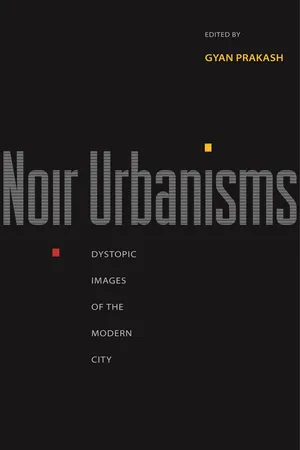
Dystopic imagery has figured prominently in modern depictions of the urban landscape. The city is often portrayed as a terrifying world of darkness, crisis, and catastrophe. Noir Urbanisms traces the history of the modern city through its critical representations in art, cinema, print journalism, literature, sociology, and architecture. It focuses on visual forms of dystopic representation--because the history of the modern city is inseparable from the production and circulation of images--and examines their strengths and limits as urban criticism.
Contributors explore dystopic images of the modern city in Germany, Mexico, Japan, India, South Africa, China, and the United States. Their topics include Weimar representations of urban dystopia in Fritz Lang's 1927 film Metropolis; 1960s modernist architecture in Mexico City; Hollywood film noir of the 1940s and 1950s; the recurring fictional destruction of Tokyo in postwar Japan's sci-fi doom culture; the urban fringe in Bombay cinema; fictional explorations of urban dystopia in postapartheid Johannesburg; and Delhi's out-of-control and media-saturated urbanism in the 1980s and 1990s. What emerges in Noir Urbanisms is the unsettling and disorienting alchemy between dark representations and the modern urban experience.
In addition to the editor, the contributors are David R. Ambaras, James Donald, Rubén Gallo, Anton Kaes, Ranjani Mazumdar, Jennifer Robinson, Mark Shiel, Ravi Sundaram, William M. Tsutsui, and Li Zhang.
- 288 pages
- English
- ePUB (mobile friendly)
- Available on iOS & Android
eBook - ePub
About this book
Information
Publisher
Princeton University PressYear
2010Print ISBN
9780691146447
9780691146430
eBook ISBN
9781400836628
The Aesthetics of the Dark City

Chapter 4

A Regional Geography of Film Noir
Urban Dystopias On- and Offscreen
Hollywood and Los Angeles after World War II
In the heyday of film noir, from the mid-1940s to the mid-1950s, the utopian aspirations that had driven the foundation and meteoric rise of the Hollywood studio system since World War I suddenly seemed fragile and liable to collapse. For the American Right, which had never much liked Hollywood on moral and political grounds, it came to appear as a Communist command post on American soil; for workers, it was a desperately insecure and often hostile place in which to try to make a living; and for the Hollywood moguls it was a dream they once had that was now threatened by industrial unrest, government regulation, and new technologies such as television.
In a lengthy and spirited defense of the Hollywood film industry from its critics published in the New York Times on April 9, 1950, Dore Schary, then head of production at MGM, contended that many Americans viewed Hollywood as a “modern Babylon,” full of “white Rolls Royces,” “blonde secretaries,” and “houses full of bear rugs littered with unclad women.”1 Americans loved Hollywood for its visions of stars on the silver screen but they understood the real place barely at all and viewed its inhabitants with mistrust.
This combination of interest and repulsion inspires attack from every angle. We are accused of being a reactionary town, interested only in a buck; of being enormously extravagant, and of being Communist-controlled. We are attacked for not using the screen to say something and we are accused of being propagandists and of filling the screen with “messages.” We are viewed as a town tortured by labor strife, and we are told that of course there is no labor problem in Hollywood because we have corrupted and suborned the labor leaders. We are called insular, cut off from and oblivious of the world, and we are regarded as a transient community which has never developed any roots.2
The apparent encircling of Hollywood by hostile voices stood in contrast to what seemed to be the continuing and unstoppable rise to greatness of Los Angeles, the city in which Hollywood was based but with which its relationship had always been ambivalent. Like Hollywood, Los Angeles emerged strongly from World War II, but unlike Hollywood, it seemed to progress onward and upward for the following twenty years as a result of prioritized investment by the federal government that had begun under the New Deal and continued with the expansion of the city’s vibrant defense, aircraft, and automobile industries, as well as its maritime trade. In 1940, Los Angeles was the fifth most populous city in the United States with 1.5 million people, behind Detroit, Philadelphia, Chicago, and New York, the latter with a population of 7.4 million.3 By 1950, Los Angeles was fourth most populous. By 1960, when the city had a population of 2.5 million, it was third, exceeded only by Chicago and New York, although physically it was much larger than both (twice the land mass of Chicago and one and a half times that of New York). And when one considered the population of Los Angeles as a sprawling five-county region, comprising Los Angeles, Riverside, Ventura, San Bernardino, and Orange counties, it had a total population of 7.75 million, putting it in competition with the Big Apple itself. For the majority white population at least, the postwar era was one of economic boom and relative political stability, characterized by Mike Davis as an “Endless Summer” in which the city consolidated its public image as a conservative, affluent, sunny, healthy, and reliable bastion of a certain kind of American comfort, increasingly enhanced by abundant domestic goods, shopping malls, freeways, television, and Disneyland.4
Interpretations of Film Noir to Date
However, film noirs from Double Indemnity (Billy Wilder, 1944), Detour (Edgar G. Ulmer, 1945), and The Big Sleep (Howard Hawks, 1946) to Criss Cross (Robert Siodmak, 1949), Kiss Me Deadly (Robert Aldrich, 1955), and Plunder Road (Hubert Cornfield, 1957) undercut the ascent of Los Angeles. In tune with the gathering crisis of the Hollywood studio system, they presented Los Angeles as a disjointed network of nondescript commercial streetscapes, pretty but morally corrupt suburbs, and an increasingly dilapidated downtown as urban jungle. These were couched in the terms of what Paul Schrader has famously called “an uneasy, exhilarating combination of realism and expressionism” in visual style and by means of stories that emphasized betrayal, mental breakdown, or inevitable doom and were frequently recounted through the use of flashbacks accompanied by introspective and maudlin voiceovers.5 This combination of distinctive approaches to mise-en-scène, filmic style, and narrative in film noir has contributed to the genre’s enduring popular appeal and to the rich critical literature that surrounds it. J. P. Telotte has interpreted film noir in terms of a crisis in the classical codes and conventions of representation and narrative favored by the Hollywood studio system.6 Frank Krutnik has related it to a crisis of patriarchal society in the United States caused by World War II, the mass mobilization for which had the effect of breaking down the traditional distinction between women as homemakers and men as breadwinners.7 And James Naremore has explained it in terms of the influence on Hollywood cinema of a variety of popular, scientific, and philosophical discourses from realist crime fiction to psychoanalysis and French existentialism.8 Studies such as these have shed important light on the genre. However, they have engaged very little with the local geography of film noirs, whether set in Los Angeles, New York, or other cities. Rather, they have tended to theorize the genre in terms of a generic American urban modernity. This is evident in the titles of many books on film noir which, notwithstanding their critical insights in other respects, tend to elevate its representation of a certain kind of urban landscape and experience to a quasi-mythical status—titles such as Voices in the Dark, In a Lonely Street, More Than Night, Somewhere in the Night, Dark City, Shades of Noir, Street with No Name, Black & White & Noir, and Noir Anxiety.9 These draw attention to the metaphoric power of “noir” and related terms such as “night” and “dark,” emphasizing foreboding, menace, and danger and, by implication, thinking about noir in terms of universal moral crisis and a generalizable visual opacity. Although many of these books acknowledge the importance of certain kinds of urban space to noir, they often do so through reference to an iconic but undifferentiated “street.”
Moral crisis, visual opacity, and the street are tremendously important to noir, and noir does offer fascinating routes into the study of modernity, film style, gender, and the politics of Hollywood cinema. However, in the existing literature there is a curious contrast between the relative lack of attention given to the specific and real cities, neighborhoods, and streets used in film noirs and what is sometimes an obsessive tendency in literature on film noir to enumerate, categorize, and classify the details of film noirs along all sorts of other lines, such as by director, by production designer, by cinematographer, by studio, by star, or by narrative structure. This tendency to generalize about the modern American city in noir seems to have at least two origins. First, the earliest theorizations of noir were presented by French critics such as Nino Frank, Raymond Borde, and Etienne Chaumeton in the late 1940s and 1950s but these critics, being at a great distance physically and culturally, were not necessarily alive to the differences between American cities.10 In Borde and Chaumeton’s now canonical Panorama du film noir (1955), little is done to speak to the specificity of American cities other than to acknowledge their modernity and toughness in general. Borde and Chaumeton refer to New York as a setting of film noir five times, to Los Angeles twice, Chicago once, and San Francisco four times—though in one of the San Francisco references they are mistaken (Somewhere in the Night is not set in San Francisco but in Los Angeles) and they never differentiate between the boroughs, districts, or neighborhoods of any given city, between the cinematic image of one city and another, or between the representation of a city from one film or film director to the next. Second, the prevalence of a generic characterization of dystopian urban modernity in film noir must surely be a function of the prominence of psychoanalytically oriented theory and criticism, which has long taken a special interest in noir because of its relatively antagonistic gender politics, because of the frequent intra-diegetic presence of psychoanalysis and psychoanalysts as a plot feature, and because of the efforts of noir filmmakers to use anti-illusionistic visual devices such as dream sequences and flashbacks to articulate neuroses and psychoses. From E. Ann Kaplan’s Women in Film Noir (1978) to Mary Ann Doane’s Femmes Fatales (1991) and Helen Hanson’s Hollywood Heroines (2008), this kind of scholarship has approached film noir as a litmus test of the gender politics of Hollywood cinema as a whole but also a genre in which, for many, female characters displayed a complexity and an autonomy often otherwise lacking in Hollywood films.11 By elaborating on distinctions between domestic and public space, the space of mise-en-scène and the interior space of the mind, and the respective spaces occupied by the viewer of a film, its characters on-screen, and the camera mediating their relationship, this work has demonstrated that cinematic space is deeply gendered.12 But, in doing so, it has inevitably paid less attention to the site-specific spatial configuration of particular cities in film noirs.
Some recent scholarship has begun to shed a more precise light on the ways in which film noir engaged with the localities of Los Angeles and their architectural and social complexities. Edward Dimendberg has sought to explore the genre in terms of a gradual prevalence of “centrifugal” (dispersing) over “centripetal” (centralizing) forces in the social and physical shaping of the mid-twentieth-century American city and its representation in film noir, although Dimendberg does not explicitly identify either tendency with one or another specific city.13 Eric Avila has interpreted the negative representation of Los Angeles in film noir as an expression of a growing distrust of urban environments by the white middle-class audiences to whom the films were primarily addressed, prompted especially by the racialization of the inner city and leading to the response known as “white flight.”14
The Prominence of Los Angeles in Film Noir
My interest in this essay, therefore, lies in going further in the directions laid out by recent work by elaborating on the geographically specific relationship between Los Angeles and film noir. I aim to do this by analyzing the particular places film noirs most frequently use as settings and what patterns (if any) are evident in the use of settings in film noirs over time. In particular, because of film noir’s special association with representations of the urban environment, I am interested in determining to what extent film noirs are set in particular named cities, which cities predominate as settings, and why. Such issues cannot be explored without considering a very large number of film noirs, across which patterns can be detected.
A filmography of all the major and minor examples of the genre, which I have compiled by surveying the most important critical literature for the purposes of this analysis, suggests that a total of 518 film noirs were produced in the United States between 1940 and 1959.15 Analysis of this filmography confirms certain facts about film noir and its geography, which have been commented on before.16 As figure 4.1 indicates, the genre peaked twice with fifty-eight films being released in 1947 and fifty-nine films in 1950. Throughout its history the settings of film noirs were predominantly American. Non-U.S. settings did feature—for example, in English gothic noirs such as Rebecca (Alfred Hitchcock, 1940) and in noirs concerning Americans abroad such as Gilda (Charles Vidor, 1946)—but such settings became slightly less prevalent in the 1950s. As figure 4.2 demonstrates, the vast majority of film noirs set in the United States featured urban settings, no doubt reflecting the significant increase in urbanization that characterized the nation during and after World War II. Having collapsed temporarily during the Depression, the average annual growth in the proportion of the total U.S. population living in cities nearly doubled from 0.7 percent in the 1930s to 1.3 percent in the 1940s and 1.7 percent in the 1950s, a rate higher than at any time since the turn of the twentieth century, while the proportion of the total population livin...
Table of contents
- Cover
- Title Page
- Copyright
- Contents
- Introduction
- Modernism and Urban Dystopia
- The Aesthetics of the Dark City
- Imaging Urban Crisis
- Contributors
- Index
Trusted by 375,005 students
Access to over 1.5 million titles for a fair monthly price.
Study more efficiently using our study tools.
Frequently asked questions
Yes, you can cancel anytime from the Subscription tab in your account settings on the Perlego website. Your subscription will stay active until the end of your current billing period. Learn how to cancel your subscription
No, books cannot be downloaded as external files, such as PDFs, for use outside of Perlego. However, you can download books within the Perlego app for offline reading on mobile or tablet. Learn how to download books offline
Perlego offers two plans: Essential and Complete
- Essential is ideal for learners and professionals who enjoy exploring a wide range of subjects. Access the Essential Library with 800,000+ trusted titles and best-sellers across business, personal growth, and the humanities. Includes unlimited reading time and Standard Read Aloud voice.
- Complete: Perfect for advanced learners and researchers needing full, unrestricted access. Unlock 1.5M+ books across hundreds of subjects, including academic and specialized titles. The Complete Plan also includes advanced features like Premium Read Aloud and Research Assistant.
We are an online textbook subscription service, where you can get access to an entire online library for less than the price of a single book per month. With over 1.5 million books across 990+ topics, we’ve got you covered! Learn about our mission
Look out for the read-aloud symbol on your next book to see if you can listen to it. The read-aloud tool reads text aloud for you, highlighting the text as it is being read. You can pause it, speed it up and slow it down. Learn more about Read Aloud
Yes! You can use the Perlego app on both iOS and Android devices to read anytime, anywhere — even offline. Perfect for commutes or when you’re on the go.
Please note we cannot support devices running on iOS 13 and Android 7 or earlier. Learn more about using the app
Please note we cannot support devices running on iOS 13 and Android 7 or earlier. Learn more about using the app
Yes, you can access Noir Urbanisms by Gyan Prakash in PDF and/or ePUB format, as well as other popular books in History & Social History. We have over 1.5 million books available in our catalogue for you to explore.