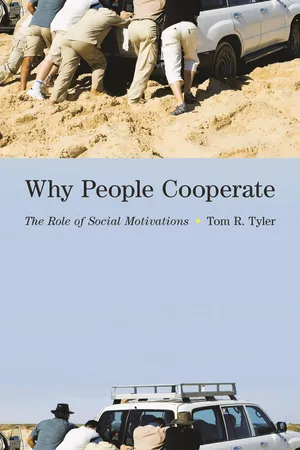
Any organization's success depends upon the voluntary cooperation of its members. But what motivates people to cooperate? In Why People Cooperate, Tom Tyler challenges the decades-old notion that individuals within groups are primarily motivated by their self-interest. Instead, he demonstrates that human behaviors are influenced by shared attitudes, values, and identities that reflect social connections rather than material interests.
Tyler examines employee cooperation in work organizations, resident cooperation with legal authorities responsible for social order in neighborhoods, and citizen cooperation with governmental authorities in political communities. He demonstrates that the main factors for achieving cooperation are socially driven, rather than instrumentally based on incentives or sanctions. Because of this, social motivations are critical when authorities attempt to secure voluntary cooperation from group members. Tyler also explains that two related aspects of group practices--the use of fair procedures when exercising authority and the belief by group members that authorities are benevolent and sincere--are crucial to the development of the attitudes, values, and identities that underlie cooperation.
With widespread implications for the management of organizations, community regulation, and governance, Why People Cooperate illustrates the vital role that voluntary cooperation plays in the long-standing viability of groups.
- 232 pages
- English
- ePUB (mobile friendly)
- Available on iOS & Android
eBook - ePub
About this book
Information
Publisher
Princeton University PressYear
2010Print ISBN
9780691158006
9780691146904
eBook ISBN
9781400836666
Table of contents
- Cover Page
- Title Page
- Copyright Page
- Contents
- List of Illustrations
- Acknowledgments
- Overview
- Section One: Introduction
- Section Two: Empirical Findings
- Section Three: Implications
- Conclusion
- Notes
- References
- Index
Trusted by 375,005 students
Access to over 1.5 million titles for a fair monthly price.
Study more efficiently using our study tools.
Frequently asked questions
Yes, you can cancel anytime from the Subscription tab in your account settings on the Perlego website. Your subscription will stay active until the end of your current billing period. Learn how to cancel your subscription
No, books cannot be downloaded as external files, such as PDFs, for use outside of Perlego. However, you can download books within the Perlego app for offline reading on mobile or tablet. Learn how to download books offline
Perlego offers two plans: Essential and Complete
- Essential is ideal for learners and professionals who enjoy exploring a wide range of subjects. Access the Essential Library with 800,000+ trusted titles and best-sellers across business, personal growth, and the humanities. Includes unlimited reading time and Standard Read Aloud voice.
- Complete: Perfect for advanced learners and researchers needing full, unrestricted access. Unlock 1.5M+ books across hundreds of subjects, including academic and specialized titles. The Complete Plan also includes advanced features like Premium Read Aloud and Research Assistant.
We are an online textbook subscription service, where you can get access to an entire online library for less than the price of a single book per month. With over 1.5 million books across 990+ topics, we’ve got you covered! Learn about our mission
Look out for the read-aloud symbol on your next book to see if you can listen to it. The read-aloud tool reads text aloud for you, highlighting the text as it is being read. You can pause it, speed it up and slow it down. Learn more about Read Aloud
Yes! You can use the Perlego app on both iOS and Android devices to read anytime, anywhere — even offline. Perfect for commutes or when you’re on the go.
Please note we cannot support devices running on iOS 13 and Android 7 or earlier. Learn more about using the app
Please note we cannot support devices running on iOS 13 and Android 7 or earlier. Learn more about using the app
Yes, you can access Why People Cooperate by Tom R. Tyler in PDF and/or ePUB format, as well as other popular books in Psychology & Applied Psychology. We have over 1.5 million books available in our catalogue for you to explore.