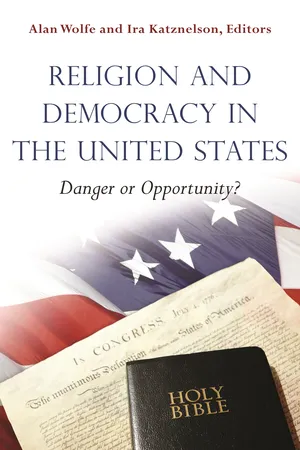
The United States remains a deeply religious country and religion plays an inextricably critical role in American politics. Controversy over issues such as abortion is fueled by opposition in the Catholic Church and among conservative Protestants, candidates for the presidency are questioned about their religious beliefs, and the separation of church and state remains hotly contested. While the examination of religion's influence in politics has long been neglected, in the last decade the subject has finally garnered the attention it deserves. In Religion and Democracy in the United States, prominent scholars consider the ways Americans understand the relationship between their religious beliefs and the political arena.
This collection, a work of the Task Force on Religion and American Democracy of the American Political Science Association, thoughtfully explores the effects of religion on democracy and contemporary partisan politics. Topics include how religious diversity affects American democracy, how religion is implicated in America's partisan battles, and how religion affects ideas about race, ethnicity, and gender. Surveying what we currently know about religion and American politics, the essays introduce and delve into the range of current issues for both specialists and nonspecialists.
In addition to the editors, the contributors are Allison Calhoun-Brown, Rosa DeLauro, Bette Novit Evans, James Gibson, John Green, Frederick Harris, Amaney Jamal, Geoffrey Layman, David Leal, David Leege, Nancy Rosenblum, Kenneth Wald, and Clyde Wilcox.
eBook - ePub
Religion and Democracy in the United States
Danger or Opportunity?
- 456 pages
- English
- ePUB (mobile friendly)
- Available on iOS & Android
eBook - ePub
Religion and Democracy in the United States
Danger or Opportunity?
About this book
Information
Publisher
Princeton University PressYear
2010Print ISBN
9780691147291
9780691147284
eBook ISBN
9781400836772
PART I
Religious Pluralism and American Democracy
Chapter 1
POLITICAL SCIENCE, DEMOCRACY, AND RELIGION
ALAN WOLFE
POLITICAL SCIENCE CATCHES UP
“Scarcely any political question,” wrote Alexis de Tocqueville in one of the most widely cited sentences in Democracy in America, “arises in the United States that is not resolved, sooner or later, into a judicial question.”1 If he were writing today, Tocqueville might be tempted to say that however any political question ends up, it originates as a religious one. Scarcely an election takes place or a policy is proposed before someone brings religion into the conversation. Some celebrate its presence, while others condemn it, but both agree that to understand what is happening in American politics, religion has to be accounted for.
Since at least the writings of Seymour Martin Lipset, Tocqueville’s analyses of democracy have been elevated to the status of social science classics, joining the ranks of Marx, Weber, and Durkheim.2 Every time we talk about voluntary associations, public opinion, self-interest rightly understood, or the tyranny of the majority, we echo themes first touched on by our French visitor. Tocqueville’s reputation as a social theorist can be exaggerated because he was not a systematic thinker and never really compared the United States to other countries. But his recognition of the power of the democratic forces being unleashed in the first decades of the nineteenth century lives on.
Much the same could be said for Tocqueville’s writings on religion. Just as he was a Frenchman writing about America, Tocqueville was a Catholic discussing the pervasive influence of Protestantism. “There is no country in the world where the Christian religion retains a greater influence over the souls of men than in America,” he proclaimed, a statement that not only reflects the Second Great Awakening that immediately preceded his visit but extends to the many religious revivals that have taken place since.3 Every time we talk about the importance of the local congregation, the voluntaristic impulses of America’s faith traditions, or the tendency of American religions to grow by recruiting new members, we are indebted to Tocqueville’s analysis.
Tocqueville may have been the most insightful visitor to explore the relationship between democracy and religion in the United States, but he was by no means the only one. Max Weber came to this country in the early years of the twentieth century to visit the St. Louis World’s Fair, and he too kept his eyes and ears open during his visit. In an essay on the Protestant sects that seemed so prevalent in American life—and to which Tocqueville had also called attention—Weber argued that, especially in newly settled regions of the United States, religion acted as a kind of moral credit agency. “Admission to the local Baptist congregation,” he wrote, “follows only upon the most careful ‘probation’ and after closest inquiries into conduct going back to early childhood.”4 Economic enterprise required conditions of trust, but social newness did not give people appropriate cues about who could be trusted and who should be shunned. Into the vacuum flowed the local congregation. People would prove their worthiness to each other by demonstrating their faith in God.
With historical predecessors as illustrious as Tocqueville and Weber, it might seem axiomatic that the social sciences in general, and political science in particular, would have developed a long-standing interest in religion. Yet something closer to the opposite actually took place: as religion became more important in American public life, the study of religion by American political scientists went into a tailspin. During the 1950s, for example, Billy Graham’s career as a public evangelist took off; the man spoke at huge rallies, not only in rural parts of the country but in the heart of Manhattan at Madison Square Garden. At the same time, conservative Catholics, concerned primarily about Soviet influence over such countries as Poland or Italy from which their families had originally come, formed political organizations determined to push the United States in a right-wing direction, especially with respect to its foreign policy. Yet the only major work done by a social scientist during this period, Will Herberg’s Protestant, Catholic, Jew, was written by a political activist (first of the left, then of the right) teaching at Drew University in New Jersey.5 At more prestigious universities, scholars, having endorsed the so-called secularization thesis, simply assumed that as the United States became more modern, religion would lose its influence. In addition, the 1950s saw the spread of quantitative techniques and behavioral approaches in American political science, and the study of religion, as subjective an area of interest as one can imagine, seemed difficult to reconcile with the objectivity so important to scholarship at that time.
As a consequence of these trends, religion was assigned a second-class status among subjects explored by American political scientists. Given what was happening in America in the decade that followed the 1950s—the election of a Catholic to the White House in 1960, the Gold-water campaign of 1964, and the first stirrings of the Christian Right, the March on Washington for civil rights led by a Baptist preacher from Georgia, Buddhists setting themselves on fire in Vietnam to protest the war, and the outbreak of spiritual fervor associated with the counterculture—the gap between the political scientists and the public only widened. In their examination of articles published in the American Political Science Review, for example, Kenneth D. Wald and Clyde Wilcox found that, over the course of its life, the journal on average published one article on religion every three years, and although there had been a slight uptick in more recent years (twenty-five articles dealing with religion in the period between 1960 and 2002), the attention devoted to the subject remained minimal.6 The reason, they argued, cannot lie in the fact that political scientists had retreated into some kind of cave unaware of the real world around them because more articles on gender and race, two other subjects of wide and increasing interest during the post–World War II period, were published than articles on religion. Nor was the cause for neglect characteristic of social science in general; sociologists paid more attention to religion in their flagship journals than did political scientists. Despite the fact that larger numbers of Americans, unlike Western Europeans, continued to attend church and to have their political behavior influenced by their religious preferences, political scientists were unwilling to give religion its due.
A general dearth of scholarly articles on the subject, moreover, constituted just one area of general neglect. Political science departments are typically organized by fields of interest such as American politics, comparative politics, international relations, and political theory. The subject of religion can be taught in any of them. Yet undergraduate courses on religion and politics during the 1950s and 1960s in any of these fields were few and far between. To cite only one example, Wellesley College offered no undergraduate courses on religion at all from 1989 until 1996; starting in the latter year, it began offering “Religion and American Politics” and added courses on religion and ethnic conflict in 2000. One might think the situation would be different at Boston College, where I teach, because BC is a Jesuit/Catholic university with a distinct religious mission. To some degree it is, as BC offered one course in the earlier period on church-state relations. But it was not until the mid-1990s that a regular undergraduate course on “Religion and American Politics” was added to the curriculum. Just as political scientists were engaged in relatively little research on religion during this period, they were also not focused on religion when it came to teaching.
To be fair, it should be pointed out that a tendency to ignore religion could also be found in other fields in which the subject deserved more widespread treatment, none more so than journalism. It is not that newspapers ignored religion, but from the end of World War II until the early 1970s, they treated it in roughly the same way they treated movies: listing services taking place over the weekend or reporting on church-sponsored charitable affairs. One study, for example, showed that, in Mark Silk’s summary of its findings, “by 1975 religious news space had reached its lowest ebb in [New York] Times history.”7 It became a common complaint among religious activists, including those who would become leaders of the religious right, that the media was dominated by secularists who showed little interest in them or the faiths for which they spoke. At least for a time, there seems to have been some truth in their complaints.
In more recent years, the trends I have been describing have begun to change, in some cases dramatically so. Many newspapers, responding to the obvious importance of the subject, started hiring full-time religion reporters and assigning them to cover political developments; between 1972 and 1982, according to yet another study, the number of column inches in American newspapers devoted to religion more than doubled.8 Such a rate of growth in religion coverage is difficult to sustain, and in just the past few years the competitive pressures on newspapers stemming from the rise of the Internet and decreases in readership have led to cutbacks in this area.9 Still, media coverage of religion remains at a high level. Significant support, moreover, exists for such coverage. The Templeton Foundation now offers an annual prize for religion reporting. The Pew Forum on Religion and American Public Life carries out extensive surveys, conducted in conjunction with academic political scientists, that are featured prominently in the media. The Religion and Ethics Newsweekly sponsors programs on public television and does its own reporting. No one could credibly claim that religion is currently undiscovered territory in the U.S. media. If anything, newspapers and television go out of their way to find religious angles on stories that, at first glance, do not seem to have one, including stories on shopping malls and day-care centers.10
A similar reversal of the cycle is fortunately taking place in political science. The American Political Science Association (APSA) allows members to define areas of interest, and religion is now among the most popular of these designations. The “Religion and Politics” section, which was founded among APSA members to further research on the subject, is among the fastest growing in the discipline; 335 people joined the section in 1989 as compared to 628 in 2007. (By way of contrast, the section on “Federalism and Intergovernmental Relations” declined from 506 to 296; “Urban Politics” dropped from 347 to 344; and “Political Psychology” increased from 292 to 426.)11 The section, in addition, has begun to publish a scholarly journal, Religion and Politics. Not unsurprisingly, more political science departments are teaching courses on religion and politics. Of the five colleges surveyed in the Boston area, three, Boston College, Brandeis University, and Harvard University, currently feature undergraduate courses dealing with religion.
As part of this renewed interest in religion among political scientists, Ira Katznelson of Columbia University, president of the APSA in 2005–06, convened a task force on the subject of “Religion and Democracy in the United States.” APSA task forces have had a long history, going back to the publication of Toward a More Responsible Two-Party System in 1950. In more recent years, task forces have been convened on inequality and American democracy, political violence and terrorism, difference and inequality in the developing world, civic education, and interdisciplinarity.
The aim of an APSA task force is to bring together prominent scholars dealing with a specific subject in order to pool their expertise and to write a report bringing the best knowledge on the topic to the general informed public. Katzn...
Table of contents
- Cover
- Halftitle
- Title
- Copyright
- Contents
- Contributors
- Acknowledgments
- Introduction
- Part I: Religious Pluralism and American Democracy
- Part II: Religion and Democratic Values
- Part III: Political Diversity and American Religion
- Part IV: Religion and Cultural Conflict
- Index
Trusted by 375,005 students
Access to over 1.5 million titles for a fair monthly price.
Study more efficiently using our study tools.
Frequently asked questions
Yes, you can cancel anytime from the Subscription tab in your account settings on the Perlego website. Your subscription will stay active until the end of your current billing period. Learn how to cancel your subscription
No, books cannot be downloaded as external files, such as PDFs, for use outside of Perlego. However, you can download books within the Perlego app for offline reading on mobile or tablet. Learn how to download books offline
Perlego offers two plans: Essential and Complete
- Essential is ideal for learners and professionals who enjoy exploring a wide range of subjects. Access the Essential Library with 800,000+ trusted titles and best-sellers across business, personal growth, and the humanities. Includes unlimited reading time and Standard Read Aloud voice.
- Complete: Perfect for advanced learners and researchers needing full, unrestricted access. Unlock 1.5M+ books across hundreds of subjects, including academic and specialized titles. The Complete Plan also includes advanced features like Premium Read Aloud and Research Assistant.
We are an online textbook subscription service, where you can get access to an entire online library for less than the price of a single book per month. With over 1.5 million books across 990+ topics, we’ve got you covered! Learn about our mission
Look out for the read-aloud symbol on your next book to see if you can listen to it. The read-aloud tool reads text aloud for you, highlighting the text as it is being read. You can pause it, speed it up and slow it down. Learn more about Read Aloud
Yes! You can use the Perlego app on both iOS and Android devices to read anytime, anywhere — even offline. Perfect for commutes or when you’re on the go.
Please note we cannot support devices running on iOS 13 and Android 7 or earlier. Learn more about using the app
Please note we cannot support devices running on iOS 13 and Android 7 or earlier. Learn more about using the app
Yes, you can access Religion and Democracy in the United States by Alan Wolfe, Ira Katznelson, Alan Wolfe,Ira Katznelson in PDF and/or ePUB format, as well as other popular books in Politics & International Relations & Politics. We have over 1.5 million books available in our catalogue for you to explore.