How and why animals produce group behaviors
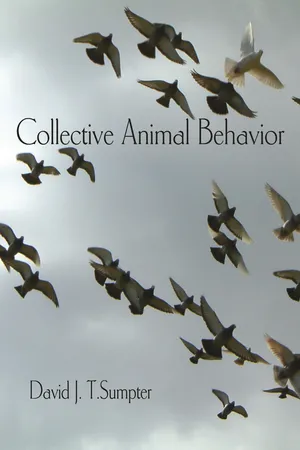
Fish travel in schools, birds migrate in flocks, honeybees swarm, and ants build trails. How and why do these collective behaviors occur? Exploring how coordinated group patterns emerge from individual interactions, Collective Animal Behavior reveals why animals produce group behaviors and examines their evolution across a range of species.
Providing a synthesis of mathematical modeling, theoretical biology, and experimental work, David Sumpter investigates how animals move and arrive together, how they transfer information, how they make decisions and synchronize their activities, and how they build collective structures. Sumpter constructs a unified appreciation of how different group-living species coordinate their behaviors and why natural selection has produced these groups. For the first time, the book combines traditional approaches to behavioral ecology with ideas about self-organization and complex systems from physics and mathematics. Sumpter offers a guide for working with key models in this area along with case studies of their application, and he shows how ideas about animal behavior can be applied to understanding human social behavior.
Containing a wealth of accessible examples as well as qualitative and quantitative features, Collective Animal Behavior will interest behavioral ecologists and all scientists studying complex systems.
- 312 pages
- English
- ePUB (mobile friendly)
- Available on iOS & Android
eBook - ePub
Collective Animal Behavior
About this book
Information
Publisher
Princeton University PressYear
2010Print ISBN
9780691148434
9780691129631
eBook ISBN
9781400837106
Table of contents
- Cover
- Halftitle
- Title
- Copyright
- Dedication
- Contents
- Acknowledgments
- Chapter 1 Introduction
- Chapter 2 Coming Together
- Chapter 3 Information Transfer
- Chapter 4 Making Decisions
- Chapter 5 Moving Together
- Chapter 6 Synchronization
- Chapter 7 Structures
- Chapter 8 Kegulation
- Chapter 9 Complicated Interactions
- Chapter 10 The Evolution of Co-operation
- Chapter 11 Conclusions
- References
- Index
Trusted by 375,005 students
Access to over 1.5 million titles for a fair monthly price.
Study more efficiently using our study tools.
Frequently asked questions
Yes, you can cancel anytime from the Subscription tab in your account settings on the Perlego website. Your subscription will stay active until the end of your current billing period. Learn how to cancel your subscription
No, books cannot be downloaded as external files, such as PDFs, for use outside of Perlego. However, you can download books within the Perlego app for offline reading on mobile or tablet. Learn how to download books offline
Perlego offers two plans: Essential and Complete
- Essential is ideal for learners and professionals who enjoy exploring a wide range of subjects. Access the Essential Library with 800,000+ trusted titles and best-sellers across business, personal growth, and the humanities. Includes unlimited reading time and Standard Read Aloud voice.
- Complete: Perfect for advanced learners and researchers needing full, unrestricted access. Unlock 1.5M+ books across hundreds of subjects, including academic and specialized titles. The Complete Plan also includes advanced features like Premium Read Aloud and Research Assistant.
We are an online textbook subscription service, where you can get access to an entire online library for less than the price of a single book per month. With over 1.5 million books across 990+ topics, we’ve got you covered! Learn about our mission
Look out for the read-aloud symbol on your next book to see if you can listen to it. The read-aloud tool reads text aloud for you, highlighting the text as it is being read. You can pause it, speed it up and slow it down. Learn more about Read Aloud
Yes! You can use the Perlego app on both iOS and Android devices to read anytime, anywhere — even offline. Perfect for commutes or when you’re on the go.
Please note we cannot support devices running on iOS 13 and Android 7 or earlier. Learn more about using the app
Please note we cannot support devices running on iOS 13 and Android 7 or earlier. Learn more about using the app
Yes, you can access Collective Animal Behavior by David J. T. Sumpter in PDF and/or ePUB format, as well as other popular books in Biological Sciences & Biology. We have over 1.5 million books available in our catalogue for you to explore.