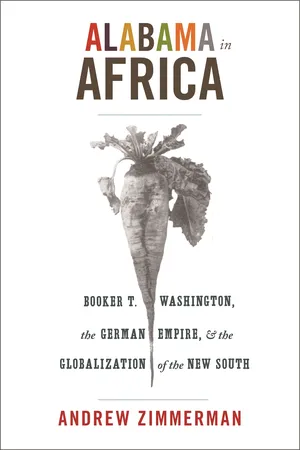
In 1901, the Tuskegee Institute, founded by Booker T. Washington, sent an expedition to the German colony of Togo in West Africa, with the purpose of transforming the region into a cotton economy similar to that of the post-Reconstruction American South. Alabama in Africa explores the politics of labor, sexuality, and race behind this endeavor, and the economic, political, and intellectual links connecting Germany, Africa, and the southern United States. The cross-fertilization of histories and practices led to the emergence of a global South, reproduced social inequities on both sides of the Atlantic, and pushed the American South and the German Empire to the forefront of modern colonialism.
Zimmerman shows how the people of Togo, rather than serving as a blank slate for American and German ideologies, helped shape their region's place in the global South. He looks at the forms of resistance pioneered by African American freedpeople, Polish migrant laborers, African cotton cultivators, and other groups exploited by, but never passive victims of, the growing colonial political economy. Zimmerman reconstructs the social science of the global South formulated by such thinkers as Max Weber and W.E.B. Du Bois, and reveals how their theories continue to define contemporary race, class, and culture.
Tracking the intertwined histories of Europe, Africa, and the Americas at the turn of the century, Alabama in Africa shows how the politics and economics of the segregated American South significantly reshaped other areas of the world.
eBook - ePub
Alabama in Africa
Booker T. Washington, the German Empire, and the Globalization of the New South
- 416 pages
- English
- ePUB (mobile friendly)
- Available on iOS & Android
eBook - ePub
Alabama in Africa
Booker T. Washington, the German Empire, and the Globalization of the New South
About this book
Information
Publisher
Princeton University PressYear
2010Print ISBN
9780691155869
9780691123622
eBook ISBN
9781400834976
Chapter 1
COTTON, THE “NEGRO QUESTION,” AND INDUSTRIAL EDUCATION IN THE NEW SOUTH
THE NEW SOUTH that Tuskegee Institute would help reproduce in West Africa was a temporary outcome of a long-standing conflict between workers and employers over the meaning of the freedom of labor. Workers, black and white, enslaved and emancipated, sought a kind of economic freedom given one of its now-classic formulations by Garrison Frazier, an African American Baptist minister interviewed in Savannah, Georgia, by General William T. Sherman and Secretary of War Edwin M. Stanton in January 1865. “Slavery,” explained Frazier, “is receiving by irresistible power the work of another man, and not by his consent. The freedom, as I understand it, promised by the [1863 Emancipation] proclamation, is taking us from under the yoke of bondage and placing us where we can reap the fruit of our own labor, and take care of ourselves and assist the Government in maintaining our freedom.”1 Frazier not only contrasted economic freedom with slavery but also implied that economic freedom stood in tension with wage labor, in which employers also took the “work of another,” compensating employees for their labor time only. Workers around the Atlantic, sometimes implicitly, sometimes explicitly, demanded, like Frazier, economic autonomy as a foundation of political and personal self-reliance, seeking to attain a freedom suggested by, but also antithetical to, emerging capitalist relations of production. Employers sought to direct the autonomous and self-emancipatory activity of workers into myriad channels, including the routines of factory, plantation, and tenant farm. The resulting economic forms were hybrids of emancipation and exploitation, rarely satisfactory to workers or to employers. The New South, both in the United States and as European authorities reproduced it across the Atlantic, represented one such hybrid.2
The American South interested European and American elites, and finally made the region a model for European colonial rule, because of the interdependent social constructions of industrial-grade cotton and submissive, hardworking, and poorly paid “Negroes.”3 Both of these constructions were vigorously resisted by the entities that they were meant to describe. The particular quality of American cotton came from constant control of varietals and, more importantly, strict supervision of African American cotton growers. As one British cotton expert warned: “Where the negro is his own master, custom, not the condition of the crop, dictates when he shall begin the harvest. Should the crop mature early, while the full heat of August is still felt, nothing will persuade the negro to face the arduous task of a day’s work in the fields, with the result that his fields may be seen white with cotton for a week or a fortnight before work is started.”4 American cotton emerged from the racist division of labor in the South as much as it did from processes of natural selection and artificial breeding. Growing American cotton in Africa or anywhere else outside the United States would involve significantly more than transplanting American cotton seeds. It would involve reproducing an approximation of the entire biological-social complex of American cotton growing, as it had developed in slavery and in freedom.
The permanent coercion needed to maintain American cotton also maintained the status of millions of southerners as “Negroes.” African Americans themselves contradicted the image of the “Negro” presupposed by ideologies of slavery and of the New South through their self-conscious political action, their everyday forms of resistance, and the simple fact of their complex humanity.5 An alleged affinity for cotton growing has long been central to racist images of African Americans, suggesting that blacks need and even enjoy the hard work, low pay, and coercive treatment of the southern cotton plantation. Even after the turn of the century, when the number of white cotton growers approached, and finally exceeded, the number of black cotton growers, many experts continued to assert that cotton could only be grown profitably with black labor.6 Industrial-quality cotton and the “Negro” of New South ideology were indeed codependent images whose failures to correspond to reality—natural, social, economic, and political—authorized coercive interventions that gave these images, in the end, a superficial plausibility. The Negro-cotton pair, interdependent in ways inconceivable to most white elites, founded a New South that would prove as attractive to the colonial rulers of Africa as it did to their counterparts in the northern and southern United States.7
The connection between blacks and cotton hardly merited discussion before emancipation, for slavery had ensured that blacks alone worked America’s cotton fields. With the end of slavery, the meaning of black freedom for political and economic elites in America and around the world came to be formulated around a so-called Negro question, which concerned the nature and the proper treatment of African Americans. The “Negro question” was largely reactive, seeking to reinterpret and thus deflect African American self-emancipation onto paths that maintained white political and economic domination. Thus, the peculiar forms of sharecropping that emerged in the southern United States travestied prior African American demands for independent family farming. Sharecrop-ping remained the main force responsible for continuing the coercion of African American cotton growers after emancipation, even as it stymied the most coercive designs of planters.
The type of industrial education promoted by Hampton and Tuskegee Institutes similarly represented an attempt to redirect African American efforts at self-education into channels supportive of the political and economic status quo. Industrial education did not mean vocational schooling but rather imparting an aptitude and enthusiasm for physical labor and personal virtues, such as cleanliness, sobriety, and thrift, that many African Americans were supposed to lack. Proponents of “industrial education” defined it against a literary or academic education, which, they claimed, had little relevance for poor, rural blacks in the South. Critics argued that industrial education accommodated and even encouraged segregation, disfranchisement, and the economic exploitation of blacks. Most scholars today side with the critics of Hampton and Tuskegee Institutes, and one historian has even described industrial education as “schooling for the new slavery.”8
Industrial education, however, contained black self-emancipation in a double sense: it sought to control black struggles for freedom, but it also preserved these efforts. Indeed, the founder and president of Tuskegee Institute, the African American Booker T. Washington, became, at the end of the nineteenth century, the best known and most widely admired global representative of the New South, ironically by encouraging blacks to limit their economic and political aspirations and to remain in the South. His national and international fame gave him the authority to begin working with the agricultural scientist George Washington Carver and the sociologist W.E.B. Du Bois on a program to transform, rather than reinforce, the dismal political and economic conditions of blacks in the South. Carver conducted agricultural research to make black farmers economically independent, producing their own means of subsistence and ending their dependence on the cotton industry. Du Bois, had he come to Tuskegee, would have worked in tandem with Carver to challenge the racist political and economic structures that prevented blacks from gaining the independence that Garrison Frazier had understood by freedom. This global renown, however, also brought Booker T. Washington to the attention of European colonial authorities, who persuaded him to help them reproduce the New South of cotton and coercion in Africa rather than revolutionize the New South in America.
COTTON AND COERCION
The biological diversity of cotton made it an unlikely candidate for a major industrial commodity of the nineteenth and twentieth centuries. The mechanical spinning and weaving of the industrial revolution required precisely standardized fibers, yet the term cotton could refer to any number of varieties of any of the four species of the genus Gossypium that had been cultivated from Asia to the Americas since antiquity. These four cultivated species were themselves artificial entities, the product of perhaps millennia of selective breeding that turned the single-cell filaments that once assisted, like dandelion fluff, in seed distribution into freakishly long and extraordinarily durable fibers, separable from the seeds they had once carried on the wind and suitable for spinning and weaving. The four species of Gossypium are themselves hardly stable, for cotton plants cross-pollinate easily and vary widely.9 The unpredictable characteristics of cotton fibers had posed few obstacles to hand spinning and weaving, since human fingers could make constant adjustments to irregularities in cotton staple. The transition from hand to factory spinning and weaving required not only the discipline of workers but also the standardization of cotton fibers. The discipline of workers and the standardization of cotton were, in fact, two aspects of a single agricultural, economic, and political process.
Long before British rule, India dominated the cotton textile industry in the Old World, a prominence it maintained until the eighteenth century, exporting textiles to markets from China to West Africa. Egyptians also cultivated cotton, beginning as early as the fifth century B.C.E. New World cottons, woven throughout Central and South America, had little role in the world market before the eighteenth century. In the eighteenth and nineteenth centuries, Europe and the United States came to exercise a near global monopoly over cotton textile manufacture because British manufacturers and American planters gradually subjected every stage of cotton production—from the selection of seeds to the cultivation of fields, to the grading of the product, to the labor of spinning and weaving—to the institutionalized coercion of the factory and the plantation.
Both mechanical- and hand-processing of textiles require similar steps. Cotton fibers have first to be separated from the seeds. The seeds can be used as fertilizer or animal feed. Oil extracted from the seeds served as a lubricant, as food, and in soap- and candle-making. Carding and combing removed dirt, pieces of stalk, and other extraneous material from the fibers and untangled and straightened them into parallel lines. Spinners then twisted the fiber into yarn, one thread at a time with spinning wheels and distaffs for most of human history. The yarn itself could be dyed before weaving, or it could be left undyed to produce “gray” cloth that could then be bleached, dyed, printed, and finished in other ways.
Cotton textiles became widely available in Europe in the twelfth century, thanks to the expansion of trade routes and to the greater contact between Europe and the Middle East resulting from the Crusades. By the thirteenth century, cotton cloth and cotton-linen blends, or fustians, became popular fabrics throughout Europe. Europeans already produced textiles from the indigenous fibers of wool and linen, and they were soon able to incorporate some cotton, exported from Arab markets to Italian cities, into their own spinning and weaving. By the fourteenth century, weavers began importing raw cotton fiber from Italy into southern Germany, turning the region into a major center of cotton weaving, a role it would resume in the nineteenth century. The terminology of cotton and cotton cloth in European languages reflects this early international economy. The term cotton, used with various spellings in Italian, French, and English, is taken directly from the Arabic al Kotn, as is the Spanish term algodón. The term calico, for printed cotton, derives from the name of the Indian city Calcutta; muslin, a fine cotton fabric, from the name of the city Mosul; and fustian, the cotton-linen mix, from Al-Fustat, a former capital of Egypt that has since been incorporated into Cairo. The German term, Baumwolle, literally “tree wool,” reflects how Europeans incorporated cotton into already existing spinning technologies.10
In the early seventeenth century, the East India Company began importing Indian calicos and muslins to Britain, where, by the middle of the century, they became popular consumer items, threatening the indigenous silk, wool, and linen textile industry. These trades persuaded the government to ban the sale of imported cottons in Britain. The East India Company continued to re-export Indian cotton textiles, including to markets in West Africa as part of the infamous triangle trade that brought enslaved Africans to the Americas. In a classic case of industrialization through import substitution, as historian Joseph E. Inikori has shown, weavers and spinners in England and Scotland, protected from Indian competition in domestic markets, gradually introduced a number of labor-saving devices in cotton spinning and weaving that soon made British labor costs cheaper per unit of output than Indian labor costs. English textile manufacturers soon competed in global markets, imitating the check fabrics popular in West African and New World markets to compete with Indian textiles sold by English and European merchants.11
Textile manufacturing in this period typically occurred in households, with a wife spinning and a husband weaving.12 At first, the low output of spinners using the distaff or wheel limited the amount of yarn available to weavers in the household organization of the textile industry. In 1764 the weaver James Hargreaves increased the amount of yarn available to him by inventing a machine that essentially simulated the fingers of several female spinners. Hargreaves called the machine a “spinning jenny,” giving a generic woman’s name to the machine that replicated this characteristically female work (see figure 1.1). The number of threads spun by a single spinner gradually increased from the single strand of the spinning wheel or distaff to the 120 spindles of the biggest spinning jennies. The spinning jenny, however, could only produce the relatively weak threads used for weft, and were thus more suitable for making fustian, with a cotton weft and linen warp. Richard Arkwright invented a water-driven spinning machine, the water frame, that employed a series of rollers to stretch and spin a stronger cotton yarn, suitable for warp. This invention allowed him to produce the first all-cotton English fabric in 1773 at his Nottingham mill. Samuel Crompton, a weaver, combined the inventions of Hargreaves and Arkwright into a “mule” (that is, a combination of the two) that could spin a much finer thread than the water frame and a much stronger thread than the jenny. This was sometimes called the “muslin wheel,” since it could spin threads fine enough for that delicate fabric. The further automation of the jenny drove spinning out of the household and into factories. These innovations in spinning at first improved the earning power of handloom weavers, who now had more raw material for their own looms. This privileged position did not last long. Engineers first automated the loom in 1785 and powered it by steam later that year. This power loom slowly displaced handloom weavers, much as the mule had displaced hand spinners.13
Whereas Britain produced large quantities of relatively inexpensive textiles for markets in China, India, West Africa, and the Americas, German manufacturers produced smaller quantities of more luxurious textiles, including velvet and velour, for European markets. Southern Germany regained its prominent position in the cotton textile industry in the late eighteenth century, after recovering from the devastation of the Thirty Years’ War. The cotton textile industry soon spread to Saxony, and, in the early nineteenth century, to Alsace in the West, which became part of Germany in 1871.14 Ge...
Table of contents
- Cover Page
- Title Page
- Copyright Page
- Contents
- List of Illustrations
- Preface
- Introduction
- Chapter 1: Cotton, the “Negro Question,” and Industrial Education in the New South
- Chapter 2: Sozialpolitik and the New South in Germany
- Chapter 3: Alabama in Africa: Tuskegee and the Colonial Decivilizing Mission in Togo
- Chapter 4: From a German Alabama in Africa to a Segregationist International: The League of Nations and the Global South
- Chapter 5: From Industrial Education for the New South to a Sociology of the Global South
- Conclusion: Prussian Paths of Capitalist Development: The Tuskegee Expedition to Togo between Transnational and Comparative History
- Notes
- Bibliography
- Index
Trusted by 375,005 students
Access to over 1.5 million titles for a fair monthly price.
Study more efficiently using our study tools.
Frequently asked questions
Yes, you can cancel anytime from the Subscription tab in your account settings on the Perlego website. Your subscription will stay active until the end of your current billing period. Learn how to cancel your subscription
No, books cannot be downloaded as external files, such as PDFs, for use outside of Perlego. However, you can download books within the Perlego app for offline reading on mobile or tablet. Learn how to download books offline
Perlego offers two plans: Essential and Complete
- Essential is ideal for learners and professionals who enjoy exploring a wide range of subjects. Access the Essential Library with 800,000+ trusted titles and best-sellers across business, personal growth, and the humanities. Includes unlimited reading time and Standard Read Aloud voice.
- Complete: Perfect for advanced learners and researchers needing full, unrestricted access. Unlock 1.5M+ books across hundreds of subjects, including academic and specialized titles. The Complete Plan also includes advanced features like Premium Read Aloud and Research Assistant.
We are an online textbook subscription service, where you can get access to an entire online library for less than the price of a single book per month. With over 1.5 million books across 990+ topics, we’ve got you covered! Learn about our mission
Look out for the read-aloud symbol on your next book to see if you can listen to it. The read-aloud tool reads text aloud for you, highlighting the text as it is being read. You can pause it, speed it up and slow it down. Learn more about Read Aloud
Yes! You can use the Perlego app on both iOS and Android devices to read anytime, anywhere — even offline. Perfect for commutes or when you’re on the go.
Please note we cannot support devices running on iOS 13 and Android 7 or earlier. Learn more about using the app
Please note we cannot support devices running on iOS 13 and Android 7 or earlier. Learn more about using the app
Yes, you can access Alabama in Africa by Angela Elisabeth Zimmerman in PDF and/or ePUB format, as well as other popular books in History & 20th Century History. We have over 1.5 million books available in our catalogue for you to explore.