"Because I am not silent," George Oppen wrote, "the poems are bad." What does it mean for the goodness of an art to depend upon its disappearance? In Being Numerous, Oren Izenberg offers a new way to understand the divisions that organize twentieth-century poetry. He argues that the most important conflict is not between styles or aesthetic politics, but between poets who seek to preserve or produce the incommensurable particularity of experience by making powerful objects, and poets whose radical commitment to abstract personhood seems altogether incompatible with experience--and with poems.
Reading across the apparent gulf that separates traditional and avant-garde poets, Izenberg reveals the common philosophical urgency that lies behind diverse forms of poetic difficulty--from Yeats's esoteric symbolism and Oppen's minimalism and silence to O'Hara's joyful slightness and the Language poets' rejection of traditional aesthetic satisfactions. For these poets, what begins as a practical question about the conduct of literary life--what distinguishes a poet or group of poets?--ends up as an ontological inquiry about social life: What is a person and how is a community possible? In the face of the violence and dislocation of the twentieth century, these poets resist their will to mastery, shy away from the sensual richness of their strongest work, and undermine the particularity of their imaginative and moral visions--all in an effort to allow personhood itself to emerge as an undeniable fact making an unrefusable claim.
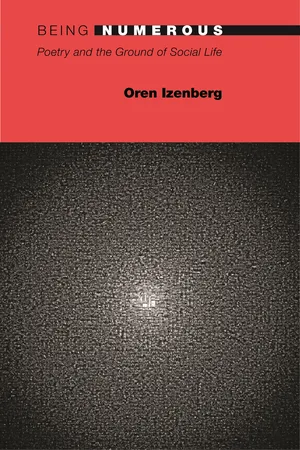
- 248 pages
- English
- ePUB (mobile friendly)
- Available on iOS & Android
eBook - ePub
About this book
Information
Publisher
Princeton University PressYear
2011Print ISBN
9780691148663
9780691144832
eBook ISBN
9781400836529
Topic
LiteraturaSubtopic
Crítica literaria en la poesíaINDEX
acknowledgment, 20, 21, 49, 95, 98
Adorno, Theodor, 26, 195n43
Aesthetic Theory, 13
“On Lyric Poetry and Society,” 13
Aerial, 144
aesthetics, 1
and Anderson, 79
and Bourdieu, 125
and Language poetry, 142
and non-poetry, 11
and O’Hara, 37, 112, 113, 125, 126, 130, 133
and Oppen, 79–80, 84, 105, 106
political, 45
sensual pleasures of, 26
and Silliman, 141
and Yeats, 36. See also beauty
Afro-Modernism, 8
Agamben, Giorgio, 197n55
agency, 42, 43, 75, 170
and Language poetry, 142, 151
and Yeats, 50, 68
Alcmene’s Problem, 130–31
Allen, Donald, 116, 119, 125, 128
The New American Poetry 1945–1960, 6, 123, 124
Ammons, A. R.: Expressions of Sea Level, 171
Tape for the Turn of the Year, 171, 172–74, 175, 179–80, 183–84, 187
Amphion, 43
an-aesthesis, 140, 141, 161
anamnetic structure, 59
anamnetic technique, 49
Anderson, Benedict, 154
Anderson, Sherwood, 79
Andrews, Bruce, I Don’t Have any Paper, So Shut Up, or, Social Romanticism, 158
Anglo-Irish Ascendancy, 46, 55, 57, 202n19
Anglo-Irish Protestants, 57
Anzeichen, 30
Apollinaire, Guillaume, 117
Appadurai, Arjun, 169–70
Aquinas, Thomas, 99
archetype, 44, 63
Arendt, Hannah, The Life of the Mind, 3
aristocracy, ...
Table of contents
- Cover
- Halftitle
- 20/21
- Title
- Copyright
- Contents
- Acknowledgments
- Introduction Poems, Poetry, Personhood
- Chpater One White Thin Bone: Yeatsian Personhood
- Chpater Two Oppen’s Silence, Crusoe’s Silence, and the Silence of Other Minds
- Chapter Three The Justice of My Feelings for Frank O’Hara
- Chapter Four Language Poetry and Collective Life
- Chapter Five We Are Reading
- Notes
- Index
Trusted by 375,005 students
Access to over 1.5 million titles for a fair monthly price.
Study more efficiently using our study tools.
Frequently asked questions
Yes, you can cancel anytime from the Subscription tab in your account settings on the Perlego website. Your subscription will stay active until the end of your current billing period. Learn how to cancel your subscription
No, books cannot be downloaded as external files, such as PDFs, for use outside of Perlego. However, you can download books within the Perlego app for offline reading on mobile or tablet. Learn how to download books offline
We are an online textbook subscription service, where you can get access to an entire online library for less than the price of a single book per month. With over 1.5 million books across 990+ topics, we’ve got you covered! Learn about our mission
Look out for the read-aloud symbol on your next book to see if you can listen to it. The read-aloud tool reads text aloud for you, highlighting the text as it is being read. You can pause it, speed it up and slow it down. Learn more about Read Aloud
Yes! You can use the Perlego app on both iOS and Android devices to read anytime, anywhere — even offline. Perfect for commutes or when you’re on the go.
Please note we cannot support devices running on iOS 13 and Android 7 or earlier. Learn more about using the app
Please note we cannot support devices running on iOS 13 and Android 7 or earlier. Learn more about using the app
Yes, you can access Being Numerous by Oren Izenberg in PDF and/or ePUB format, as well as other popular books in Literatura & Crítica literaria en la poesía. We have over 1.5 million books available in our catalogue for you to explore.