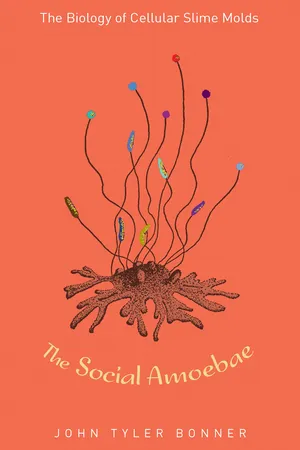
Noted biologist and author John Tyler Bonner has experimented with cellular slime molds for more than sixty years, and he has done more than anyone else to raise these peculiar collections of amoebae from a minor biological curiosity to a major model organism--one that is widely studied for clues to the development and evolution of all living things. Now, five decades after he published his first pioneering book on cellular slime molds, Bonner steps back from the proliferating and increasingly specialized knowledge about the organism to provide a broad, nontechnical picture of its whole biology, including its evolution, sociobiology, ecology, behavior, and development. The Social Amoebae draws the big lessons from decades of research, and shows how slime molds fit into and illuminate biology as a whole.
Slime molds are very different from other organisms; they feed as individual amoebae before coming together to form a multicellular organism that has a remarkable ability to move and orient itself in its environment. Furthermore, these social amoebae display a sophisticated division of labor; within each organism, some cells form the stalk and others become the spores that will seed the next generation. In The Social Amoebae, Bonner examines all these parts together, giving a balanced, concise, and clear overview of slime mold biology, from molecules to cells to multicells, as he advances some unconventional and unexpected insights.
- 157 pages
- English
- PDF
- Available on iOS & Android
eBook - PDF
About this book
Information
Table of contents
- Cover
- CONTENTS
- PREFACE
- 1 Introduction
- 2 The Life Cycle
- 3 Evolution
- 4 Ecology
- 5 Behavior of Amoebae and Cell Masses
- 6 Morphogenesis
- 7 Differentiation
- 8 The Future
- BIBLIOGRAPHY
- INDEX
Trusted by 375,005 students
Access to over 1.5 million titles for a fair monthly price.
Study more efficiently using our study tools.
Frequently asked questions
Yes, you can cancel anytime from the Subscription tab in your account settings on the Perlego website. Your subscription will stay active until the end of your current billing period. Learn how to cancel your subscription
No, books cannot be downloaded as external files, such as PDFs, for use outside of Perlego. However, you can download books within the Perlego app for offline reading on mobile or tablet. Learn how to download books offline
We are an online textbook subscription service, where you can get access to an entire online library for less than the price of a single book per month. With over 1.5 million books across 990+ topics, we’ve got you covered! Learn about our mission
Look out for the read-aloud symbol on your next book to see if you can listen to it. The read-aloud tool reads text aloud for you, highlighting the text as it is being read. You can pause it, speed it up and slow it down. Learn more about Read Aloud
Yes! You can use the Perlego app on both iOS and Android devices to read anytime, anywhere — even offline. Perfect for commutes or when you’re on the go.
Please note we cannot support devices running on iOS 13 and Android 7 or earlier. Learn more about using the app
Please note we cannot support devices running on iOS 13 and Android 7 or earlier. Learn more about using the app
Yes, you can access The Social Amoebae by John Tyler Bonner in PDF and/or ePUB format, as well as other popular books in Biological Sciences & Biology. We have over 1.5 million books available in our catalogue for you to explore.