From Pulitzer Prize–winner Garry Wills, the story of Augustine's Confessions
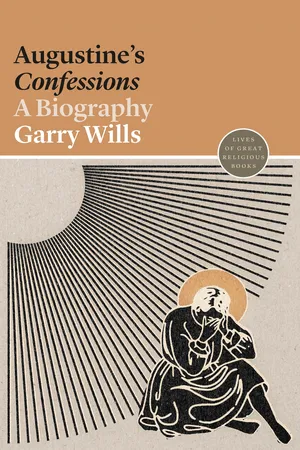
In this brief and incisive book, Pulitzer Prize-winning historian Garry Wills tells the story of the Confessions--what motivated Augustine to dictate it, how it asks to be read, and the many ways it has been misread in the one-and-a-half millennia since it was composed. Following Wills's biography of Augustine and his translation of the Confessions, this is an unparalleled introduction to one of the most important books in the Christian and Western traditions.
Understandably fascinated by the story of Augustine's life, modern readers have largely succumbed to the temptation to read the Confessions as autobiography. But, Wills argues, this is a mistake. The book is not autobiography but rather a long prayer, suffused with the language of Scripture and addressed to God, not man. Augustine tells the story of his life not for its own significance but in order to discern how, as a drama of sin and salvation leading to God, it fits into sacred history. "We have to read Augustine as we do Dante," Wills writes, "alert to rich layer upon layer of Scriptural and theological symbolism." Wills also addresses the long afterlife of the book, from controversy in its own time and relative neglect during the Middle Ages to a renewed prominence beginning in the fourteenth century and persisting to today, when the Confessions has become an object of interest not just for Christians but also historians, philosophers, psychiatrists, and literary critics.
With unmatched clarity and skill, Wills strips away the centuries of misunderstanding that have accumulated around Augustine's spiritual classic.
- 176 pages
- English
- ePUB (mobile friendly)
- Available on iOS & Android
eBook - ePub
About this book
Information
Publisher
Princeton University PressYear
2011Print ISBN
9780691217642
9780691143576
eBook ISBN
9781400838028
The Book’s Birth
CHAPTER 1
To write the biography of Confessions, we have to start in the delivery room—how and when was it born? We shall see that the when can partly be determined by the how. How did Augustine write Confessions? Well, in the strict sense, he didn’t—didn’t set words down on papyrus or parchment. Augustine has been painted, by artists as great as Botticelli, Carpaccio, and Benozzo Gozzoli, seated at a desk and writing. He did not do that. Oh, he undoubtedly wrote things like notes to himself, or lists of items, or instructions to individual brothers in his monastic community. But the books, sermons, and letters that have come down to us were all dictated to scribes. Even a book that feels as intimate as Confessions was spoken to several of the many scribes Augustine kept busy. That was the normal practice in antiquity. Even in prison, Saint Paul had a scribe on hand. Even when living as a hermit, Saint Jerome had teams of scribes. The population of ancient scribes was a vast one.
Writing was a complex and clumsy process. That was especially true in the classical period, when papyrus scrolls were used. One needed at least three hands to unroll the scroll on the left, to roll it up on the right, and to write a series of columns in the intermediate spaces. Besides, even the mixing of the ink and trimming of the reed pens (quills arrived in the Middle Ages) had to be done while the scroll was held open at the spot reached by the scribe. Since the rolls were written on one side only, they could run to great lengths, as much as thirty feet long.
Obviously, the author could not be doing all this and composing in his mind. The only efficient way to function was for the author to dictate to a shorthand writer (tachygrapher), who took the text down on tablets of wax or wood. Then this first scribe, with the help of assistants, would write the text on a scroll. Other scribes would copy this text on other scrolls—the only way to duplicate a text in the age before printing presses. A man would read slowly from the master text while a number of scribes created their own copies. There was no need for these secondary scribes to decipher the first man’s shorthand signs. After he made the master copy, multiple facsimiles were needed. Paul sent copies of the same letter to several places—to the churches of Galatia for instance. He sent his Epistle to the Romans to Jerusalem as well as to Rome. He also had to keep copies by him, for his own reference and to supply those asking for clarification of the record.
Writings, created with such labor, could be lost in transit where couriers were careless or in peril—Augustine’s first letter sent to Jerome did not reach him, causing endless later trouble. Books could easily disappear if there were not enough copies made or preserved. Even though Augustine kept his own archives in good order, his very first book is irretrievably lost. Teams of scribes had to be kept at work all the time to bring a book into existence and keep it there. The Late Antique church historian Eusebius tells us that the church father Origen had seven tachygraphers and a horde of other scribes and calligraphers to replicate what the shorthand experts took down and wrote out (History of the Church 6.23).
The making of books was an expensive as well as laborious and time-consuming process. One of the principal costs of Augustine’s episcopal establishment was the production of his many books. He wrote five million words that have come down to us, most of them after he became the bishop of Hippo. Isidore of Seville famously said that anyone who claims to have read all of Augustine must be a liar. In a recently discovered letter (Divjak 23-A), Augustine says that in less than three months he had dictated 6,000 lines of text—James O’Donnell suggests he made the count for payment to his scribes.
Besides all the scribal payments, there was the costly material of which books were made. To form double-ply sheets from the papyrus plant was labor-intensive, from cutting to cross-laying to drying. Even more difficult was the skinning, stretching, scraping, and drying of sheep or calf or goat skin to make parchment. And copyists had to keep the sheet numbers in order if they wrote the text before the sheaves (quires) were bound into a codex. Augustine had to be serviced by what amounts to a literary industrial complex in order to produce the amazing number of his books.
It may distance Augustine from us if we think we are not communing with him directly as he writes in solitude, just as we read in solitude. But this is the exact reverse of the ancients’ view. Theirs was an oral culture; they learned better and remembered better when they heard words sounded by a human voice. Plato makes Socrates say that spoken discourse pierces to the soul, while writing lies on the surface (Phaedrus 276b–d). Ancient readers did not normally read in solitude. As writing was a cumbrous process, reading was a clumsy one. People most often read aloud, even when they were alone. Augustine says that it puzzled people to see Ambrose reading silently (Confessions 6.3). Reading was difficult, since the letters were written without word-separation or punctuation (scripta continua). When Paul sent a letter to a gathering, an official lector read it aloud—most in the gathering were not able to make sense of the written row of letters. That is why the author of Revelation says, “Happy whoever reads these words out, and happy those who hear him” (1.3).
So even written words were shot through with oral elements—the vocal phenomena of the author at one end of the process dictating and a reader at the other end voicing the words. The writing was almost like a musical score—a set of signs to be given acoustical reality in performance. For Augustine’s contemporaries, this “bypassing” of the merely written would make his words all the more vivid. Paul hints at such bypassing of the written when he says to the Corinthians,
Am I renewing my introduction to you—do I, like others, really need (or don’t I) credentials presented to you or by you? Yourselves are my credentials, written on my heart—there all can find and read them. You are in fact a letter sent by Messiah for me to deliver, one not written in ink but in the Spirit of the living God, written not on stone tablets but on the fleshy tablets of the heart. (2 Cor. 3.1)
There are other ways writing was made to serve oral delivery. In Ezekiel’s vision, a hand reaches down from heaven with a scroll in it. “Man, eat what is in front of you, eat this scroll, and then go and speak to the Israelites” (Ezek. 3.1). The prophet digests the divine message so he can speak it. Similarly, the prophet in Revelation (10.10–11) swallows the “little scroll” in the angel’s hand, and the angel tells him to go prophesy. So, paradoxically, the oral externals of Augustine’s performance convey more inwardness to his original audience than writing alone could do.
The difficulty of reading in the ancient world had another impact on Confessions. The scripta continua, with no word divisions, no chapter-and-verse markings, made it hard to look up citations in a scroll or codex Since Augustine weaves a constant web of scriptural language throughout his text, it is clear that he is relying principally on his capacious memory in these citations—not looking them up, one by one. The power of memory in an oral culture is proverbial. Thomas Jefferson, who thought black people intellectually inferior to whites, marveled at their memory, a side-product of their oral culture (Notes on the State of Virginia, Query XIV). Cicero said that all public speakers must have well-trained memories (The Orator 2.350–60). The ancient orators did not read speeches to their audience (a difficult process, whether with scroll or codex), but memorized long orations—something still possible in the nineteenth century, when Edward Everett delivered his two-hour address at Gettysburg from memory (his regular practice when speaking on solemn occasions). Augustine, as we shall see, explored the vast capabilities of memory in Confessions Book 10. He was an example of what he is analyzing and praising there. His intimate knowledge of Scripture was necessary to his performance of Confessions.
The fact that Augustine cited Scripture from memory explains his resistance to the new translation Jerome was making into Latin of the Jewish Scripture from the Hebrew original rather than from the Greek translation (Septuagint). Augustine, who only spoke Latin, had memorized his Bible in the Latin translation familiar in Africa. It was a wrench to jettison that hard-won memorization of so large a body of work. (See Augustine, Letters 28.2, 71.3–6, 82.34–35). The familiar Latin words had become a part of Augustine, one he did not want to disturb unduly.
Augustine, like Ezekiel, or like the John of Revelation, had “eaten” the Scripture and afterward thought in its terms and rhythms, with and through its words. It is sometimes said that authors like Abraham Lincoln were so influenced by the King James English Bible that it affected their style. But the omnipresence of Scripture in Augustine goes far beyond that. Scripture informs the whole long prayer that is Confessions. The echoes are not footnoted or underlined in the original, but italics here will suggest how deeply interfused are Augustine’s words and the Bible’s:
To whom before you should I call out, Cleanse me of my inmost sins, and outward promptings fend off from your servant? I believe in you and that is why, you know Lord, I address you. Have I not anticipated accusation of my own sins, and you freed my heart of impiety? I do not take you into court, you who are Truth. I would not deceive myself, not let my iniquity tell itself a lie, so I go not to court with you. If you arraign our sins, Lord—Lord, who can stand the indictment ? (1.6)
The sacred writings are present in Confessions not only when Augustine quotes them but in the way he uses his own words. The most basic verse structure of the Psalms, as of all Hebrew poetry, is a two-line unit in which the second line repeats, reverses, or elaborates on the first one. An example is quoted in the opening words of Confessions, from Psalm 146.5:
Vast is what you do,
what you know beyond assaying.
This pattern informs much of Confessions, its sighing replications, his way of turning a thought over and over. These give the book its air of slow reflection and inwardness. The words cast a spell and we are taken down into Augustine’s deepest self. Thus, by a paradox, Augustine’s use of other people’s words (the sacred authors’) helps him speak most authentically as himself.
The fact that Augustine can maintain this meditative spell in Confessions is a key to its dating. Once launched on this interior exploration, Augustine sustains a tone and intensity throughout at least the first ten books (we can argue later about the last three). It is true that Augustine composed some works over a number of years—notably City of God and The Trinity. But City of God is a work whose purpose and method shifted over the years of its composition, and work on The Trinity was suspended because of an accident—and those books do not have the incantatory continuity of Confessions. A sustained single effort seems to have produced Confessions.
This has been doubted by some. The book must have been begun in 397, before Augustine learned of Ambrose’s death in that year, since there is no awareness that he has died. But Augustine stops the narrative part of the book at Book 9, the time of his baptism ten years earlier. Yet Book 10 gives an account of his soul at the time of writing. Some think that the first nine books were released by themselves, and readers asked what his state was after that decade. They point to a passage of Book 10 that says:
The testimony to my past sins—which you have forgiven and hidden away to give me happiness in you, transforming my soul by faith and by baptism into you—may that testimony stir the heart in those who read or hear it. (10.4)
That does not say people have read some earlier form of the present work. It is more natural to think they have been reading the present text, the one he is continuing. The matter is clearer in the passage that is most often used to claim that Book 10 was not an original part of Confessions:
Many have asked what my condition is at the moment of my testifying, both those who know me and those who know me not but have heard something from me or about me. (10)
He does not say some people have read the earlier parts of this book, or that they have necessarily read anything. He refers to those have heard (audierunt) something (aliquid) from me or about me (ex me vel de me). Nothing could be more general, more non-specific about Confessions or any other book. If he is being asked by those who know him personally, that does not restrict the questions to anything that has been written by him or about him. And those who have only heard “about me,” contrasted with those who have heard “from me,” are getting their information from someone else, not from Confessions.
Who was likely to ask these questions? If they were people who had read an earlier version of Confessions, the more expected request would be that he continue the story, not that he would break off and make a later report. Who, by contrast, would be likely to ask that he give an account of himself in 397? There were many who challenged Augustine, not only foes like the Manicheans or Donatists, but those of his own faith who (as we shall see) questioned the validity of his consecration as bishop or had heard other rumors. The occasion of questioning was, therefore, not obviously the reading of Books 1 through 9 in an earlier published form.
Nonetheless, for a long time many scholars thought Book 10 was added later on. They then went on to ask when the book was added. They settled on 401 because of some verbal similarities between Book 10 and Explaining the Psalms, Psalm 36, which was dated to 401. But if Augustine was partly repeating himself, would he do it at the same time, or later? The latter seems more likely, as occasion arose. Besides, Pierre-Marie Hombert has dated the psalm commentary to 403, stretching the composition of Confessions to six years (397–403).1
Some who would not date Book 10 after the first nine books do think that Books 11–13 were added later. After all, even Book 10 is about Augustine, while the last three books are outside the narrative of Confessions entirely. They are an exegetical exercise on the opening of Genesis. To some they seem so outside the ambit of the book that t...
Table of contents
- Cover Page
- Series Page
- Title Page
- Copyright Page
- Contents
- A Note on the Translation
- Chapter 1. The Book’s Birth
- Chapter 2. The Book’s Genre
- Chapter 3. The Book’s African Days
- Chapter 4. The Book’s Ambrose
- Chapter 5. The Book’s “Conversion”
- Chapter 6. The Book’s Baptismal Days
- Chapter 7. The Book’s Hinge
- Chapter 8. The Book’s Culmination
- Chapter 9. The Book’s Afterlife: Early Reception, Later Neglect
- Notes
- Basic Readings
- Index
Trusted by 375,005 students
Access to over 1.5 million titles for a fair monthly price.
Study more efficiently using our study tools.
Frequently asked questions
Yes, you can cancel anytime from the Subscription tab in your account settings on the Perlego website. Your subscription will stay active until the end of your current billing period. Learn how to cancel your subscription
No, books cannot be downloaded as external files, such as PDFs, for use outside of Perlego. However, you can download books within the Perlego app for offline reading on mobile or tablet. Learn how to download books offline
Perlego offers two plans: Essential and Complete
- Essential is ideal for learners and professionals who enjoy exploring a wide range of subjects. Access the Essential Library with 800,000+ trusted titles and best-sellers across business, personal growth, and the humanities. Includes unlimited reading time and Standard Read Aloud voice.
- Complete: Perfect for advanced learners and researchers needing full, unrestricted access. Unlock 1.5M+ books across hundreds of subjects, including academic and specialized titles. The Complete Plan also includes advanced features like Premium Read Aloud and Research Assistant.
We are an online textbook subscription service, where you can get access to an entire online library for less than the price of a single book per month. With over 1.5 million books across 990+ topics, we’ve got you covered! Learn about our mission
Look out for the read-aloud symbol on your next book to see if you can listen to it. The read-aloud tool reads text aloud for you, highlighting the text as it is being read. You can pause it, speed it up and slow it down. Learn more about Read Aloud
Yes! You can use the Perlego app on both iOS and Android devices to read anytime, anywhere — even offline. Perfect for commutes or when you’re on the go.
Please note we cannot support devices running on iOS 13 and Android 7 or earlier. Learn more about using the app
Please note we cannot support devices running on iOS 13 and Android 7 or earlier. Learn more about using the app
Yes, you can access Augustine's Confessions by Garry Wills in PDF and/or ePUB format, as well as other popular books in Teologia e religione & Critica letteraria antica e classica. We have over 1.5 million books available in our catalogue for you to explore.