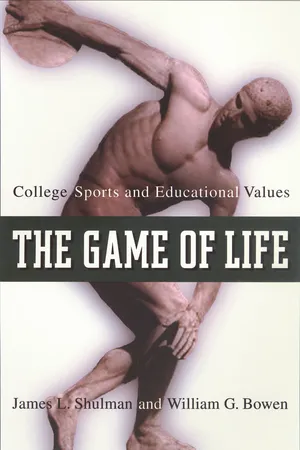
The President of Williams College faces a firestorm for not allowing the women's lacrosse team to postpone exams to attend the playoffs. The University of Michigan loses $2.8 million on athletics despite averaging 110,000 fans at each home football game. Schools across the country struggle with the tradeoffs involved with recruiting athletes and updating facilities for dozens of varsity sports. Does increasing intensification of college sports support or detract from higher education's core mission?
James Shulman and William Bowen introduce facts into a terrain overrun by emotions and enduring myths. Using the same database that informed The Shape of the River, the authors analyze data on 90,000 students who attended thirty selective colleges and universities in the 1950s, 1970s, and 1990s. Drawing also on historical research and new information on giving and spending, the authors demonstrate how athletics influence the class composition and campus ethos of selective schools, as well as the messages that these institutions send to prospective students, their parents, and society at large.
Shulman and Bowen show that athletic programs raise even more difficult questions of educational policy for small private colleges and highly selective universities than they do for big-time scholarship-granting schools. They discover that today's athletes, more so than their predecessors, enter college less academically well-prepared and with different goals and values than their classmates--differences that lead to different lives. They reveal that gender equity efforts have wrought large, sometimes unanticipated changes. And they show that the alumni appetite for winning teams is not--as schools often assume--insatiable. If a culprit emerges, it is the unquestioned spread of a changed athletic culture through the emulation of highly publicized teams by low-profile sports, of men's programs by women's, and of athletic powerhouses by small colleges.
Shulman and Bowen celebrate the benefits of collegiate sports, while identifying the subtle ways in which athletic intensification can pull even prestigious institutions from their missions. By examining how athletes and other graduates view The Game of Life--and how colleges shape society's view of what its rules should be--Bowen and Shulman go far beyond sports. They tell us about higher education today: the ways in which colleges set policies, reinforce or neglect their core mission, and send signals about what matters.
The Institutionalization and Regulation of College Sports in Historical Perspective
Let the good work go on—but who the devil is making you all this trouble? Football, in my opinion, is best at its worst. I do not believe in all this namby-pamby talk, and I hope the game will not be emasculated and robbed of its heroic qualities. People who don’t like football as now played might like whist—–advise them to try that.
—Frederic Remington, writing to Walter Camp upon the establishment of the Camp Commission on Brutality in Football (1894)
It was once possible for college sports administrators on the one hand, and university presidents and trustees on the other, to evade responsibility for the difficulties of intercollegiate athletics. Each side could plausibly claim the other possessed the authority to act. That claim no longer holds water.
—Knight Commission on Intercollegiate Athletics, A New Beginning for a New Century (1993)
SOME PEOPLE love college sports and others hate them. Some who feel passionately about colleges and universities regard their sports programs as their best feature; others regard them as “just part of the scene”—accepted and generally appreciated, but not of primary importance; still others believe that athletic programs are completely irrelevant. One fact is clear to all: however one feels about them, intercollegiate athletic programs have become thoroughly institutionalized within American higher education. How did these programs become such a consequential part of what these colleges do? Has the “fit” between the educational missions of the institutions and the nature of the athletic programs changed over time? How has the place of athletics within the institutional structure of colleges and universities been affected by other trends in the society, and especially by the increasing specialization within athletics, commercial incentives, and the intense competition for admission to the most selective schools?
The historical record—shaped by a myriad of actors, including the entertainment industry, the media, and various regulatory authorities—is of course far more than a mere reference point. As we saw in the Prelude, history and tradition are themselves potent factors in shaping debate and justifying current policies. In this chapter, we provide a context for the rest of the book by examining the changing place of intercollegiate athletics within the institutional fabric of colleges and universities.
THE MISSIONS OF COLLEGES AND UNIVERSITIES AND THE RATIONALE FOR SUPPORTING INTERCOLLEGIATE ATHLETICS
Determining how certain activities fit within an institution depends, of course, on how—and if—the institutional mission is defined. Mission statements of colleges and universities are rarely short and specific. Most go on for a number of pages, with subheadings and bullet points. But two slightly different themes do emerge, as the following excerpts from four mission statements illustrate:1
Knowledge for its own sake and for preparing flexible minds:
Kenyon is an academic institution. The virtue of the academic mode is that it deals not with private and particular truths, but with the general and the universal. It enables one to escape the limits of private experience and the tyranny of the present moment. . . . As an undergraduate institution, Kenyon focuses upon those studies which are essential to the intellectual and moral development of its students. The curriculum is not defined by the interest of graduate or professional schools, but by the faculty’s understanding of what contributes to liberal education. . . . Ours is the best kind of career preparation, for it develops qualities that are prized in any profession. Far beyond immediate career concerns, however, a liberal education forms the foundation of a fulfilling and valuable life. To that purpose Kenyon College is devoted.
Yale’s liberal education is an education meant to increase in young people a sense of the joy that learning for the sake of learning brings, learning whose goal is not professional mastery or technical capacity for commercial advantage, but commencement of a life-long pleasure in the human exercise of our minds, our most human part.
Education for leadership or success in life:
Penn inspires, demands, and thrives on excellence, and will measure itself against the best in every field of endeavor in which it participates. Penn is proudly entrepreneurial, dynamically forging new connections and inspiring learning through problem-solving, discovery-oriented approaches.
The mission of the University of Michigan is to serve the people of Michigan and the world through preeminence in creating, communicating, preserving and applying knowledge, art, and academic values, and in developing leaders and citizens who will challenge the present and enrich the future.
How, then, does intercollegiate athletics relate to such missions? As many faculty critics have pointed out, there is no direct connection between organized athletics and the pursuit of learning for its own sake. It can be said, however, that athletic competition helps provide a more balanced life for some number of students than they would find otherwise. The dictum of a “sound mind in a sound body” captures the idea.
The second theme in the mission statements—which invokes excellence in all pursuits and embraces the training of leaders—casts a wider net. It is much easier to make a straightforward case for intercollegiate athletics under this banner, and there has been no shortage of speeches and statements extolling the ways in which athletic competition fosters learning for life, training for leadership, the ability to work in teams, competitiveness, self-control, and discipline. Perhaps the most famous quotation of this genre is the Duke of Wellington’s oft-cited aphorism: “The battle of Waterloo was won on the playing fields of Eton.” To test these notions, we will present data on which attributes and actions differentiate athletes from other students; we will also test whether these differences should be attributed to participation in college sports or to differences that were present before students entered college.
At schools with the most extensive intercollegiate athletic programs, where athletes constitute 20 to 30 percent of the student body, athletic programs may have deep effects on the composition of the student body, the distribution of students by field of study, the degree to which various groups of students interact, and the overall emphasis placed on academic achievement. In addition, the presence of large numbers of athletes (who go on to make up equally large proportions of the alumni/ae) may have long-lasting effects on the priorities of the school. In all of these respects, the nature of intercollegiate athletic programs may shape as well as reflect the missions of the colleges and universities that offer them. In such settings, sports are seen as part of the school’s core educational mission, and it is on these terms that sports programs should be judged.
A second, often unwritten, justification for college sports programs emphasizes their impact on building a sense of community. In order for Hamilton to have an identity that distinguishes it from Wesleyan, the students (past, present, and future) need to feel part of a cohesive community. Sports can play an important role in creating a campus ethos—in part through public ritual (the Saturday afternoon game), but also through the banner on the dorm room wall and the stories on the back page of the student paper. These “bonding” effects can be important in attracting students and in making the campus a pleasant place for everyone. They are also thought to sustain alumni loyalty and, over the long run, contribute to the financial strength of the institution and to its reputation within its state and beyond. (Athletics can of course lead to negative as well as positive reputational effects. Cheating scandals, for example, can damage an institution’s reputation for academic integrity.)
There is a third, but somewhat different, way in which athletic programs may be tied to an institution’s mission. The High Profile sports of football and men’s basketball, in particular, may be valued because of their potential revenue-generating capacity. Although all of the educational institutions in our study are not-for-profit entities, and as such are prohibited from “making money,” they are of course allowed to generate revenues that can be used to support their not-for-profit mission. Indeed, all of these colleges and universities raise substantial amounts of revenue by providing services (products that they make available for a price). Tuition revenues are the largest and most obvious example, but schools also sell sweatshirts and operate a range of auxiliary activities such as bookstores and museum shops.
The potential revenue-generating justification for intercollegiate athletics falls squarely under this heading—schools can be seen as “investing” in an athletic enterprise whose ticket sales, booster donations, and sneaker endorsements may provide dollars that can be used to cover the costs of a range of activities, including of course the costs of the Lower Profile sports. Moreover, successful athletic programs may be thought to benefit the institution financially by generating increased alumni/ae support, encouraging legislators to vote for larger appropriations (in the case of public universities), and providing marketing exposure. The success or failure of athletics seen as an investment should be judged in the same way in which any other investment is assessed—by comparing revenues with costs and calculating a rate of return.
How do athletic programs, justified in these different ways, affect a school’s core mission? Hanna Gray has written of the importance of focusing on the educational purposes of a university and understanding how successful pursuit of its core mission confers a wide array of benefits on society at large:
In the long history of discussion over the responsibilities and purposes of universities, there has been too little emphasis on clarifying the all-important benefit that flows from their own special mission. Such statements make the academic world sound aloof, self-absorbed, and arrogant, as though it cared not at all about the world and its urgent problems and saw no obligation to help in alleviating social ills or improving the state of society or assisting the country in achieving significant national goals. To reply that the development of human and intellectual capital is in itself an enormous contribution of central social priority strikes those who see major needs immediately at hand as somehow unresponsive, especially given the public resources invested in higher education. . . . [Besides international economic competition] there are, of course, many other ways in which universities serve their communities—for example, in the provision of medical care or through projects carried on by scholars in a variety of fields such as urban studies, poverty, and education. These grow out of the universities’ educational missions, and that should be the test.2
Intercollegiate athletics can be assessed, then, in terms of its direct effects on the core educational mission of a college or university (including its effects on the kinds of students enrolled, the education that they receive as undergraduates, and the lives that they go on to lead). It can also be judged in terms of its impact on campus ethos, alumni/ae loyalty, and institutional reputation. Finally, it can be assessed as an activity that, in some situations, might be expected to earn a measurable financial return that will help to make other things possible. Needless to say, these are far from mutually exclusive perspectives, but it is helpful to distinguish among them in thinking about the rationale for electing to support a particular kind of intercollegiate athletic program.
FROM STUDENT CLUBS TO HIGHLY PROFESSIONALIZED ATHLETIC DEPARTMENTS
The world of college sports garners a great deal of attention on the pages of the leading newspapers and magazines and in radio and television coverage of sports events. There is no denying the attention given to the NCAA basketball tournament, debates over equal opportunity for women to compete at the intercollegiate level, admissions standards for athletes, an array of highly publicized scandals concerning illegal payments to athletes, and methods of ranking football teams for the purposes of postseason competition. It seems clear that our revealed preference, as a society, is for an extensive commitment to sports within higher education. Anyone who wants to claim that sports has no place in a college or university is quickly going to run headlong into both the insatiable appetite for sports that is evident in our daily lives—and the reality of history.
The first intercollegiate athletic contest took place in 1852 when boats from Harvard and Yale raced on Lake Winnipesaukee in New Hampshire. Though historians record the participants as having thought of the race as “a jolly lark,” historian Ronald Smith notes that that first boat race was sponsored by a real estate promoter who was selling land in the area.3 We should not believe that commercial ties to athletics arose only recently. The race signaled the beginning of an enterprise that would grow rapidly during the second half of the nineteenth century.
In 1859 Williams lost to Amherst in the first intercollegiate baseball contest (by a score of 73–32!), and in 1869 Princeton lost to Rutgers in the first football game. But how did such student-organized athletic competitions become embedded in the very core of the leading educational institutions of the country? The rest of this chapter is devoted to examining the factors that led college sports to become increasingly institutionalized over the course of the 20th century. The record of how athletics were absorbed into the institution is central to understanding the rest of this book, since the policies concerning how many (and which) athletes are admitted and how these athletically inclined students live during their time on campus are shaped by the degree to which institutions have come to claim athletics as their own.
Early Days: The Rise of Football
The new sport of football, akin more to soccer than to the sport we know as football today, developed rapidly in the 1870s and in the process changed dramatically through the absorption of rugby rules (via games be...
Table of contents
Cover
Half title
Title
Copyright
Contents
List of Figures
List of Tables
Preface to the Paperback Edition
Prelude: Four Snapshots
Preface
Chapter 1. The Institutionalization and Regulation of College Sports in Historical Perspective
Chapter 2. The Admissions Game: Recruiting Male Athletes and the Implications of Selection
Chapter 3. The College Game: Academic Outcomes for Men
Chapter 4. Men’s Lives after College: Advanced Study, Jobs, Earnings
Chapter 5. The Development of Women’s Athletic Programs
Chapter 6. New Players: The Recruitment and Admission of Women Athletes
Chapter 11. The Financial Equation: Expenditures and Revenues
Chapter 12. Key Empirical Findings
Chapter 13. Taking Stock
Chapter 14. Thinking Ahead: Impediments to Change and Proposed Directions
Appendix A: Scorecards
Appendix B: Supplementary Data
Notes
References
Index
Trusted by 375,005 students
Access to over 1.5 million titles for a fair monthly price.
Study more efficiently using our study tools.
Frequently asked questions
Yes, you can cancel anytime from the Subscription tab in your account settings on the Perlego website. Your subscription will stay active until the end of your current billing period. Learn how to cancel your subscription
No, books cannot be downloaded as external files, such as PDFs, for use outside of Perlego. However, you can download books within the Perlego app for offline reading on mobile or tablet. Learn how to download books offline
Perlego offers two plans: Essential and Complete
Essential is ideal for learners and professionals who enjoy exploring a wide range of subjects. Access the Essential Library with 800,000+ trusted titles and best-sellers across business, personal growth, and the humanities. Includes unlimited reading time and Standard Read Aloud voice.
Complete: Perfect for advanced learners and researchers needing full, unrestricted access. Unlock 1.5M+ books across hundreds of subjects, including academic and specialized titles. The Complete Plan also includes advanced features like Premium Read Aloud and Research Assistant.
Both plans are available with monthly, semester, or annual billing cycles.
We are an online textbook subscription service, where you can get access to an entire online library for less than the price of a single book per month. With over 1.5 million books across 990+ topics, we’ve got you covered! Learn about our mission
Look out for the read-aloud symbol on your next book to see if you can listen to it. The read-aloud tool reads text aloud for you, highlighting the text as it is being read. You can pause it, speed it up and slow it down. Learn more about Read Aloud
Yes! You can use the Perlego app on both iOS and Android devices to read anytime, anywhere — even offline. Perfect for commutes or when you’re on the go. Please note we cannot support devices running on iOS 13 and Android 7 or earlier. Learn more about using the app
Yes, you can access The Game of Life by James L. Shulman,William G. Bowen in PDF and/or ePUB format, as well as other popular books in Pedagogía & Educación superior. We have over 1.5 million books available in our catalogue for you to explore.