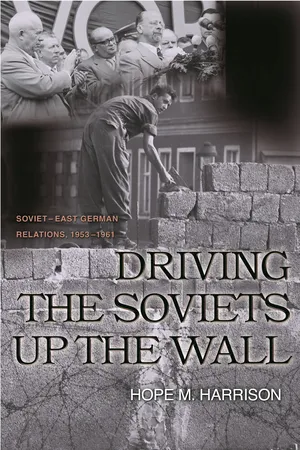
The Berlin Wall was the symbol of the Cold War. For the first time, this path-breaking book tells the behind-the-scenes story of the communists' decision to build the Wall in 1961. Hope Harrison's use of archival sources from the former East German and Soviet regimes is unrivalled, and from these sources she builds a highly original and provocative argument: the East Germans pushed the reluctant Soviets into building the Berlin Wall.
This fascinating work portrays the different approaches favored by the East Germans and the Soviets to stop the exodus of refugees to West Germany. In the wake of Stalin's death in 1953, the Soviets refused the East German request to close their border to West Berlin. The Kremlin rulers told the hard-line East German leaders to solve their refugee problem not by closing the border, but by alleviating their domestic and foreign problems. The book describes how, over the next seven years, the East German regime managed to resist Soviet pressures for liberalization and instead pressured the Soviets into allowing them to build the Berlin Wall. Driving the Soviets Up the Wall forces us to view this critical juncture in the Cold War in a different light. Harrison's work makes us rethink the nature of relations between countries of the Soviet bloc even at the height of the Cold War, while also contributing to ongoing debates over the capacity of weaker states to influence their stronger allies.
- 368 pages
- English
- ePUB (mobile friendly)
- Available on iOS & Android
eBook - ePub
About this book
Information
Publisher
Princeton University PressYear
2011Print ISBN
9780691124285
9780691096780
eBook ISBN
9781400840724
CHAPTER ONE

1953
Soviet–East German Relations and Power Struggles in Moscow and Berlin
OUR STORY BEGINS with the pivotal six months from Stalin’s death in March to the East German leaders’ official visit to Moscow in August 1953. The developments in these months in Soviet policy vis-à-vis the GDR and in East German and Soviet domestic politics set the stage for much of the remainder of the GDR’s existence. This chapter will introduce the key dynamics and issues in Soviet–East German relations to be examined in this book: (1) Soviet vacillations about what policy to follow regarding the GDR; (2) Ulbricht’s resistance to alleviating his harsh socialist policies; (3) the East German refugee problem and conflicting views on how to resolve it; (4) East German economic difficulties and divergent views about how to handle them; (5) the precariousness of the East German regime in the face of challenges from West Germany and West Berlin; (6) Soviet policy preferences versus real policy implementation on the ground in the GDR; and (7) conflicting Soviet and East German tendencies regarding establishing legitimacy versus control in the GDR. This chapter also presents the basis for the later East German capacity to turn its domestic weakness into bargaining strength with the Soviets, the birth of a super-ally.
In 1953 and afterward, two different patterns operated in the relationship between the Soviet Union and East Germany: One followed the traditional model of a dominant patron to a subservient, dependent client; and the other showed more characteristics of the tail wagging the dog. Although on many issues between 1953 and 1961, the first pattern prevailed, there were also important instances of East Germany’s independent behavior and the incapacity of the Soviets to control East German policies.
It was not clear in 1953 whether Ulbricht would maintain his hold on power in the face of Soviet and domestic criticism or whether one of his opponents would succeed him. Ulbricht’s autocratic leadership style and unyielding policies were at the heart of the domestic political struggle in East Berlin and also an essential component in relations between East Berlin and Moscow.
WHO WAS WALTER ULBRICHT?
Walter Ulbricht was an essential part of the establishment of Soviet communism in Germany. Hence, following his path to power also illuminates the rise of communism there, the process of Stalinization, and the subsequent challenges of de-Stalinization. Ulbricht dominated East German politics between 1945 and 1971. His leadership style has been described by people who worked with him, and by scholars, as Stalinist, dictatorial, cold, overbearing, and rigid.1 He was rude, had few social graces, and was hardly an inspiring speaker. He was concerned above all with his personal power and displayed indefatigable energy in propagating his own “cult of personality.” Ulbricht had strong organizational skills and paid great attention to detail. He possessed an acute sense for power and how best to maintain and augment it, both domestically and in his relations with the Soviets. He was also a staunch believer in Marxism-Leninism and was quick to defend the Soviet Union as the first communist state.
The future East German leader was born on 1 July 1893 in Leipzig, Germany, the first child of Ernst and Pauline Ulbricht. Ernst was a tailor, and Pauline stayed at home taking care of Walter and then his younger brother and sister. They lived in a poor, rather unseemly area of town, Naundörfchen. Leipzig itself was an important industrial city in Germany and at the end of the nineteenth century became “the cradle of the German labor movement.” Ernst and Pauline both joined the Social Democratic Party, or SPD. (The Communist Party did not then exist.) The young Walter often listened while his parents and their friends discussed socialism. He helped his father distribute leaflets and read the socialist newspaper to him while his father made clothes.
Walter Ulbricht joined the SPD in 1912 at the age of nineteen.2 The SPD’s “strong Leipzig branch soon became known for its radicalism and Marxist revolutionary zeal.”3 Ulbricht joined socialist clubs and took classes at the Leipzig Workers Educational Institute, where he wrote essays describing how the capitalists were doomed to lose out to the “youthful vigor” of the proletariat, people like himself.4 In 1915, after World War I broke out, Ulbricht was drafted into the army and stationed in Galicia, Macedonia, Serbia, and Belgium. He managed to maintain contact with socialists in Leipzig, and they supplied him with socialist materials to distribute in the army and at the front. Ulbricht deserted the “imperialist,” “Prussian” army on more than one occasion and was caught and imprisoned for several months at a time.5
At the end of the war, Ulbricht joined the Communist Party of Germany (KPD), which was formed in 1919. At the age of twenty-six, he began to devote himself full-time to communist activities. He wrote for the party newspaper, and then in 1921 got his first paid party job as district secretary in Jena. In 1923 he was elected to the Central Committee and became a member of the Military Council, and thus moved to Berlin. He was elected as a KPD deputy to the Reichstag in 1928 and became a full member of the KPD’s ruling body, the Politburo, in 1929. Upon assuming the post of political director of the KPD in the Berlin-Brandenburg district in November 1929, Ulbricht became the top man in Berlin. He was also a member of the KPD’s Organizational Buro, for which he wrote articles about the nuts and bolts of how to develop the party’s base among the “proletariat” in factories.6
Early in his career, Ulbricht developed links to Moscow. In 1922 he was a KPD delegate to the Fourth World Congress of the Communist International (Comintern). There he met Lenin for the first and only time—a great source of pride to him, especially when others, such as Khrushchev, had never met Lenin.7 After a communist uprising in Germany failed in 1923 and the KPD was briefly banned, Ulbricht went to Moscow to study at the Comintern’s Lenin School. The Comintern sent him to Vienna in September 1924 to help organize a strike by metal workers. The Austrian authorities arrested him, discovered his counterfeit identification papers, and imprisoned him for three months. Upon his release, the Comintern sent him on to Prague as the organizational instructor of the Comintern Executive Committee.8 He was then called back to Moscow to work in the Comintern’s Organizational Division, where he earned the nickname “Comrade Cell” for his good work in organizing communist cells in factories. He specialized in very detailed work on how to start a communist factory newspaper, how to distribute it, how to conduct propaganda and agitation, and generally how to persuade people to become communists.9 As Wolfgang Leonhard, Ulbricht’s later colleague in Berlin from 1945 to 1948, observed, “His strong points were his talents as an organizer, his phenomenal memory for names, his skill in foreseeing each successive change in the Party line, and his tireless industry. He never seemed to be exhausted even after the longest day’s work. . . . (A)s always when he was dealing with the practical matters of organization . . . Ulbricht seemed to be entirely in his element.”10
In the debate raging in the KPD in the 1920s about whether or not to emulate the Soviet bolshevik methods, Ulbricht argued strongly for bolshevization. This meant tightening the organizational structure and banning any dissent from the leaders’ decisions, as well as closely following Soviet policies. When Ulbricht returned from Moscow to Berlin in 1925 to work on the Central Committee’s (CC) Organizational Committee, bolshevization was one of his key goals.11 In 1925 Ulbricht became a member of the CC’s Secretariat with responsibility for agitation and propaganda. In 1928, in addition to being elected to the German Reichstag, he became a member of the Comintern’s political secretariat in Moscow. He was responsible for transmitting and implementing Comintern policy in Germany. As a result of his contacts in Germany and in Moscow, Ulbricht was always better connected than his opponents within the KPD and learned to use information against them.12
By the late 1920s and early 1930s, Ulbricht was a senior KPD and Comintern official. He was a German, yet believed that the Soviet Union was the vanguard of the communist movement. Others, even within the KPD, probably thought his loyalties were too divided between his native and communist homelands. In speeches as a Reichstag deputy, he argued for the creation of a Soviet Republic in Germany. And even as Germany was hit by the Depression, with unemployment rising dramatically, he still argued that the main German communist efforts should be directed toward supporting the Soviet Union and the Red Army.13
The War Years in Moscow
Ulbricht’s activities during the Nazi years of 1933–45, and especially his time in Moscow, would be crucial to his emergence as the leader of the newly created communist East Germany in 1949. After Adolf Hitler came to power in January 1933 and the Reichstag fire of February was blamed on the communists, the KPD was outlawed and many members arrested. Ulbricht went into hiding and then fled to Paris, following other KPD members. Between 1933 and 1938, Ulbricht worked alternately in Paris, Prague, and Moscow to maintain connections with communists still in Germany who managed to evade arrest and detention in a concentration camp and who could thus keep fighting for communism against the Nazis.14 In 1937, the German government deprived Ulbricht of German citizenship “because of his alleged intention to commit high treason.” It is not clear whether he became a Soviet citizen or not.15
From 1938 through April 1945, Ulbricht lived in the Soviet Union. He was based in Moscow with other Comintern representatives at the Hotel Lux except for six months between October 1941 and March 1942 when much of Moscow was evacuated due to the Nazi advance. The Comintern leaders were sent to Ufa, farther east toward the Urals. When Hitler double-crossed Stalin by abrogating the 1939 Molotov-Ribbentrop Pact and invading the Soviet Union in June 1941, many Germans in the Soviet Union, even communist Germans, were deported or sent to the gulag. Ulbricht and several other KPD leaders, however, managed to escape this fate. They helped the Red Army to process information from German POWs about the German army and to propagandize the German POWs about the virtues of communism. For the first two years of the war between the Germans and Soviets, Ulbricht’s main task was to meet with German POWs and make radio broadcasts trying to persuade German soldiers to return to Germany and fight against Hitler and for communism.16
Ulbricht was also one of the main organizers of the National Committee for Free Germany (NKFD), founded in July 1943 among KPD members in exile in the Soviet Union. The goals of this committee were both to train people to spread communist propaganda at the front among German soldiers and to begin training a cadre of officials who would return to a defeated Germany at the end of the war and build a new antifascist regime.17 After the February 1945 Yalta Conference of Soviet, American, and British leaders Stalin, Franklin Delano Roosevelt, and Winston Churchill, planning in the NKFD accelerated for a post-Hitler, democratic, anti-fascist, parliamentary regime. According to Soviet instructions, this was not to be socialist; just anti-fascist.18 Two weeks before Nazi Germany surrendered on 8–9 May, ten members of the KPD, led by Ulbricht and called the “Gruppe Ulbricht,” returned to Germany. Flying in an American-made Douglas aircraft, they flew to the outskirts of Berlin to begin their task of rebuilding Germany.19
Back in Berlin
All of Ulbricht’s organizational skills would be put to the test now, starting with getting rudimentary local administrations up and running in the wake of Germany’s destruction and defeat. Ulbricht also faced a challenge from the communists who had remained in Germany, mostly in concentration camps. These communists wanted to resume where they had left off in 1933 with their plans for establishing socialism and a Soviet republic in Germany. They could not understand why Ulbricht and his Soviet bosses quashed these plans, but Ulbricht’s instructions from the Soviets were clear:
. . . to support the activities of the occupying powers in the str...
Table of contents
- Cover
- Half title
- Title
- Copyright
- Dedication
- Contents
- List of Maps
- Preface
- Acknowledgments
- Abbreviations
- Introduction The Dynamics of Soviet–East German Relations in the Early Cold War
- Chapter One 1953: Soviet–East German Relations and Power Struggles in Moscow and Berlin
- Chapter Two 1956–1958: Soviet and East German Policy Debates in the Wake of the Twentieth Party Congress
- Chapter Three 1958–1960: Khrushchev Takes on the West in the Berlin Crisis
- Chapter Four 1960–1961: Ulbricht, Khrushchev, and the Berlin Wall
- Conclusion
- Notes
- Notes on Sources
- Bibliography
- Index
Trusted by 375,005 students
Access to over 1.5 million titles for a fair monthly price.
Study more efficiently using our study tools.
Frequently asked questions
Yes, you can cancel anytime from the Subscription tab in your account settings on the Perlego website. Your subscription will stay active until the end of your current billing period. Learn how to cancel your subscription
No, books cannot be downloaded as external files, such as PDFs, for use outside of Perlego. However, you can download books within the Perlego app for offline reading on mobile or tablet. Learn how to download books offline
Perlego offers two plans: Essential and Complete
- Essential is ideal for learners and professionals who enjoy exploring a wide range of subjects. Access the Essential Library with 800,000+ trusted titles and best-sellers across business, personal growth, and the humanities. Includes unlimited reading time and Standard Read Aloud voice.
- Complete: Perfect for advanced learners and researchers needing full, unrestricted access. Unlock 1.5M+ books across hundreds of subjects, including academic and specialized titles. The Complete Plan also includes advanced features like Premium Read Aloud and Research Assistant.
We are an online textbook subscription service, where you can get access to an entire online library for less than the price of a single book per month. With over 1.5 million books across 990+ topics, we’ve got you covered! Learn about our mission
Look out for the read-aloud symbol on your next book to see if you can listen to it. The read-aloud tool reads text aloud for you, highlighting the text as it is being read. You can pause it, speed it up and slow it down. Learn more about Read Aloud
Yes! You can use the Perlego app on both iOS and Android devices to read anytime, anywhere — even offline. Perfect for commutes or when you’re on the go.
Please note we cannot support devices running on iOS 13 and Android 7 or earlier. Learn more about using the app
Please note we cannot support devices running on iOS 13 and Android 7 or earlier. Learn more about using the app
Yes, you can access Driving the Soviets up the Wall by Hope M. Harrison in PDF and/or ePUB format, as well as other popular books in Politics & International Relations & International Relations. We have over 1.5 million books available in our catalogue for you to explore.