How did the world come to be organized into sovereign states? Daniel Philpott argues that two historical revolutions in ideas are responsible. First, the Protestant Reformation ended medieval Christendom and brought a system of sovereign states in Europe, culminating at the Peace of Westphalia in 1648. Second, ideas of equality and colonial nationalism brought a sweeping end to colonial empires around 1960, spreading the sovereign states system to the rest of the globe. In both cases, revolutions in ideas about legitimate political authority profoundly altered the "constitution" that establishes basic authority in the international system.
Ideas exercised influence first by shaping popular identities, then by exercising social power upon the elites who could bring about new international constitutions. Swaths of early modern Europeans, for instance, arrived at Protestant beliefs, then fought against the temporal powers of the Church on behalf of the sovereignty of secular princes, who could overthrow the formidable remains of a unified medieval Christendom. In the second revolution, colonial nationalists, domestic opponents of empire, and rival superpowers pressured European cabinets to relinquish their colonies in the name of equality and nationalism, resulting in a global system of sovereign states. Bringing new theoretical and historical depth to the study of international relations, Philpott demonstrates that while shifts in military, economic, and other forms of material power cannot be overlooked, only ideas can explain how the world came to be organized into a system of sovereign states.
eBook - ePub
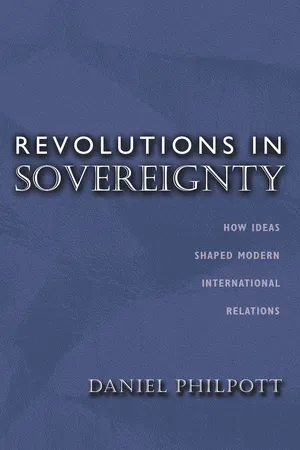
Revolutions in Sovereignty
How Ideas Shaped Modern International Relations
- 352 pages
- English
- ePUB (mobile friendly)
- Available on iOS & Android
eBook - ePub
About this book
Information
Publisher
Princeton University PressYear
2010Print ISBN
9780691057477
9780691057460
eBook ISBN
9781400824236
PART ONE:
REVOLUTIONS IN SOVEREIGNTY
ONE
INTRODUCTION: REVOLUTIONS IN
SOVEREIGNTY
VIRTUALLY ALL OF the earth’s land is parceled by lines, invisible lines that we call borders. Within these borders, supreme political authority typically lies in a single source—a liberal constitution, a military dictatorship, a theocracy, a communist regime. This is sovereignty. Hobbes and Bodin and Grotius first wrote of the modern version of the principle in the sixteenth and seventeenth centuries; by the middle of the seventeenth century, states across Europe practiced it. A generation ago, the sovereign state captured nearly the entire land surface of the globe when European colonies received their independence. Sovereignty has come closer to enjoying universal explicit assent than any other principle of political organization in history.
But sovereignty is again the issue. During the past decade, the United Nations has lent its imprimatur to intervention in war-torn, malnourished, dictatorial, and minority-persecuting states, in Iraq, Somalia, Haiti, Rwanda, Bosnia, Cambodia, Liberia, and elsewhere. Fifteen European states have formed a European Union, creating among other things a common currency among eleven of these states, continuing an amalgamation of governance begun in 1950 with the founding of the European Coal and Steel Community. Intervention, integration—both challenge the sovereign state’s territorial supremacy. They are conspicuous challenges—“revolutions in sovereignty,” as I will call them. They overthrow some of the basic rules of authority that define international relations, rules that I will call “the constitution of international society.”
When a political order ruptures, in international politics as in national politics, its rivaling factions will send their scribes to seek out the order’s origins—conservatives, to fortify its pedigree; revolutionaries, to expose its flawed foundations. More measured scholars will also interest themselves in the order, but will eschew declaiming, seeking instead simply to understand what sorts of winds first brought it about and what sorts are now carrying it away. Mine is this task of understanding. If our sovereign states system is cracking, how did it ever come to be?
That is the question that I propose to answer in this book. My premise: The sovereign states system arrived most commandingly through revolutions. Through two prominent ones in particular. The first is what political scientist John Gerard Ruggie describes as “the most important contextual change in international politics in this millennium”—the shift in Europe from the medieval world to the modern international system, which took full shape at the Peace of Westphalia in 1648.1 The system then spread, rapidly expanding across the globe when the colonial empires collapsed after World War II. Colonial independence is the second revolution. These forging moments, which successively wrought the sovereign state system, were both the yield of volcanic periods, ones of wars, crises, and imbroglios that in the end amounted to refining furnaces, casting an apparatus so hardy that it came to organize every piece of land on the globe, an apparatus that has only now begun to crack. It is these casting moments whose causes I want to discover. I want to discover the origins of international revolutions just as historians and sociologists seek the origins of the French, American, and Russian revolutions.
My central claim: Revolutions in sovereignty result from prior revolutions in ideas about justice and political authority. What revolutions in ideas bring are crises of pluralism. Iconoclastic propositions challenge the legitimacy of an existing international order, a contradiction that erupts in the volcano—the wars, the riots, the protests, the politics—that then brings in the new order. This, through a typical chain of events: The ideas convert hearers; these converts amass their ranks; they then demand new international orders; they protest and lobby and rebel to bring about these orders; there emerges a social dissonance between the iconoclasm and the existing order; a new order results. In early modern Europe, it was the Protestant Reformation that brought a century of war, culminating in the Thirty Years’ War (1618–1648), which in turn brought about a system of sovereign states. In the twentieth century, it was nationalism and racial equality that brought the revolts, protests, and colonial wars that extended the system globally. For both revolutions, international agreement upon sovereign statehood was the terms on which a crisis of pluralism was settled.
My claim, too, is about what revolutions in sovereignty are not. That is, they are not merely the aftereffects of the rise and fall of great powers, or of slow shifts in class structure or political structure, in technology, commerce or industrial production, or in the division of labor, methods of warfare, or population size. Such forces contribute to the upheavals but do not solely bring them about. It takes a revolution in ideas to bring a revolution in sovereignty.
I suspect, though, that most citizens of most international societies would find the very idea of an international revolution a bizarre notion, a malapropism. Why? Because they widely believe that politics within borders and politics between polities are two sorts of realms with two sorts of habits. Within borders there are constitutions and there are revolutions. We enjoy civic familiarity; we fly flags symbolizing our common life; we recall, in eulogy or censure, a revolution, a founding moment, one that we remember through paintings, monuments, oratory, and criticism, through lessons and stories about battles, debates, heroes, and traitors. We speak of 1776, 1789, or 1917, of the spirit of the revolution, of the intentions of founders. We do not, however, exalt, versify, or acclaim in reverent public ritual the 1648 Peace of Westphalia, which christened modern international relations, nor repeat lore to schoolchildren about the early 1960s, when Britain, France, and Belgium freed their colonies.2 Only scholars write of such things, and they do so cooly to categorize and chronicle, not to pronounce or polemicize.
The eccentricity of international revolutions, the reluctance to remember them, I further suspect, lies in the strangeness of the very idea of an international constitution, an order that arranges the authority of states, empires, colonies, nations, the United Nations, and the European Union much as a domestic constitution establishes courts, the powers of presidents, and the federal rights of regions. That there are others states, empires, and the like, each having its own authority and having the authority to trade and negotiate and fight with each other, is something that most citizens of most states during most times take for granted, and do not consider the product of anyone’s design or the work of architects or framers. In fighting, trading, and negotiating, states and their citizens reflect upon these rules no more than baseball players reflect upon the underlying rules of the game when they throw to first base or steal second base. Fighting, trading, negotiating, they believe, is the real business of nations.
Behind the perceived eccentricity of both the revolutions and the constitutions, I finally suspect, lies beliefs about what kinds of forces dominate the two realms, domestic and international politics. Within borders, we more readily believe that notions of justice, both laudable and damnable, energize politics. Beyond, we are more awed by power—military, economic, political, and technological. Marxists, materialists, prophets of technology, and mavens of other academic schools have posed variants of this view. But the most widespread version, not only among scholars but also, I think, among statespersons and many citizens, has been the Realist school, which regards wars, alliances, balances of power, and the rises and falls of states and empires as the germane international events, and which holds that the contest over the international distribution of military and economic power is what propels these events. The separation is not hermetic. There are materialists and even Realists who grant significance to domestic politics; and there are idealists in international politics. But the emphases are clear. In international relations scholarship, 92 percent of hypotheses and 94 percent of variables used by scholars were Realist, according to one analyst.3
Publics determine their canons of memory according to what forces they think influential. We would more likely remember orders and revolutions if we thought them the fruit of will and design, ideas and vision. Otherwise, why take seriously the founders, speeches, and battles? But if we think ideas infirm and the drive for material power eclipsing, we will also think that rules and orders are deceptive emissions, forgettable surface reflections, and that references to them are strange usages, fragments of false grammar. Here lies the link between the eccentricity of the revolutions and constitutions, and skepticism toward ideas as their cause. Rather than the rule of nonintervention established at Westphalia or the 1960 United Nations resolution that declared colonies free, we are more likely to remember the longbow at Agincourt, the rise of French armies and finance under Richelieu, the rise of Germany, the decline of the British Empire, and other rises and falls, alliances and balances, and wars. It is inside the state where constitutions matter, where ideas hold sway, where the order was once different but then altered by wise founders or reckless revolutionaries; outside the realm, ideas are muffled by necessity, by the workings of colossal, impersonal forces.
This view I want to challenge. What happens between states is less the handiwork of impersonal forces and more like the idea-infused polity than we are used to thinking. International relations has always had a constitution, an order defining the very entities that rise, fall, ally, balance, negotiate, make war, and make peace, decreeing whether the world is organized into a system of states rather than a Holy Roman Empire, a European Union rather than a simple system of states, whether states may hold colonies, whether stateless nations may become states, and whether states may intervene in one another’s affairs. Publics in most times and places may take for granted the significance of these orders. But at particular charged times and places, aristocrats, liberals, Protestants, Catholics, nationalists, and colonists have shouted and fought both for and against their provisions. For such parties, the basic rules of authority around which the international world is organized represent exaltations or denials of justice.
It could turn out, though, that this advocacy and laud and protest and outrage amount to what Marx called false consciousness. Taking a long view, perhaps the beliefs of particular strata in the justice or injustice of international rules of authority are of little importance, and new orders emerge or fade only when armies, economies, and military technology first emerge or fade. This thinking, too, I want to challenge. The moral ideas of Protestants, nationalists, and liberal democrats, about rights to worship, self-determination, racial equality, and human rights are not just assessments that we now call “political philosophy,” but are effectual in creating new authority. Tumultuous disputation yields novel orthodoxy; revolutions in ideas bring revolutions in sovereignty; and so the revolutions are worth remembering.
My argument will likely encounter two sorts of critics, each stirred by opposite convictions, both difficult to satisfy at once. One sort is the skeptic who doubts ideas’ influence on politics. Ideas, for this doubter, may adhesively bind the joints of political structures by inducing people to think them just or satisfactory, or they may inspire this or that politician’s zeal, but on balance, in the aggregate, on the big events, they have little effect. This view reaches back to Karl Marx, who replaced Hegel’s history of the unfolding of spirit with a history driven by class conflict, and to Emile Durkheim, who thought a society’s politics, religion, and philosophy to be mostly the products of its underlying division of labor.4 It finds resonance, too, in much of historical sociology of the past generation, which finds huge structures of class and state institutions behind large historical developments—the formation of the state, social revolutions, and the development of democracy and dictatorship. We find the view, finally, in the long tradition of realpolitik, in which international orders are fashioned by the competition for wealth, land, and power, particularly between states.5
Meeting such skepticism invokes the book’s project: a demonstration of ideas’ influence. I want to show that revolutions in sovereignty, Westphalia and colonial independence, occur when ideas arrive on the scene, and proceed most vigorously in those locales where ideas are most voluble. Likewise, revolutions do not correspond well enough in time and place with the skeptic’s structures—class, technology, the balance of power—to earn these structures the bulk of the credit for causing the revolutions. Along with asserting these correlations of time and place, I will also offer an account of the events, incidents, movements, and methods by which ideas moved politics—that is, a story of how revolutions in sovereignty result from revolutions in ideas. Through these methods, I will engage this skepticism, posing its plausible account of each revolution, but seeking to reveal its inadequacy for explanation.
The other sort of criticism doubts the value of this engagement. The view of these critics is quite opposite to the skeptics’. To them, the influence of ideas is not dubious, but unexceptional. It requires no proof, but is obvious to anyone who has ever considered the matter. The demonstration, then, is unnecessary. If these critics implacably insist that skepticism of ideas is implausible, it will be difficult to answer them. But we may nonetheless ask them to account for the tenacious prestige of such skepticism. It rolls forward, after all, inside and outside the academy. Realism, as I have mentioned, persists formidably in the academic study of international relations, but it is also voiced, again and again, in policy journals, in opinion pieces, in the State Department, Defense Department, and White House, in the Congress, and in the foreign counterparts of these institutions, behind closed doors, out in public, pervasively. It is true that during the past decade, more and more scholars in international relations have turned back to ideas, arguing for their influence upon foreign aid policy, states’ responses to outside threats, nuclear weapons policy, the end of the Cold War, and other international phenomena. Many call themselves “constructivists,” emphasizing that national interests are defined or “constructed,” not fixed, and that ideas, meanings, and discourses contribute to this definition of interests. Nearly all of these scholars, though, treat seriously the Realist hypothesis that the apparent handiwork of ideas is instead the fruit of the state pursuing material interests. They consider this argument, they provide evidence against it, and in so doing they implicitly pay tribute to its stature.6 This combination of respect for and dissent from skepticism of ideas is what I adopt here.
To explain how revolutions in ideas brought the revolutions in sovereignty that brought us the system of sovereign states that so essentially defines world politics today, even if certain trends now depart from it, is my central purpose in this book. Making the case will require fashioning a couple of tools, which are important aims of the book, too. First, I describe that which is revolutionized: the constitution of international society. Only if we know just what an international constitution is can we identify and compare revolutions in sovereignty. This description appears in chapter 2. In chapter 3, I tell a brief history of constitutions of international society in the West, illustrating them and identifying their key revolutions. The second tool is an account of how ideas exert influence in international relations, and even more generally, in politics. In chapter 4 I develop a framework to describe this influence, one that asserts two crucial...
Table of contents
- Cover
- Half Title
- Title
- Copyright
- Dedication
- Contents
- Tables and Figures
- Preface
- Part One: Revolutions in Sovereignty
- Part Two: The Founding of The Sovereign States System at Westphalia
- Part Three: The Revolution of Colonial Independence: The Global Expansion of Westphalia
- Part Four: The Revolutions Considered Together
- Notes
- Bibliography
- Index
Trusted by 375,005 students
Access to over 1.5 million titles for a fair monthly price.
Study more efficiently using our study tools.
Frequently asked questions
Yes, you can cancel anytime from the Subscription tab in your account settings on the Perlego website. Your subscription will stay active until the end of your current billing period. Learn how to cancel your subscription
No, books cannot be downloaded as external files, such as PDFs, for use outside of Perlego. However, you can download books within the Perlego app for offline reading on mobile or tablet. Learn how to download books offline
Perlego offers two plans: Essential and Complete
- Essential is ideal for learners and professionals who enjoy exploring a wide range of subjects. Access the Essential Library with 800,000+ trusted titles and best-sellers across business, personal growth, and the humanities. Includes unlimited reading time and Standard Read Aloud voice.
- Complete: Perfect for advanced learners and researchers needing full, unrestricted access. Unlock 1.5M+ books across hundreds of subjects, including academic and specialized titles. The Complete Plan also includes advanced features like Premium Read Aloud and Research Assistant.
We are an online textbook subscription service, where you can get access to an entire online library for less than the price of a single book per month. With over 1.5 million books across 990+ topics, we’ve got you covered! Learn about our mission
Look out for the read-aloud symbol on your next book to see if you can listen to it. The read-aloud tool reads text aloud for you, highlighting the text as it is being read. You can pause it, speed it up and slow it down. Learn more about Read Aloud
Yes! You can use the Perlego app on both iOS and Android devices to read anytime, anywhere — even offline. Perfect for commutes or when you’re on the go.
Please note we cannot support devices running on iOS 13 and Android 7 or earlier. Learn more about using the app
Please note we cannot support devices running on iOS 13 and Android 7 or earlier. Learn more about using the app
Yes, you can access Revolutions in Sovereignty by Daniel Philpott in PDF and/or ePUB format, as well as other popular books in Politics & International Relations & Political History & Theory. We have over 1.5 million books available in our catalogue for you to explore.