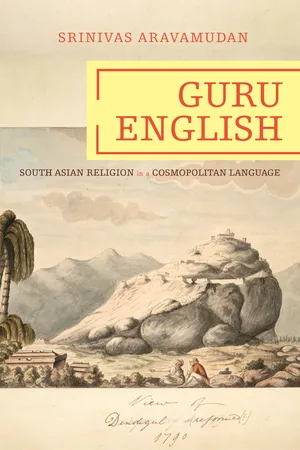
Guru English is a bold reconceptualization of the scope and meaning of cosmopolitanism, examining the language of South Asian religiosity as it has flourished both inside and outside of its original context for the past two hundred years. The book surveys a specific set of religious vocabularies from South Asia that, Aravamudan argues, launches a different kind of cosmopolitanism into global use.
Using "Guru English" as a tagline for the globalizing idiom that has grown up around these religions, Aravamudan traces the diffusion and transformation of South Asian religious discourses as they shuttled between East and West through English-language use. The book demonstrates that cosmopolitanism is not just a secular Western "discourse that results from a disenchantment with religion, but something that can also be refashioned from South Asian religion when these materials are put into dialogue with contemporary social move-ments and literary texts. Aravamudan looks at "religious forms of neoclassicism, nationalism, Romanticism, postmodernism, and nuclear millenarianism, bringing together figures such as Swami Vivekananda, Sri Aurobindo, Mahatma Gandhi, and Deepak Chopra with Rudyard Kipling, James Joyce, Robert Oppenheimer, and Salman Rushdie.
Guru English analyzes writers and gurus, literary texts and religious movements, and the political uses of religion alongside the literary expressions of religious teachers, showing the cosmopolitan interconnections between the Indian subcontinent, the British Empire, and the American New Age.
- 336 pages
- English
- ePUB (mobile friendly)
- Available on iOS & Android
eBook - ePub
About this book
Information
Publisher
Princeton University PressYear
2011Print ISBN
9780691118284
9780691118277
eBook ISBN
9781400826858
CHAPTER ONE
Theolinguistics: Orientalists, Brahmos, Vedantins, and Yogis
Let the Persian or the Greek, or the Roman, or the Arab, or the Englishman march his battalions, conquer the world, and link the different nations together, and the philosophy and spirituality of India is ready to flow along the new-made channels into the veins of the nations of the world. The calm Hindu’s brain must pour out its own quota to give to the sum total of human progress. India’s gift to the world is the light spiritual.
—Swami Vivekananda, Lectures from Colombo to Almora
EUROPEAN COMPARATIVE FRAMEWORKS dominated the first attempts to render South Asian religious practices into English. By resituating ancient Sanskrit texts and granting them greater performative force than they had at that point in time, the British orientalists demonstrated a neoclassical sensibility. The recent Mughal hegemony in northern India was displaced by a convergent account of Hinduism as the religion of the majority population. The textualism of such an approach also favored Brahmanical interpreters of Hindu religion over popular practitioners. An antiquarian idealization of texts and doctrines allowed for a rationalizing account of the revelations behind Hindu practices and an etiological narrative about historical distortions. The Christian and deist affiliations of these investigators influenced the selection of texts and the objectives of the first translations. The hired interlocutors of the orientalists had ample indication of the kinds of texts and interpretations sought by their employers and were most enterprising in finding appropriate originals—and sometimes inventing them.
Such neoclassicism had a delayed impact when Hindu modernizers took up the task of the religious rejuvenation of their peers and the proselytization of others. Keeping with orientalist simplifications that demonized Islam as a foreign entity and depicted the non-Islamic majority as civilized but disenfranchised, many Hindu revivalists built on the deistic and monotheistic interpretation of Brahman-dominated Hinduism suggested by these recent interventions. One goal was to go beyond traditional Brahmanical ritual and decry the priestly stranglehold on religion. A Hindu deism or (even a moderate monotheism) was the foundational clearing to be carved out of a polytheistic forest. As indigenous religion consisted of orthopraxies rather than orthodoxies, and as only specific sects have linear histories, Romila Thapar has suggested that premodern Hinduism had never become “a uniform, monolithic religion,” but had always remained “a flexible juxtaposition of religious sects.” The modern construction of “syndicated Hinduism” is to be understood as an administrative reorganization of the “rest” under the sign of a renovated Brahmanism.1
In this chapter, I first discuss some of the early innovations of the orientalists and their linguistic imitators, followed by a section on the significant impact of Rammohun Roy’s dialogue with Unitarianism. The continuation of Brahmo theism in place of Rammohun’s deism under the syncretic experimentation of Keshub Chunder Sen’s New Dispensation religion is the focus of the third section. The chapter is rounded off with an account of how neo-Advaita and yoga as espoused by spiritual entrepreneurs such as Vivekananda and Yogananda took up the mission of a rejuvenated Hinduism for the twentieth century, in place of the Christianized legacy of the Brahmos that had been crafted for a mid-Victorian audience. Such neoclassicism, disseminated through linguistic innovation and doctrinal suppleness, participates in and creates a representational framework for the part-orientalist, part-anglicist theolinguistics that is Guru English. This structure features Guru English as both specialized register and generalized discourse.
The brilliance of first-generation orientalists such as William Jones, Charles Wilkins, and Nathaniel Brassy Halhed, who went to India in the late eighteenth century, turned out to be no guarantee against the dismissal of South Asian pasts by anglicists such as William Bentinck, Charles Trevelyan, and Thomas Macaulay in the 1830s. Orientalist antiquarianism was quickly undermined by the values of modernizing utilitarianism. William Jones’s intense Hinduphilia was countered by James Mill’s virulent Hinduphobia: Mill’s suspicion of India under-girding his History of British India was magisterially emphasized by his declaration that a trip there would be unwise. Such a trip would only compromise Mill’s search for impartial objectivity and was therefore best avoided. A European vantage point was better, from which evidence could be sifted and judged. Knowledge of India was “singularly defective” because of “partial impressions” acquired by observers. Instead, a “cursory survey” by a writer who had never visited India and who had only elementary acquaintance with its languages would nonetheless approximate judicial neutrality.2
The reverence that some South Asianists still have for the orientalists is readily matched by modernizing attacks on the Indo-European civilizational myths propagated by a line of orientalists from Jones to Max Müller, Mircea Eliade, and Louis Dumont.3 Religion and philology once ruled supreme for orientalist erudition on South Asia, whereas more recent materialist approaches foregrounding economics or politics are skeptical of past disciplinary biases toward religion and culture. For every David Kopf who still defends orientalism, Susobhan Sarkar (or more recently, Javed Majeed) shows that utilitarians were not as dismissive of India as is sometimes made out. Earlier, Rammohun Roy or Syed Ahmed Khan more readily accepted criticism about their societies than later Indian and Pakistani nationalists would ever concede.4 Framed in terms of identifying the hitherto excluded discontents of the colonial state formation, the discoveries of the influential historical journal Subaltern Studies in recent decades constitute a major advance. More recently, however, subalternist scholarship has fallen victim to its own success, becoming increasingly mired in theoretical disagreements about the relative weight to be accorded to Marxist versus postmodernist methodologies, and to political-economic indicators versus cultural-religious phenomena. Additionally, the historiographical exceptionalism of many Indian historians who ignore comparative frameworks has been roundly criticized.5
For these reasons, the battle between mythopoetic orientalism and antiorientalist critique continues in complex and displaced ways. Edward Said’s disciplinary intervention into the contemporary politics of knowledge and his dressing-down of European orientalism as malevolent colonialist teleology has become a tenacious point of reference among a variety of South Asianist cultural scholars who wish to modify his insights to their object. Within India, the metanarrative around urban-educated middle-class nationalism that characterizes ruling-class hegemony is now under challenge by groups putting forward alternative histories, whether Dalit, tribal, or regional. Given these new disciplinary and political challenges, Ashis Nandy cannily suggests that there are still four kinds of stories that continue to be told about Indian modernity. While the first template is the progress narrative of Westernization and modernization familiar to early colonial historians and still popular among South Asianists in the era of globalization, the second is the opposing narrative, involving Hindu nationalist resurgence against British domination, as the next chapter discusses in relation to Bankimchandra Chatterjee and Sri Aurobindo. The third template involves the Gandhian departure from both the European thesis and the indigenous antithesis, one that includes considerable autocritique of Indian society even as it consolidates Brahmanical modernization by reference to asceticism, nonviolence, and self-denial. The fourth template, and only recently emergent according to Nandy, is a post-Gandhian set of popular political movements that rejects upper-caste leadership and questions hegemony and bourgeois consolidation from the standpoint of various subaltern groups representing a demographic majority that was hitherto silenced. It is this standpoint that was brought to the forefront of history and anthropology by Subaltern Studies, even though this is, properly speaking, not so much one standpoint for another nationalist narrative as a location from which multiple epistemic fractures and many other microhistories can be described from below.6
Although related to these four templates, Guru English marks a fifth strand, with a cosmopolitan and diasporic logic that articulates countercommunities and virtual spaces rather than just replicating the naturalized boundaries of national or regional imaginings. Guru English also takes off along with the early Western assimilationists, sometimes tests its mettle against Hindu revivalists, and at other times beds down with them. However, when compared with the third and fourth templates, Guru English eschews the groundedness of Gandhian nationalist politics, and has little connection with post-Gandhian regional populisms. Rather, Guru English heads for political futures that are still only partially realized by cosmopolitan deracination. Such theolinguistic outreach is a direct function of the cosmopolitan-national interface. Relying on modernized and often transnational mediation of supposedly traditional practices and doctrines, Guru English is sometimes vehicle and at other times fabricator.
Guru English has been hitherto ignored as a generalized theolinguistics, perhaps because it reveals the pattern of the “global popular” rather than that of a substantive historiography or discourse located in South Asian space. Frivolous and extraterritorial, Guru English can also be seen as unevenly or insufficiently globalized. The cultural consumerism of the global popular, which can, for instance, be discerned through the action-attraction movies produced by Hollywood, Bollywood, or Hong Kong cinema, suggests a series of related particularities and material practices rather than any grand narrative of cultural globalization.7 The formation of the global popular—in its most expanded sense, which ought to include Guru English—is difficult to historicize because of the fragmentary and transcommunal nature of cosmopolitan religious thematics and dispositions. However, more recently there have been suggestions that the postcolonial is itself a globalizing version of the commodifiable and the exotic, in which case Guru English is an excellent specific instance of a more generalized phenomenon.8
Conventional histories of philosophy and religion are of little help here, although much can be gleaned from individual case studies that can be put together to designate a larger whole. Early movements that retail South Asian religion for an international audience—especially those featuring the orientalists, the Brahmos, the Theosophists, and the early Vedantists—form an important prehistory for Guru English and need to be studied more carefully in terms of the present as their eventual outcome.9 Gauri Viswanathan’s brilliant analysis of conversion as creating tension between civil society, religion, and political authority—and thereby deconstructing secular modernity—furnishes important pointers. However, Guru English is perhaps better understood as a medium of cosmopolitan expression or transidiomatic background rather than as the critical agency enacted by narratives of conversion. Along with the work done by theorists of relativism such as Bruno Latour and Barbara Herrnstein Smith, Viswanathan’s book has suggested the adoption of more flexible approaches to the question of truth within pluralized and incommensurable contexts.10 Rather than “meticulous[ly] construct[ing] ethnographic plots” of conversion in the manner of the colonial census as documented by Viswanathan, Guru English represents a transcommunal phantasm of global interactivity without a strong sociological basis—or doctrinal core—to underpin its claims. A number of religious universalisms and cosmopolitanisms come together through Guru English, allowing these mutants and recombinants to jostle, proliferate, and clash within the confines of a common theolinguistic frame.
Peter van der Veer’s call for an interactional perspective in historical investigation can help mitigate the disciplinary proprietorship that field specialists exhibit toward those arguing for a thoroughly hybridized cultural history. While studying the joint impact of British Christianity and Indian Hinduism on each other, van der Veer uncovers a series of paradoxes concerning the manner in which secularity and religiosity were jointly constructed and policed by the modern colonial state apparatus and by each other. Critiquing both Marxist materialist and Weberian culturalist accounts of the rise of modernity, van der Veer demonstrates that the emergent public sphere in both the metropolis and the colony was strongly influenced by the rise of voluntary religious movements and also by the universalization of religion as a cultural category. Aided by comparative philology, nationalists were especially keen to find their own path to an alternative modernity that combined spirituality, science, and political progress, even as colonial officials were triangulating their secular rule against the mobilization of British Christian missionaries and South Asian neoreligious revival. It helped enormously that neophyte spiritual movements in the West (such as mesmerism, Theosophy, or paganism) could project intellectual affinities with analogs from ancient India, however fantasmatic these affinities might have seemed to skeptical observers then, or might still seem to us now.11 Guru English operates within this hazy space of East-West interconnection, a theolinguistics amply enabled by the fuzzy logic of comparative philology and the dizzy identifications of colonial desire. A result of interactional, transnational, translational, and transidiomatic exchanges, Guru English sometimes produces the minimal amount of communicative noise and sometimes engenders substantial neoreligious movements that animate practi...
Table of contents
- Cover
- Half title
- Title
- Copyright
- Dedication
- Contents
- Acknowledgments
- Introduction
- Chapter One Theolinguistics: Orientalists, Brahmos, Vedantins, and Yogis
- Chapter Two From Indian Romanticism to Guru Literature
- Chapter Three Theosophistries
- Chapter Four The Hindu Sublime, or Nuclearism Rendered Cultural
- Chapter Five Blasphemy, Satire, and Secularism
- Chapter Six New Age Enchantments
- Afterword
- Notes
- Index
Trusted by 375,005 students
Access to over 1.5 million titles for a fair monthly price.
Study more efficiently using our study tools.
Frequently asked questions
Yes, you can cancel anytime from the Subscription tab in your account settings on the Perlego website. Your subscription will stay active until the end of your current billing period. Learn how to cancel your subscription
No, books cannot be downloaded as external files, such as PDFs, for use outside of Perlego. However, you can download books within the Perlego app for offline reading on mobile or tablet. Learn how to download books offline
Perlego offers two plans: Essential and Complete
- Essential is ideal for learners and professionals who enjoy exploring a wide range of subjects. Access the Essential Library with 800,000+ trusted titles and best-sellers across business, personal growth, and the humanities. Includes unlimited reading time and Standard Read Aloud voice.
- Complete: Perfect for advanced learners and researchers needing full, unrestricted access. Unlock 1.5M+ books across hundreds of subjects, including academic and specialized titles. The Complete Plan also includes advanced features like Premium Read Aloud and Research Assistant.
We are an online textbook subscription service, where you can get access to an entire online library for less than the price of a single book per month. With over 1.5 million books across 990+ topics, we’ve got you covered! Learn about our mission
Look out for the read-aloud symbol on your next book to see if you can listen to it. The read-aloud tool reads text aloud for you, highlighting the text as it is being read. You can pause it, speed it up and slow it down. Learn more about Read Aloud
Yes! You can use the Perlego app on both iOS and Android devices to read anytime, anywhere — even offline. Perfect for commutes or when you’re on the go.
Please note we cannot support devices running on iOS 13 and Android 7 or earlier. Learn more about using the app
Please note we cannot support devices running on iOS 13 and Android 7 or earlier. Learn more about using the app
Yes, you can access Guru English by Srinivas Aravamudan in PDF and/or ePUB format, as well as other popular books in Social Sciences & Asian Literary Criticism. We have over 1.5 million books available in our catalogue for you to explore.