Today the United States has one of the highest poverty rates among the world's rich industrial democracies. The Failed Welfare Revolution shows us that things might have turned out differently. During the 1960s and 1970s, policymakers in three presidential administrations tried to replace the nation's existing welfare system with a revolutionary program to guarantee Americans basic economic security. Surprisingly from today's vantage point, guaranteed income plans received broad bipartisan support in the 1960s. One proposal, President Nixon's Family Assistance Plan, nearly passed into law in the 1970s, and President Carter advanced a similar bill a few years later. The failure of these proposals marked the federal government's last direct effort to alleviate poverty among the least advantaged and, ironically, sowed the seeds of conservative welfare reform strategies under President Reagan and beyond.
This episode has largely vanished from America's collective memory. Here, Brian Steensland tells the whole story for the first time--from why such an unlikely policy idea first developed to the factors that sealed its fate. His account, based on extensive original research in presidential archives, draws on mainstream social science perspectives that emphasize the influence of powerful stakeholder groups and policymaking institutions. But Steensland also shows that some of the most potent obstacles to guaranteed income plans were cultural. Most centrally, by challenging Americans' longstanding distinction between the "deserving" and "undeserving" poor, the plans threatened the nation's cultural, political, and economic status quo.
eBook - ePub
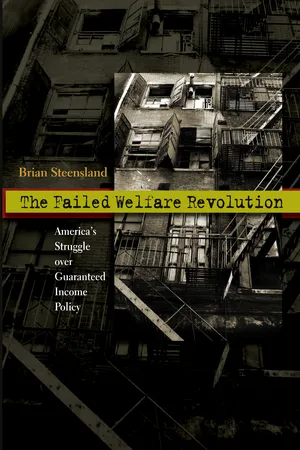
The Failed Welfare Revolution
America's Struggle over Guaranteed Income Policy
- 320 pages
- English
- ePUB (mobile friendly)
- Available on iOS & Android
eBook - ePub
About this book
Information
Publisher
Princeton University PressYear
2011Print ISBN
9780691177977
9780691127149
eBook ISBN
9781400837489
CHAPTER ONE
The Rise of Guaranteed Annual Income
The New Deal era is typically viewed as the “big bang” of the American welfare state. President Roosevelt’s legislation established the basic template of social provision that shaped federal policy development during the nation’s pivotal episodes of reform, and it continues, however embattled, to exert considerable influence today. The idea of guaranteeing citizens a minimum annual income on the basis of need alone broke sharply with this New Deal template. This raises two related questions: Why did the idea arise in the first place? And why did the idea, which from today’s vantage point appears quite liberal, garner early support from across the political spectrum?
The answer to the first question can be found by looking at the intersecting impact of influential stakeholders, changing cultural perceptions, and new government capacities. During the Kennedy era, experts inside and outside the government considered GAI plans because their views of work, opportunity, and justice were changing. Factors such as the country’s postwar affluence, troubling patterns in unemployment, and concerns about technology in the workplace led to a reconsideration of the relationship between employment and income. The civil rights movement gave policy experts further cause to reevaluate the status quo. They increasingly recognized both the sources of systemic injustice in American society and that unemployment and industrial automation took a disproportionate toll on blacks. The consequence was the willingness, if not the imperative, among some experts and social commentators to think outside the dualities of existing antipoverty policy, since these new ideas and trends challenged the assumption that the able-bodied poor were responsible for their own impoverished condition and were therefore undeserving of government assistance. Despite these changes in thinking, however, GAI proposals received little traction within government policymaking circles during the Kennedy era because the institutional conditions within government were not auspicious. It was Johnson’s War on Poverty initiatives that gave government experts the mandate, political autonomy, and organizational capacity conducive to fully developing GAI proposals as part of a broader plan to fight poverty.
Concerning the second question, a few factors contributed to the appeal of GAI plans across the ideological spectrum. The plans were new and ambiguous. They had few serious precedents and therefore were not already associated with any particular political party or ideological position. Their details were also underspecified. The term “guaranteed income” encompassed a variety of proposals that differed considerably in their eligibility criteria, delivery mechanisms, and benefit levels. The plans could be generous or stingy, universal or narrowly targeted. There were also different rationales for proposing GAI plans that aligned with competing causal stories about the sources of poverty. So in some cases, experts guided by different policy paradigms favored objectively similar plans. The two causal stories that played the most central role in the rise of the plans were those that saw either the deficiencies of the labor market or the deficiencies of the welfare system itself as the main source of poverty. People holding the latter view, at least during this early stage, further supported GAI plans because they promised to shrink the scope of the federal bureaucracy and the government’s role in the labor market. Despite these differences in detail and rationale, however, the element all GAI proposals shared was their challenge to the symbolic and programmatic categories inscribed in the existing welfare system, since the plans were not based on work capacity but on economic need, family size, or both.
Consideration of GAI proposals was part of a broader effort to fight poverty, reform the welfare system, and expand rights and opportunities for blacks. While each of these issues received substantial attention during the early 1960s, GAI plans themselves received little. Prior to 1966, the idea was still limited largely to policy circles and discussions among experts. On the rare occasions that they did receive attention, the proposals were characterized as marginal and “far out,” since the notion of guaranteeing citizens basic economic security was still beyond most people’s imaginations.
THE SEEDS AND THE SOIL
The Categorical Nature of American Welfare Policy
Since the early 1800s, both private charity and public social provision have categorized the poor based on social expectations that they work.1 Prior to this period, there was little organized support for the poor. Family and community were largely responsible for caring for the needy. More institutional forms of poor support, such as poorhouses, developed during the nineteenth century alongside the social disruptions that accompanied the spread of capitalist enterprise and urbanization. Historians trace the roots of categorizing the poor within these new institutions to the increasing prevalence of wage labor coupled with already strong strands of Anglo-American individualism that emphasized self-reliance. Poorhouses reinforced the work ethic by restricting their provision to the “impotent” poor while the “able-bodied” were typically left to fend for themselves, mainly through greater participation in the labor market. The rise of “scientific charity” in the late 1800s, which sought to systematize public and private sector provision for the poor, further codified these distinctions. Reformers during this era worried that the poor might view relief—especially public relief—as an entitlement, so they sought to purge the “able-bodied” from poorhouses and to keep relief even for the deserving poor as a primarily private endeavor.2
A new wave of reform during the Progressive Era generated policy innovations that Roosevelt would incorporate into his subsequent New Deal legislation. Women’s groups lobbied for mothers’ pensions and by 1920 forty states had enacted them, despite opposition from charities that argued that support for these women should remain in the private sector.3 Though these pensions were for the deserving poor (widows with children), their benefit levels varied from meager to generous because program administration was left up to individual states. In 1935, Roosevelt’s Social Security Act used mothers’ pensions as the model for the Aid to Dependent Children (ADC) program. As scholars have noted, the Social Security Act created programs that both reflected and reinforced existing distinctions between categories of people based on work expectations, race relations, gender ideology, and local labor market conditions.4 ADC was no exception. Lawmakers anticipated that the program would generate little controversy because it was for a “deserving” category of recipient. Mothers with young children were expected to stay in the home and raise good citizens, so they merited government support. Furthermore, since Congress excluded agricultural, domestic, and casual workers from New Deal programs, the program functionally excluded most blacks. For these reasons, the structure of the ADC program was conservative in many ways. Yet it also marked a significant breakthrough. The program was the first federal recognition of single mothers as a deserving group worthy of social provision.5
By the late 1960s, the ADC program (which had been renamed Aid to Families with Dependent Children, or AFDC, in 1962) was the antipoverty program most closely identified with the increasingly pejorative term “welfare.”6 Two legislative changes after 1935 set the course for the program’s transformation from being relatively uncontroversial to being embattled.7 The first change took place in 1939, when another New Deal program, Old Age Insurance, expanded its eligibility criteria to include the most deserving portion of the existing ADC population: the wives and children of deceased workers who qualified for federal retirement benefits. The removal of this deserving group from the ADC rolls meant that the program’s overall composition changed, and, after World War II, it began to serve increasing numbers of unwed mothers and racial minorities. It was during this postwar period that welfare backlash, particularly in the South, began on a limited scale. In 1962, Congress expanded the program by allowing states to provide benefits to two-parent families headed by unemployed men. This meant that male unemployment now became an issue addressed through the “welfare” system, which further heightened the program’s stigmatized status. Able-bodied, unemployed men have always been the paradigmatic “undeserving” population. This change in the AFDC system foreshadowed the controversy over GAI proposals, since male unemployment was at the center of the debate over GAI plans.
In the postwar period, these categories still constituted the ideological foundation of the American welfare state. Because benefits for undeserving populations were administered locally rather than federally, the undeserving poor, if they were eligible for public assistance at all, received benefits that varied widely among states in their levels of support. Many considered these benefits to be grossly inadequate and existing eligibility standards to be too restrictive, especially during a period of postwar economic affluence. The emergence of GAI proposals in the early 1960s challenged the ideological core of this existing system.
The Origins of Guaranteed Annual Income
Though GAI legislation first appeared on the governmental agenda in the 1960s, the notion of having the government provide citizens with a basic minimum annual income developed alongside the modern welfare state during the interwar period, first in England and then in the United States. Historically, the idea has had many names, including state bonus, social dividend, social wage, citizenship income, and social credit. Some of the earliest published mentions, in the form of a state bonus, appeared in England in the years following World War I. Others proposed the idea during the 1930s in the midst of the Great Depression and the Keynesian revolution in economics. Social workers and social movement leaders in the United States advanced GAI plans as a challenge to Roosevelt’s legislative agenda. In England, economists developed proposals for a “social dividend” that by the 1940s were held out as an alternative to the dominant welfare state paradigm outlined in the Beveridge Report.8
During this same period, the economists Milton Friedman and George Stigler (both future Nobel laureates) developed the idea of the negative income tax (NIT), which was the type of GAI plan that ultimately served as the basis for Nixon’s proposal. While working at the Treasury Department, Friedman originally formulated the concept as a way to even out the tax penalty for fluctuations in earnings among low-income workers in order to make the tax system more equitable.9 In 1946, Stigler published an article in the American Economic Review in which he proposed an NIT program as a more effective method of alleviating poverty than increases in the minimum wage. Though the specific recommendation took up only one paragraph of his argument (the majority was devoted to criticizing minimum wage increases), the article presaged many of the issues that would become pivotal in the debates over GAI proposals.10
The basic principles of the NIT were relatively simple. It extended the tax scale below a specified break-even point and filing units at income levels below this point would receive payments from the government instead of paying taxes. If a filing unit received no income, it would receive a “minimum income guarantee.” As income levels increased up the scale from zero, government transfer payments would be reduced by some proportion of the earned income. This was the “negative tax rate.” At the break-even point, the government payments ceased. Above the break-even point, the filing unit would be expected to pay taxes. For NIT rates less than 100 percent, as earned income rose, disposable income (earnings plus government payments) rose also. A tax rate of less than 100 percent preserved work incentives by some margin: the lower the rate, the stronger the incentives.
Stigler’s main concern about income maintenance programs of any type was, in fact, work incentives. “Incomes of the poor,” he contended, “cannot be increased without impairing incentives.”11 But he argued that this was not an insurmountable problem. He pointed out that the same essential tension between income levels and work incentives was inherent in progressive income taxes and estate taxes. Though the threat to incentives had also been a subject of debate when these earlier tax policies were initially considered, the trade-offs grew to be accepted. In contrast to programs that offered in-kind benefits to the poor, direct income transfers, such as the NIT, Stigler felt, were administratively simpler and allowed people to spend the money on what they wanted. Stigler proposed his solution accordingly.
There is a great attractiveness in the proposal that we extend the personal income tax to the lowest income brackets with negative rates in those brackets. Such a scheme could achieve equality of treatment with what appears to be a (large) minimum of administrative machinery. If the negative rates are appropriately graduated, we may still retain some measure of incentive for a family to increase its income. We should no doubt encounter many perplexing difficulties in carrying out this plan, but they are problems which could not be avoided, even though they might be ignored by a less direct attack on poverty.12
Stigler’s discussion was prescient. He hit on many of the themes that would recur as GAI proposals were later debated, including equality of treatment, work incentives, administrative simplicity, and freedom of choice. His recognition that a negative income tax would result in “equality of treatment” for the poor anticipated their threat to categories of worth, though little indicated that he realized how much of an obstacle this would actually be. He did recognize that an income-oriented antipoverty program as direct and transparent as an NIT would confront political problems that a more diffuse, service-oriented strategy might not. And the contrast he drew between the NIT and minimum wage increases also foreshadowed some of the reasons why some business leaders in the 1960s would favor GAI proposals. Some labor leaders, on the other hand, would be ambivalent about a program they feared might undermine union bargaining leverage in wage disputes.
Affluence and Technological Change
It would be about fifteen years before the next set of publications brought public attention to GAI proposals generally and to the NIT in particular. In the intervening years the nation enjoyed a period of unprecedented economic prosperity. Growth in the gross national product, real income, and standards of living were hallmarks of a new affluence in which most Americans enjoyed gains in discretionary income. Beyond just the necessities of life, most Americans, even those in the working class, could participate in the new postwar consumer culture.13 However, as the general population flourished during the Eisenhower years, less noticeable changes caught the eye of some social commentators. Two trends that proved to be especially relevant to the development of GAI proposals were increasing levels of income inequality and perceived threats to skilled labor wrought by the changing nature of industry. These trends pointed to specific social conditions that policymakers would soon have to address. They also proved to be two aspects in a broader debate about the nature of social citizenship in an affluent nation: How much basic equality was required by a good society? And could income security be expected in the absence of employment?
The economist John Kenneth Ga...
Table of contents
- Cover
- Half title
- Title
- Copyright
- Dedication
- Contents
- Preface
- Abbreviations
- Introduction Understanding the Failed Welfare Revolution
- Chapter One The Rise of Guaranteed Annual Income
- Chapter Two Guaranteed Annual Income Goes Public
- Chapter Three The Origins and Transformation of the Nixon Plan
- Chapter Four Nixon’s Family Assistance Plan Stalls
- Chapter Five Defeat and Its Policy Legacy
- Chapter Six Carter and the Program for Better Jobs and Income
- Chapter Seven Lost Opportunities, Consequences, and Lessons
- Chapter Eight Culture and Welfare Policy Development
- Notes
- References
- Index
Trusted by 375,005 students
Access to over 1.5 million titles for a fair monthly price.
Study more efficiently using our study tools.
Frequently asked questions
Yes, you can cancel anytime from the Subscription tab in your account settings on the Perlego website. Your subscription will stay active until the end of your current billing period. Learn how to cancel your subscription
No, books cannot be downloaded as external files, such as PDFs, for use outside of Perlego. However, you can download books within the Perlego app for offline reading on mobile or tablet. Learn how to download books offline
We are an online textbook subscription service, where you can get access to an entire online library for less than the price of a single book per month. With over 1.5 million books across 990+ topics, we’ve got you covered! Learn about our mission
Look out for the read-aloud symbol on your next book to see if you can listen to it. The read-aloud tool reads text aloud for you, highlighting the text as it is being read. You can pause it, speed it up and slow it down. Learn more about Read Aloud
Yes! You can use the Perlego app on both iOS and Android devices to read anytime, anywhere — even offline. Perfect for commutes or when you’re on the go.
Please note we cannot support devices running on iOS 13 and Android 7 or earlier. Learn more about using the app
Please note we cannot support devices running on iOS 13 and Android 7 or earlier. Learn more about using the app
Yes, you can access The Failed Welfare Revolution by Brian Steensland in PDF and/or ePUB format, as well as other popular books in Politics & International Relations & Social Policy. We have over 1.5 million books available in our catalogue for you to explore.