How a German city became Polish after World War II
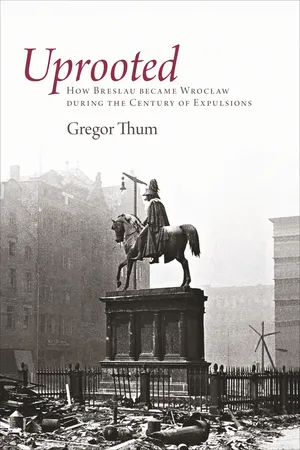
With the stroke of a pen at the Potsdam Conference following the Allied victory in 1945, Breslau, the largest German city east of Berlin, became the Polish city of Wroclaw. Its more than six hundred thousand inhabitants—almost all of them ethnic Germans—were expelled and replaced by Polish settlers from all parts of prewar Poland. Uprooted examines the long-term psychological and cultural consequences of forced migration in twentieth-century Europe through the experiences of Wroclaw's Polish inhabitants.
In this pioneering work, Gregor Thum tells the story of how the city's new Polish settlers found themselves in a place that was not only unfamiliar to them but outright repellent given Wroclaw's Prussian-German appearance and the enormous scope of wartime destruction. The immediate consequences were an unstable society, an extremely high crime rate, rapid dilapidation of the building stock, and economic stagnation. This changed only after the city's authorities and a new intellectual elite provided Wroclaw with a Polish founding myth and reshaped the city's appearance to fit the postwar legend that it was an age-old Polish city. Thum also shows how the end of the Cold War and Poland's democratization triggered a public debate about Wroclaw's "amputated memory." Rediscovering the German past, Wroclaw's Poles reinvented their city for the second time since World War II.
Uprooted traces the complex historical process by which Wroclaw's new inhabitants revitalized their city and made it their own.
- 552 pages
- English
- ePUB (mobile friendly)
- Available on iOS & Android
eBook - ePub
About this book
Information
Publisher
Princeton University PressYear
2011Print ISBN
9780691152912
9780691140247
eBook ISBN
9781400839964
PART ONE
THE POSTWAR ERA:
RUPTURE AND SURVIVAL
CHAPTER ONE
Takeover
ON AUGUST 2, 1945, THE FINAL COMMUNIQUÉ OF THE POTSDAM CONFERence announced to the world the Allies’ decision to remove from the German Reich all territories east of the Oder and Lusatian Neisse rivers and place them under Polish administration, with the exception of northern East Prussia, which was to be ceded to the Soviet Union. By this point in time a Polish mayor was already in office in Breslau and the population exchange was in full swing. Before the Allies had reached an agreement about the precise location of the new German-Polish border, and while experts in the London Foreign Office and the Washington State Department were still reviewing the economic and logistical consequences of the various border proposals, the Soviet government and the Soviet-installed Polish regime had resolved the border issue on their own.
A FAIT ACCOMPLI
As early as February 20, 1945, the State Defense Committee (GOKO) of the Soviet Union stipulated in top secret decree no. 7558 that—subject to a definitive decision at a peace conference—the Oder and the Lusatian Neisse rivers were to be regarded as the western Polish border and that the Red Army was to turn over civil administration to Polish authorities in the German territories east of this border. Only a strip of land between forty and sixty-two miles wide behind the front, as well as railway lines, important bridges, and other resources needed to supply the Soviet forces were to be exempt from this transfer.1 In order to install a Polish administration in German territories east of the Oder-Neisse line prior to the Potsdam Conference, Poland’s provisional government was eager to obtain power as quickly as possible—despite the fact that its hands were more than full with rebuilding from scratch the completely devastated Polish state. Every single institution had to be reestablished and innumerable posts filled.
Completing these tasks proved all the more difficult, as the allocation of leadership positions in the country had already set a course toward a Soviet-style socialist regime. In order to maintain the appearance of democratic government, administrative posts were assigned according to proportional representation of all the leading political parties. Behind the scenes, however, the communists and socialists sought to divvy up the key positions among themselves. Until the communists had established themselves as the sole power in Poland, and the Polish Socialist Party (PPS) was merged with the Polish Workers’ Party (PPR) to form the Polish United Workers’ Party (PZPR) in late 1948, there were bitter power struggles in Poland that further obstructed the already difficult process of rebuilding the country. Appointments according to party affiliation rather than professional qualifications, the sudden dismissal of people who had fallen out of grace overnight, and the continual restructuring of agencies as political spheres of influence shifted—all of this contributed to an atmosphere of instability in the first years after the war and exacerbated the administrative chaos.2
The impending Polish takeover of the German territories was listed as a separate agenda item for the first time on March 12, 1945, in the minutes of a session of the provisional government’s Council of Ministers.3 On that day the Red Army was already at the Oder River, preparing for its final major offensive against Berlin. Speed was of the essence if the Polish government was to assume control of the eastern German territories from the Red Army and establish a comprehensive Polish administration, at least symbolically, before the Allies assembled as victors and determined Germany’s new borders. On March 14, the Council of Ministers divided the future Polish western territories into four provisional administrative districts: East Prussia (Prusy Wschodnie; renamed Warmia and Masuria shortly thereafter), West Pomerania (Pomorze Zachodnie), Lower Silesia (Dolny Śląsk), and Opole Silesia (Śląsk Opolski).4 In administrative terms the territory of the Free City of Danzig was not part of the western territories, but instead was merged with the former province Pomerelia and several bordering districts to create the Gdańsk voivodeship, as the provinces of Poland are traditionally called. It was not until May of 1946 that the government harmonized administrative structures in the old and the new provinces by transforming the districts of the western territories into the regular voivodeships of Olsztyn, Szczecin, Wrocław, and Silesia—the latter through a consolidation of the Opole Silesia and Katowice voivodeships. Prior to this, the administration of the western territories differed from that of the rest of Poland owing to the special tasks that had to be addressed there.5
Already on March 14, 1945, the Council of Ministers appointed government plenipotentiaries for each of the four districts. In contrast to the regular voivodes in central Poland, these plenipotentiaries were in charge not only of the civil administration in their districts, but also of the railways, the postal service, the citizens’ militia (police), and the various “operative groups” (grupy operacyjne), as the representatives of the Warsaw ministries operating in the western territories were called.6 General Aleksander Zawadzki (PPR), who was already voivode of Katowice, was appointed government plenipotentiary in Opole Silesia. The posts of government plenipotentiary in West Pomerania and in Warmia and Masuria were assumed by the previous liaison officers of the Polish government to the Soviet fronts, First Lieutenant Leonard Borkowicz (PRR) and Colonel Jakub Prawin (PRR), respectively. Former Kielce deputy voivode Stanisław Piaskowski (PPS) was appointed head of the civil administration in Lower Silesia, the only civilian and socialist amid high-ranking communist military officers. The government also decided to assign a representative from the Ministry of Public Security (MBP) as a deputy to each of the district plenipotentiaries. Because of uncertainty about how the German population would react to the appearance of Polish officials, ensuring public safety was regarded as one of the most important tasks in the new territories. Thus the establishment of the Polish administration there bore the traits of a military operation.
Reflecting the political significance of the largest city in the new territories, the government also selected on March 14 the future mayor of Polish Breslau. It chose Bolesław Drobner (1883–68), who up to then had directed the department for labor, social welfare, and public health within the Polish Committee of National Liberation. Drobner, who had been born in Krakow, was an experienced socialist politician and functionary of the PPS. During the war he had lived in the Soviet Union and been part of the leadership of the Union of Polish Patriots (ZPP) there. Helpful for this new post in Breslau, Drobner was fluent in both Russian and German. Before the First World War he had studied chemistry in Berlin, Zurich, and in Freiburg, where he later earned his doctoral degree.7 However, he had never been to Breslau and thus became mayor of a major city he had never seen.
During the transition period the western territories were given not only a special administrative structure but also their own central administration in Warsaw. Most of the responsibilities were initially held by the Ministry of Public Administration (MAP). The Office of the General Plenipotentiary of the Recovered Territories (Generalny Pełnomocnik do Spraw Ziem Odzyskanych) had been located there since April 1945, under the direction of the minister himself—initially Edward Ochab (PPR) and, after the formation of the Provisional Government of National Unity on June 28, Władysław Kiernik from the Polish Peasant Party (PSL). Authority in the western territories was not really centralized, however, until the Ministry of the Recovered Territories (MZO) was created in November 1945. This ministry assumed sole responsibility for establishing a Polish administration in the western territories, for the entire resettlement process, the economic revival, and the distribution of previously German property. It was dissolved in 1948, along with the special administration of the western territories. Władysław Gomułka, who as the First Secretary of the PPR was one of the country’s most influential figures, headed this powerful ministry. The communists used the post to secure a key position in the new Poland. Through Gomułka, they controlled one-third of Polish state territory, a significant portion of Poland’s industrial potential, and the enormous value of all the former German property in the western territories that had to be redistributed among the populace.8
THE MISSION OF THE GOVERNMENT PLENIPOTENTIARIES
The government plenipotentiaries sent to the western territories were confronted with enormous challenges. They had to create a Polish administrative apparatus that could take over responsibility for the occupied territories from the Red Army as soon as possible. All existing assets, in particular industrial facilities, warehouses, and food storehouses, had to be protected from plundering, vandalism, and deterioration. In addition, a minimum of public safety and order had to be ensured—a difficult undertaking in a society brutalized by war and occupation. Authorities also had to allocate apartments and distribute food in order to create somewhat tolerable living conditions for the expanding number of Polish settlers in the territories, especially for the employees of the Polish administration. They had to reconstruct the infrastructure immediately, beginning with water, gas, and electrical service, public transportation, and hospitals. Finally, a groundwork had to be laid on which Polish cultural life could develop: schools and universities were needed, as were libraries, bookstores, theaters, cinemas, newspapers, and radio stations. For help in fulfilling these tasks, the Polish authorities could draw upon the local German population only to a limited extent, since the latter was supposed to be used solely for subordinate activities until its evacuation. Management positions were to be given in principle only to Poles. This proved difficult because the educated Polish elite had suffered the greatest casualties during the war and the occupation. In addition, only supporters of a socialist Poland were considered for key positions. Thus, despite their professional qualifications, people regarded as bourgeois or conservative were from the start excluded or entrusted only with responsibilities devoid of influence or prestige.
In mid-April, authorities began setting up the Polish administration in Lower Silesia. Government Plenipotentiary Stanisław Piaskowski reached an agreement with the staff of the Soviet forces’ First Ukrainian Front that he would establish the provisional seat of the district administration in the small city of Trzebnica (Trebnitz), located north of Wrocław. However, after Marshal Konstantin Rokossovsky transferred the staff quarters of his Second Belarusian Front to Trzebnica, Piaskowski moved his administration to the larger city of Legnica (Liegnitz) in June 1945.9 Legnica, a former Prussian district capital, was well situated in terms of transportation lines and had suffered little war damage. However, this city soon became too crowded as well. After the dissolution of the Soviet fronts in late May 1945, all units of the Red Army stationed in Poland were assembled in the northern army group of the Soviet forces under the leadership of Marshal Rokossovsky, who relocated his headquarters—an enormous complex that not only directed Soviet troops in Poland but also played a central role in supplying the units stationed in the Soviet occupation zone in Germany—to Legnica. In November 1945 Piaskowski again moved his district administration, this time to Wrocław. By then, the government in Warsaw had decided that the city of Wrocław would constitute not an independent province but only an independent municipal district within the voivodeship of Wrocław, which encompassed all of Lower Silesia.10
The arrival of the Polish administrative cadre in what had been German territory marked an epochal caesura. Given the prevailing circumstances, however, this was not accompanied by any sort of triumphal demonstration. The first roughly four hundred employees of the Lower Silesian provincial administration who left Kielce on April 20, the advance guard of a significant authority, had to travel the final twenty miles from Trzebnica to Wrocław on foot due to damaged railroad tracks and a shortage of motor vehicles.11 In May 1945 the authorities commanded only eleven functioning vehicles in the entire province, which much complicated the task of establishing area-wide Polish administration.12 Plenipotentiaries at the county and municipal level traveled in groups of five to ten to their posts in the countryside, not infrequently on bicycles or even on foot. A few lightly armed militiamen were all they had for their protection.13 Once in place the plenipotentiaries served for the time being as the sole representatives of the new Polish order and had to stand their ground in an environment where Germans still predominated. This was made all the more difficult by the fact that they usually were not familiar with the area. Since communication networks were down, they were left largely to their own resources during this initial phase. They had to make do with what they had been able to take with them—provisions for the first days, handguns, a Polish flag, and the necessary forms to issue announcements and decrees. Everything else had to be organized locally.14 Whether it was possible under these conditions to establish both a functioning Polish administration and the prerequisites for Polish settlement was largely dependent on the improvisational skills and engagement of these representatives and their staffs.
“NOAH’S ARK” IN KRAKOW
Immediately following his appointment as mayor of Wrocław, Bołesław Drobner began to look for a cadre for the future municipal administration. With this in mind he opened an office called the Wrocław Municipal Administration–Krakow Branch (Zarząd miasta Wrocławia–filia w Krakowie) in the city of Krakow.15 People could volunteer for the “operative group” that was supposed to function as the advance guard of the Polish administration as soon as the siege of Breslau had ended. Civil servants, engineers, craftsmen, as well as militiamen, cooks, and drivers were soug...
Table of contents
- Cover
- Half title
- Title
- Copyright
- Contents
- Acknowledgments
- A Note on Names
- Prologue A Dual Tragedy
- Introduction
- Part One The Postwar Era: Rupture and Survival
- Part Two The Politics of the Past: The City’s Transformation
- Part Three Prospects
- Appendix 1 List of Abbreviations
- Appendix 2 Translations of Polish Institutions
- Appendix 3 List of Polish and German Street Names
- Notes
- Sources and Literature
- Map of Poland after the Westward Shift of 1945
- Simplified Map of Wrocław Today
- Index
Trusted by 375,005 students
Access to over 1.5 million titles for a fair monthly price.
Study more efficiently using our study tools.
Frequently asked questions
Yes, you can cancel anytime from the Subscription tab in your account settings on the Perlego website. Your subscription will stay active until the end of your current billing period. Learn how to cancel your subscription
No, books cannot be downloaded as external files, such as PDFs, for use outside of Perlego. However, you can download books within the Perlego app for offline reading on mobile or tablet. Learn how to download books offline
Perlego offers two plans: Essential and Complete
- Essential is ideal for learners and professionals who enjoy exploring a wide range of subjects. Access the Essential Library with 800,000+ trusted titles and best-sellers across business, personal growth, and the humanities. Includes unlimited reading time and Standard Read Aloud voice.
- Complete: Perfect for advanced learners and researchers needing full, unrestricted access. Unlock 1.5M+ books across hundreds of subjects, including academic and specialized titles. The Complete Plan also includes advanced features like Premium Read Aloud and Research Assistant.
We are an online textbook subscription service, where you can get access to an entire online library for less than the price of a single book per month. With over 1.5 million books across 990+ topics, we’ve got you covered! Learn about our mission
Look out for the read-aloud symbol on your next book to see if you can listen to it. The read-aloud tool reads text aloud for you, highlighting the text as it is being read. You can pause it, speed it up and slow it down. Learn more about Read Aloud
Yes! You can use the Perlego app on both iOS and Android devices to read anytime, anywhere — even offline. Perfect for commutes or when you’re on the go.
Please note we cannot support devices running on iOS 13 and Android 7 or earlier. Learn more about using the app
Please note we cannot support devices running on iOS 13 and Android 7 or earlier. Learn more about using the app
Yes, you can access Uprooted by Gregor Thum in PDF and/or ePUB format, as well as other popular books in History & 20th Century History. We have over 1.5 million books available in our catalogue for you to explore.