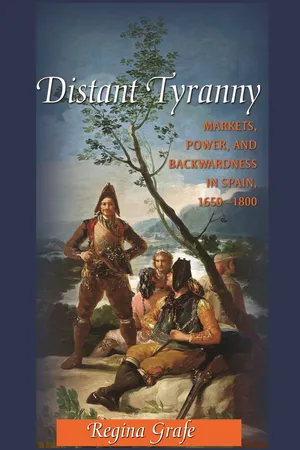
Spain's development from a premodern society into a modern unified nation-state with an integrated economy was painfully slow and varied widely by region. Economic historians have long argued that high internal transportation costs limited domestic market integration, while at the same time the Castilian capital city of Madrid drew resources from surrounding Spanish regions as it pursued its quest for centralization. According to this view, powerful Madrid thwarted trade over large geographic distances by destroying an integrated network of manufacturing towns in the Spanish interior.
Challenging this long-held view, Regina Grafe argues that decentralization, not a strong and powerful Madrid, is to blame for Spain's slow march to modernity. Through a groundbreaking analysis of the market for bacalao--dried and salted codfish that was a transatlantic commodity and staple food during this period--Grafe shows how peripheral historic territories and powerful interior towns obstructed Spain's economic development through jurisdictional obstacles to trade, which exacerbated already high transport costs. She reveals how the early phases of globalization made these regions much more externally focused, and how coastal elites that were engaged in trade outside Spain sought to sustain their positions of power in relation to Madrid.
Distant Tyranny offers a needed reassessment of the haphazard and regionally diverse process of state formation and market integration in early modern Spain, showing how local and regional agency paradoxically led to legitimate governance but economic backwardness.
- 320 pages
- English
- ePUB (mobile friendly)
- Available on iOS & Android
eBook - ePub
About this book
Information
Chapter 1
Markets and States
HISTORIANS OF EARLY MODERN EUROPE have to explain at least two exceedingly far-reaching phenomena. The first one turned people who had thought about themselves as the citizens of a town or the subjects of an estate or village—be it seigneurial or royal—slowly but surely into subjects and eventually citizens of a nation-state. The second one, less often appreciated but equally important, was that Europeans' livelihoods became subject to changes in markets that were a long way out of their local or regional reach. By the eighteenth century almost all people in Europe, even in relatively remote areas, had become subject to the risks and opportunities of “national” markets, “international” competition, and intercontinental trade.1 These twin developments and the cultural and social transformations they embodied are the theme of national historiographies under such titles as “The Making of Modern Country X,” be it France, England, or even the more controversial cases of Germany or Italy. It is a sign of the difficulties in accounting for these twin processes in Spain that there is no “The Making of Modern Spain” to the best of my knowledge.
The nation-state with a domestic, nationwide market has proven surprisingly long-lived even in today's global age. However, historiographical scholarship has reached a consensus that this national focus has its limitations and pitfalls; this book is written in that spirit. Any sense of the national complemented rather than substituted for local and regional allegiances, while at the same time it was shaped by new global interactions.2 The outlook on life of fishermen in a Basque village remained shaped by local factors, even if conflicts between the Spanish Crown and European competitors in far-flung Atlantic waters might threaten their livelihood. Language, rituals, religiosity, and traditions continued to be locally determined in most places. This is probably truer in Spain than elsewhere in western Europe. Yet there is a danger of getting lost in the marvelous idiosyncrasies of the local and losing sight of the fundamental changes that were taking place at the same time. By the early nineteenth century the European nation-state was a well-articulated bureaucratized apparatus that was more powerful than all of its predecessors. It was also governing over a territory that was considerably more economically integrated in the interior and often more integrated on the outside with neighboring countries, colonial offshoots, and faraway consumers and producers.3
Economic development was largely “Smithian” in the premodern era: it depended on the process of market expansion and deepening so aptly described by Adam Smith in the late eighteenth century.4 This is not to downplay the importance of the contribution of intellectual developments, as well as science and technology. Yet even into the early phases of the Industrial Revolution economic growth derived predominantly from the benefits of increased division of labor made feasible through specialization and exchange.5 Exchange fostered specialization; specialization improved skills; skills underpinned innovation.6 Innovation led to new and cheaper consumer goods; new and cheaper consumer goods were an incentive to increase income; increased income raised demand; demand fostered further exchange.7 The process is almost trivial and could be declined up and down in slightly altered sequences. Nonetheless, it was remarkably powerful. Integrated markets were no guarantee for economic growth. But without them, technological change, human capital improvements, and other potential sources of productivity gains were less likely to occur, and where they did happen, their impact on economic growth was seriously circumscribed.
Without integrated markets the fiscal base of the state was hard to establish and expand, too. Thus the relationship between emerging states and integrating markets worked both ways. For its survival and military protection the modernizing state depended increasingly on its subjects' economic well-being and its own ability to tax. The rise of the nation-state and the rise of nationally integrated markets was a dual but simultaneous process. It has attracted a lot of attention from various quarters including historical economics, sociology, and the study of nationalism, identity, language, and social habitus.
This chapter, however, concentrates on the dominant political economy models that try to explain the relation between markets and states in Europe's early modern economies. Placed into the context of Spanish history, some of the main assumptions of the model turn out to be highly problematic and in urgent need of revision. A lopsided focus on the state as predator has distracted economists and economic historians from trying to understand better how states became jurisdictionally and economically integrated units in the first place. The void has been filled by a number of poorly historicized references to concepts borrowed from historians and historical sociologists such as “absolutism” and “patrimonialism.” These concepts were supposed to delineate the development of European states from fragmented sovereignty to unified nation-states. Thus a particular kind of modernization theory was applied that could conveniently latch onto the idea of the “early modern period” as an era in which political and economic institution-building passed through a number of transformations that paved the way from a “premodern” to a “modern” world. Polities that failed to take the prescribed route hence became “failed” states. These terms, whether premodern or modern or failed, are all highly suggestive, but they are also per se perfectly empty of meaning.
Political Economy: What Sort of State Is Needed for Growth?
Historical political economy approaches the relationship between states and markets from a normative perspective by asking what kind of state and governance was conducive to the growth of private markets. Since the 1970s, institutional economics (often referred to as “new institutional economics,” or NIE) has integrated the role of the state explicitly into neoclassical economics and has radically altered the way economists think about the state. Unlike Marxist or neo-Marxist theories, institutional economics does not see the state as an embodiment of power and class relations, and thus as the origin of markets. Instead NIE holds that markets largely (though not exclusively) emerge spontaneously out of Adam Smith's famous “propensity to truck and barter and exchange.”8 Exchanges of goods in the market are beneficial but not costless. They are subject to transaction costs associated with getting goods to and from the market, information gathering, protection against cheating, changing currencies or measures, and a whole litany of other costs.9
From the NIE point of view, economic growth depends on low transaction costs or, put another way, on efficient economic organization. In 1973 North and Thomas expressed in one succinct sentence what has become a credo for economists ever since: “Efficient economic organization entails the establishment of institutional arrangements and property rights that create an incentive to channel individual economic effort into activities that bring the private rate of return close to the social rate of return.”10 Put simply, Adam Smith's invisible hand only develops to its full potential if institutions support secure property rights.11 Greif more recently reformulated the link between institutions and markets as the “fundamental problem of exchange”: for transactions to occur and the market to function, those involved need to commit ex ante and comply ex post. In plain English: economic agents need to trust their business partners before making a deal and be forced if necessary to fulfill their side of the bargain by some higher authority after they have agreed on a transaction.12
In many cases private order institutions can provide trust and enforcement based on common religious or ethnic backgrounds, or contractual agreements among their members.13 Merchant guilds, like the Castilian, Basque, and Catalan consulados, were a case in point. Through social pressure and sometimes commercial tribunals, they kept members on the straight and narrow.14 Yet the single most important “third party enforcers” were, and are, political rulers, be they town councils or kings.15 The problem is that from a political economy point of view the role of power and the ruler is highly ambiguous. As the protector of individuals' lives and property, the ruler needs to be strong and have a monopoly of violence.16 But as a strong actor with a monopoly of violence the state itself can become a predator that endangers personal property and safety.17 Thus for states to be conducive to growth they need to protect subjects' or citizens' private property rights from threats at the hand of their fellow subjects or citizens without in turn becoming a threat to those very same property rights.
The specter of the predatory state has led historical political economy to produce an extraordinarily large corpus of research on the question of how to “tame” the state in its role as a potential threat to property rights. By contrast, the discipline has spent much less time trying to understand how states became autonomous, powerful actors that were able to extend protection in the first place. It has done so at its peril. What had begun as the important realization that markets needed states quickly became a study of how the state as the enemy of the market could be constrained.18
The Early Modern State as a Predator
Economists and economic historians have sidelined the question of state-building by referring to a set of assumptions derived from historical sociology that provide a parsimonious and supposedly uncorrelated, but problematic, prime mover for European state-building. The argument is that military competition between European rulers created a binding exogenous constraint on fiscal decision making in the early modern period. A “military revolution” necessitated the creation of a “fiscal-military state.”19 Competition between rulers for territory and subjects was undoubtedly a central feature of European political development in the Middle Ages. When exogenous changes to military technology, especially firearms and artillery, began to shift the advantage from defense to offense, this in turn necessitated large new investments in urban defense and other costly strategic changes.20
The increased size of European armies in the early modern period bears witness to some of these changes. Castile had 20,000 soldiers under arms in 1470; the “Spanish” army had 150,000 in 1550, 200,000 in 1590, and 300,000 in the 1630s at its peak.21 Large numbers of mercenaries had to be paid with some regularity lest they join the enemy. Alternatively soldiers might choose to pay themselves and embark on looting campaigns that civilian populations in Italy, the Germanies, and the Netherlands came to fear more than anything else.22 While Habsburg Spain built up the largest infantry seen in Europe since the Roman Empire, the Netherlands and Britain began to expand professionalized navies, substituting the earlier strategy of impressing merchant vessels into service.23
Political economists have thus argued that a change in military technology and strategy and the impetus it gave to European state formation created an inescapable constraint on early modern rulers. Since military activity is subject to indivisibilities—larger armies are cheaper per capita—the optimum size of the state increased, and this fostered a territorial consolidation process.24 In this phase of “mergers and acquisitions,” roughly from the mid-fifteenth to the early nineteenth century, mere survival as a minor state was not an option most of the time.25 Instead, states had to consolidate into larger units with larger fiscal potential to survive. Size alone, however, was no guarantee of success. The external constraint imposed by military contest also implied that rulers in any given polity had to push hard for fiscal resources.26 That required a strong state. The ultimate winner of this contest was England, but there were second prizes. France, Sweden, Denmark, Spain, the Netherlands, and a number of smaller territories managed to hang on to independent statehood, something lost by most small territories, principalities, and city-states.
Military competition and the need for a strong state that it created, however, also meant that the state had a strong incentive to increase its revenue through predation.27 Rulers were of course aware that expropriating their subjects and lenders through taxes or debt defaults was damaging to their reputation as borrowers in the longer run. But, faced with a threat to the survival of their rule, any concern about the future was supposedly heavily discounted.28 States could thus become in Olson's famous phrase “stationary bandits.”29 Unless one argues that long-term economic development is ultimately the outcome of a cruel geographical lottery that favored some regions and limited others, institutions, chief among them the state, are the most likely source of differential growth paths across countries.30 Having accepted (often implicitly) the supposedly overwhelming pressure for revenue, the question became how polities could maximize revenue while minimizing the threat to property rights domestically. With this the focus immediately shifted to domestic constraints on rulers' revenue raising and rules for spending.
Political economy has argued that the existence or absence of “parliamentary representation,” a political regime that tied rulers' decisions to the approval of a larger group of subjects or citizens, was the single most important variable in explaining long-term economic performance. The distinction between rulers, kings, princes, or modern autocrats who were not constitutionally constrained and those who were became the central causal element believed to explain the growth potential of early modern states.31 In a seminal 1989 article, North and Weingast argued that the way in which the English Glorious Revolution improved the state's ability to finance itself demonstrated empirically the virtuous effects of such representation. Before the Civil War, Parliament's refusal to vote taxes for the Tudor monarchy had limited the Crown's foreign policy. Its credit was poor, and sovereign interest rates were high. Exactions, defaults, and forced loans provided a stopgap, but by expropriating its subjects and lende...
Table of contents
- Cover Page
- Title Page
- Copyright Page
- Table of Contents
- Acknowledgments
- Preface
- Chapter 1 - Markets and States
- Chapter 2 - Tracing the Market: The Empirical Challenge
- Chapter 3 - Bacalao: A New Consumer Good Takes on the Peninsula
- Chapter 4 - The Tyranny of Distance: Transport and Markets in Spain
- Chapter 5 - Distant Tyranny: The Historic Territories
- Chapter 6 - Distant Tyranny: The Power of Urban Republics
- Chapter 7 - Market Growth and Governance in Early Modern Spain
- Chapter 8 - Center and Peripheries
- Conclusions
- A Note on the Sources
- Bibliography
- Index
Trusted by 375,005 students
Access to over 1.5 million titles for a fair monthly price.
Study more efficiently using our study tools.
Frequently asked questions
Yes, you can cancel anytime from the Subscription tab in your account settings on the Perlego website. Your subscription will stay active until the end of your current billing period. Learn how to cancel your subscription
No, books cannot be downloaded as external files, such as PDFs, for use outside of Perlego. However, you can download books within the Perlego app for offline reading on mobile or tablet. Learn how to download books offline
Perlego offers two plans: Essential and Complete
- Essential is ideal for learners and professionals who enjoy exploring a wide range of subjects. Access the Essential Library with 800,000+ trusted titles and best-sellers across business, personal growth, and the humanities. Includes unlimited reading time and Standard Read Aloud voice.
- Complete: Perfect for advanced learners and researchers needing full, unrestricted access. Unlock 1.5M+ books across hundreds of subjects, including academic and specialized titles. The Complete Plan also includes advanced features like Premium Read Aloud and Research Assistant.
We are an online textbook subscription service, where you can get access to an entire online library for less than the price of a single book per month. With over 1.5 million books across 990+ topics, we’ve got you covered! Learn about our mission
Look out for the read-aloud symbol on your next book to see if you can listen to it. The read-aloud tool reads text aloud for you, highlighting the text as it is being read. You can pause it, speed it up and slow it down. Learn more about Read Aloud
Yes! You can use the Perlego app on both iOS and Android devices to read anytime, anywhere — even offline. Perfect for commutes or when you’re on the go.
Please note we cannot support devices running on iOS 13 and Android 7 or earlier. Learn more about using the app
Please note we cannot support devices running on iOS 13 and Android 7 or earlier. Learn more about using the app
Yes, you can access Distant Tyranny by Regina Grafe in PDF and/or ePUB format, as well as other popular books in Economics & Economic History. We have over 1.5 million books available in our catalogue for you to explore.