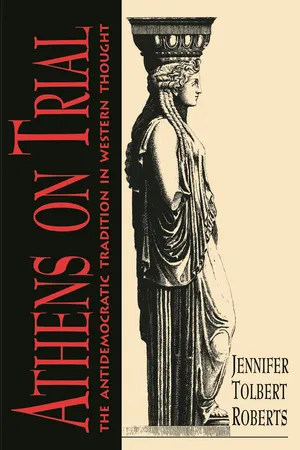
The Classical Athenians were the first to articulate and implement the notion that ordinary citizens of no particular affluence or education could make responsible political decisions. For this reason, reactions to Athenian democracy have long provided a prime Rorschach test for political thought. Whether praising Athens's government as the legitimizing ancestor of modern democracies or condemning it as mob rule, commentators throughout history have revealed much about their own notions of politics and society. In this book, Jennifer Roberts charts responses to Athenian democracy from Athens itself through the twentieth century, exploring a debate that touches upon historiography, ethics, political science, anthropology, sociology, philosophy, gender studies, and educational theory.
- 426 pages
- English
- ePUB (mobile friendly)
- Available on iOS & Android
eBook - ePub
About this book
Information
Publisher
Princeton University PressYear
2011Print ISBN
9780691029191
9780691056975
eBook ISBN
9781400821327
Chapter One
INTRODUCTION
The search for descent is not the erecting of foundations: on the contrary, it disturbs what was previously considered immobile; it fragments what was thought unified; it shows the heterogeneity of what was imagined consistent with itself.
—Michel Foucault, Nietzsche, Genealogy, History
DURING THE LONG WAR between Athens and Sparta, the irreverent Athenian aristocrat Alcibiades defected to the enemy because of serious charges pending against him concerning various kinds of sacrilege against the state-supported religion. Once in Sparta, Thucydides maintains, Alcibiades sought acceptance by insisting that his active involvement in Athenian politics did not really suggest support of Athenian democracy, which, he contended, was an “acknowledged folly” that all sensible Athenians recognized as silly.
The accuracy of this claim cannot be proven or disproven. Alcibiades’ criteria for good sense must necessarily have been subjective, and even if we could tell who was sensible and who was not, still we could not poll the dead Athenians to find out what the sensible ones thought. What is plain, however, is that some of Alcibiades’ brightest contemporaries spoke ill of the democratic government of their native state—Thucydides, for example, Plato, and Alcibiades’ teacher Socrates—and that they were supported in this endeavor after Alcibiades’ death by a famous adoptive Athenian, Aristotle (from Stagira in northern Greece), who became Plato’s longtime pupil. Out of their reservations was born political theory—literally, “looking at the city-state.” As J. S. McClelland has recently pointed out, “It could almost be said that political theorizing was invented to show that democracy, the rule of men by themselves, necessarily turns into rule by the mob…. If there is such a thing as a western tradition of political thought,” McClelland concludes, “it begins with this profoundly anti-democratic bias.”1 And so in fifth- and fourth-century Athens there began a strange and compelling symbiosis between the democratic body politic and the body of antidemocratic theorizing. This interplay lived on in thought long after the independent democratic city-state of Athens had ceased to exist. Parasitic on Athenian democracy, classical political theory kept it alive by its compulsive need to point up its failures again and again and again.
It is a curious phenomenon that the hostile tradition about Athenian democracy should have sprung from the written word, for in reality Athenian government was the product of a civilization that was oral in essence. Much in politics is always accomplished by politicians talking to one another, but democracy frequently entails some kind of public record of formal debate and decision, something along the lines of the American Congressional Record or the French Archives Parlementaires. For Athens this is completely lacking. Words once spoken in the assembly and the council vanished into the air, and we are left with Thucydides’ version of Pericles’ funeral oration, Demosthenes’ accounts of his own heroism, and parodies of political life such as those in Aristophanes’ Congresswomen out of which to reconstruct what was really said. An intensely verbal people, the Athenians had little interest in a literal record of sayings and doings. An underdeveloped technology discouraged regular record keeping, and lack of interest discouraged improvements in technology. No real records of government proceedings survive beyond the laws and inscriptions chiseled in stone. Even words, of course, can be cryptic. The vote to send Miltiades out to accomplish good for Athens concealed an expedition against the island of Paros, and an impending attack on the Corinthians was encoded in the vote that Corinth should be “safe.” People lie about both their intentions and their motives, and the survival of words is no guarantee that lived reality can be faithfully recaptured. But words are a beginning, and the highly impressionistic nature of the images of Athenian democracy that have come down to us has opened the door to a wide range of interpretations of Athens’s government and history.
Despite the secondhand nature of the words that have survived—the speeches “reported” in Thucydides’ history, Plato’s version of Socrates’ trial, Plutarch’s moralizing biographies written centuries after the fact—most of those who have sought to recapture the reality of Athenian political life have done so through media that are almost exclusively verbal. Only recently have archaeologists sought to clarify cruxes by seeking out and analyzing evidence of a physical nature. During the Roman republic as well as the French Revolution, in both Renaissance Italy and eighteenth-century Britain, the history of the Athenian democracy was reconstructed by reading the writings of the ancients and the accretion of early modern speculation that was itself based on these writings, as one written word upon another sought to recapture a phenomenon that was oral in its origins.
Writing about Athenian democracy began in the fifth century itself. Tragedy and comedy both were intensely concerned with the nature of the civic bond. Their messages, however, are inscribed in a way that has made the ideology of Attic playwrights singularly obscure. As in the Roman republic, moreover, surviving texts date from a comparatively late period in the state’s development, and they are rarely authored by the chief participants. We have not a word from the pen of Cleisthenes, of Themistocles, of Aristides, of Ephialtes; given the uncertainties that surround the speeches in Thucydides’ history, we may have nothing from Pericles either, or from Cleon. We have, in short, no equivalent at all of America’s federalist papers; we have no diaries of Miltiades, no correspondence between Pericles and Ephialtes in which they map strategy and grope toward ideology. The antidemocratic account of the development of Athenian government in the treatise entitled The Constitution of the Athenians sometimes attributed to Aristotle was written about a century after the outbreak of the Peloponnesian War, a century and a half after Xerxes’ invasion of Greece. The poetry of Solon aside, the studied verbal tradition about Athens started only after the Persian Wars and began with the tragedies of Aeschylus, followed by Herodotus’s casual asides and the debate on government he set in sixth-century Persia. One of the most popular sources from which later civilizations learned about Greek history was the biographies of Plutarch, composed half a millennium after the Peloponnesian War.
Neither Herodotus nor Thucydides deals much with theories of domestic politics, but the picture of Athenian democracy in Thucydides’ history has made a deep impression on readers. Thucydides seems to have preferred some form of broad oligarchy, and he consistently portrays the Athenian demos as unreasoning and unreasonable. He connects Athens’s loss of the Peloponnesian War with the inadequacies of her democratic system. In Pericles Thucydides saw a dramatic exception to the norms of Athenian political life; for Pericles, he writes, unlike other Athenian politicians, was able to control the multitude rather than being controlled by it, whereas his successors, “more on a par with one another, and each seeking to be foremost, ended by committing even the conduct of public affairs to the whims of the masses,” a practice that produced a predictable “host of blunders” (2.65.6). The so-called Old Oligarch (once thought to be Xenophon) depicted democracy as a tyranny of the poor over the beleaguered rich, whereas the real Xenophon was captivated by Sparta and discounted working people as a legitimate force in politics.
During the fourth century, the question of Athenian democracy came to be subsumed by larger questions of political, ethical, and educational theory and the search for the best life in the best state. Plato mocked the amateurism of the democratic system and pilloried the leaders it brought to power, and Plato’s Socrates maintained that Pericles was accused of having made the Athenians “idle, cowardly, loquacious, and greedy” by instituting state pay for state service such as jury duty (Gorgias 515E). Horrified by the execution of Socrates and pessimistic about the possibility of reforming his native state of Athens, Plato sought refuge in composing ideal constitutions for various (presumably imaginary) elitist states. In his Republic he elevated his disapproval of Athenian democracy into a broad theoretical attack on democracy in general, and his intellectual authoritarianism discouraged an open dialogue on the subject with truth as its aim. Meanwhile the other renowned fourth-century educator, Isocrates, cast soulful glances back at the so-called ancestral constitution of bygone days when political privilege was allotted on a sliding scale according to class. In his own century he longed for some overlord such as Philip of Macedon who could lead the Greeks to recover their lost pride in a glorious campaign against the Persians. In the meantime his pupil Theopompus composed a searing attack on the Athenians’ choice of leaders.
Taking up political theory where Plato had left it, Aristotle foreshadowed certain schools of twentieth-century thought in advocating apathy as the tamer of democracy. Sharing Xenophon’s conviction that the poor simply were not political material, he sought to exclude such people from the decision-making process, arguing on occasion against granting them any share in the state but at other times resting content with the expectation that indifference would deter at least the farmers from bothering themselves with the political life of the city. Only people with a modicum of property, Aristotle writes, can have the leisure that fosters the attainment of goodness, and so ideally “it must be these people and only these who are citizens” since the class of mechanics and shopkeepers lead lives that are “ignoble and inimical to goodness” (Politics 1328b–29a [7.8.2]).2 Specific allegations against Athens are buried in the Politics in a theoretical attack on democracy in general, but the shortcomings of Athens in particular come to the fore in the Constitution of the Athenians composed in Aristotle’s lifetime either by Aristotle himself or by one of his pupils (based perhaps on notes taken during Aristotle’s lectures.) There Pericles’ institution of state pay for jurors is ascribed solely to his desire to compete with the personal largess of his rival, Cimon, and reference is made to the school that considered this system corrosive. The author emphasizes the decline of Athens after Pericles’ death when “a series of men who were the ones most willing to thrust themselves forward and gratify the many with an eye to immediate popularity held the leadership of the people (demagogian)” (28.4).3
Only democracy made antidemocratic theory possible. Some of this facilitation lay in principles of dialogue and antithesis; as the Yale political scientist Robert Dahl has recently pointed out, “The very notion of democracy has always provided a field day for critics.”4 Some lay in a shared belief in responsible citizenship and the equitable distribution of authority and privilege. Aristotle’s concept of the citizen, for example, owed a great deal to the evolution of that ideal in classical Athens. With the building blocks of political thought forged in democratic Athens, Athenian intellectuals constructed an elaborate attack on the very idea of democracy. By the time of the Macedonian conquest, all these blocks were squarely in place: Athenian democracy was a class government that constituted a tyranny of the poor over the rich. Like all tyrannies, this one was conducted according to whim rather than law. The democracy was incapable of conducting foreign policy and hence brought upon itself its grievous defeats first at the hands of Sparta and subsequently at those of Philip. The execution of Socrates was only the most prominent example of the rottenness of the Athenian jury system, which selected jurors largely from the lower classes and even went so far as to pay citizens for their time. The demos was irrational and excessive in its expectations of its leaders and thus treated them harshly and unreasonably. The Athenian system was bound to fail, posited as it was on the erroneous supposition that people of unequal merit should receive equal treatment. People who are not of comparable excellence should not be treated as if they were, and struggling workers cannot hope to attain the wisdom or objectivity accessible to men of leisure and education. A moderate sort of democracy at Athens was perhaps not such a bad thing when some appropriate class distinctions were observed, but at some point in the fifth century these distinctions ceased to be made. Pericles himself may possibly have had some merit, but his successors exploited the potential for demagogy in the rule of an uneducated assembly unfettered by legal precedent, and after his death Athenian political life became debased. Nor were the Athenians always just in their dealings with other city-states. It was no wonder they got their comeuppance at Chaeronea.
There existed an alternate and equally impressionistic tradition, one that could be extracted from the fragments of the pre-Socratic philosophers, from the pages of Herodotus and Demosthenes, from Sophocles and Euripides, and even from speeches reported by the antidemocratic Thucydides and Plato—Pericles’ funeral oration delivered in 430 after the first year of the Peloponnesian War, for example, and Protagoras’s defense of the democratic system. But it was not this alternate strand that European thinkers picked up and developed, but rather the hostile tradition. Under the Roman republic, Polybius discounted classical Athens as a chaotic state unworthy of serious examination, and Cicero was preoccupied with the ingratitude of the demos toward its leaders, with whose martyrdom he identified passionately. In the early empire, Valerius Maximus underlined the Athenians’ mistreatment of their great leaders and Pompeius Trogus stressed the decline of Athens in the fourth century. Livy, though he did not discuss Athens directly, did much to undermine the reputation of classical democracy in the eyes of future centuries by his disparaging treatment of the Roman plebs. Athenian government did not fare much better at the hands of Greek writers than it had at those of Latin ones. Diodorus of Sicily, who relied primarily on the fourth-century world history by Ephorus of Cyme in Asia Minor, was supportive of the Athenians in their foreign policy but extremely critical of their form of government, stressing the emotionalism and ingratitude of the demos in dealing with its leaders and applauding the murder of the democratic reformer Ephialtes. Plutarch, by far the most influential source for ancient Greek history and politics until the nineteenth century, was inclined to view Athenian politics as a series of attempts by unscrupulous demagogues and persecuted statesmen to manipulate a fickle and volatile mob. The second-century orator Aelius Aristides wrote an impassioned attack on Plato’s view of Greek democracy, but it represented such a departure from a comfortingly consistent tradition that future generations chose to disregard it.
Not surprisingly, people in the Middle Ages knew little about Athenian democracy and cared less. During the Renaissance, classical history was rediscovered, and because the Renaissance began in Italy, it sparked a certain amount of interest in the city-state as a political unit. In view of the notorious obsession of Renaissance men and women with the life of the mind, one might suppose that the school of Hellas would have captured their imaginations. In fact, however, other Renaissance preoccupations—stability, for example—proved dominant, and the writings of Machiavelli, Giannotti, and Guicciardini make clear that it was the armed camp on the Eurotas that was held up as an ideal to emulate while the city of Athena was put forward as a cautionary example to avoid.
If Italian republicans had little warmth for Athenian democracy, the great experiment received a still chillier reception from northern monarchists. In 1576 Jean Bodin published his Six Books of a Commonwealth, which was translated into English in 1606 and enjoyed enormous popularity throughout Europe. There Athens is portrayed as the prototype of the popular state, and Bodin marshals a full panoply of classical citations to demonstrate the evils of popular government. “If we shall beleeve Plato,” he begins, “wee shall find that he hath blamed a Popular estate, tearming it, A Faire where every thing is to bee sold. We have the like opinion of Aristotle, saying, That neither Popular nor Aristocraticall estate is good, using the authorities of Homer…. And the Orator Maximus Tirius holds, That a democraty is pernicious, blaming for this cause the estate of the Athenians, Syracusians, Carthagineans and Ephesians: for it is impossible (saith Seneca) that he shall please the people, that honours vertue.” “How,” Bodin asks, “can a multitude, that is to say, a Beast with many heads, without iugement, or reason, give any good councel? To aske councel of a Multitude (as they did in oldtimes in Popular Commonweals) is to seek for wisdome of a mad man.”5
Bodin exercised a profound influence on the British royalist Robert Filmer, who in the 1630s composed his memorable Patriarca, subtitled A DEFENCE OF THE NATURAL POWER OF THE KINGS AGAINST THE UNNATURAL LIBERTY OF THE PEOPLE. Predictably, Filmer makes use of Athens as an example of the evils of popular government, and in a pastiche gleaned from Thucydides, pseudo-Xenophon, Livy, Tacitus, Cicero, and Sallust, he assails the shortsightedness and volatility of the mob, who “are not led by wisdom to judge of anything, but by violence and rashness.”6 Opposed to Filmer in seventeenth-century England was a whole school of classical republicans whose writings sparked the contention of Hobbes that there was scarcely anything so conducive to antimonarchic sedition as the study of classical history.7 Athens fared rather better in this climate, but since the cardinal question that exercised these men concerned the contest of republicanism and monarchy, their writings do not always show fine distinctions among the classical states. To the idealistic martyr Algernon Sidney, governments as diverse as Sparta, Athens, and republican Rome all afforded variations on a single theme: the wondrous excellence of the mixed constitution. James Harrington, however, took a harder look at Athens and concluded that the Athenians had sinned grievously in their aggressive foreign policy, calling it inexcusable to bring one’s allies under bondage, “by which means Athens gave occasion of the Peloponnesian War, the wound of which she died stinking.”8
As the eighteenth century began, the abortive attempts of the British Tories to impeach a handful of Whig ministers spawned a series of remarkable essays on accountability in government, the first of which, the Discourse of the Contests and Dissentions Between the Nobles and the Commons in Athens and Rome with the Consequences they had upon both those States, was penned by none other than Jonathan Swift. Swift’s tract set a precedent for the intensive mining of Athenian history for use in contemporary political squabbles, and he was promptly answered by several other essayists who harvested antiquity with a glee difficult for twentieth-century minds to comprehend. While some involved in the controversy repeated the accusations of fickleness and ingratitude that it had become customary to make against the Athenians, others held up the rigorous Athenian system of accountability as an exemplary prototype for modern times. Lavish use was also made of the Athenian example by the enemies who hounded Walpole in the 1720s and 1730s, as the collection known as Cato’s Letters and the journal The Craftsman cried out for the need to keep an ever-watchful eye on government expenditure. The name of Pericles was frequently brought forward, and so far from decrying the ingratitude he encountered at the hands of the demos, the opposition to Walpole saw an inspiring example for their own day in the high standards to which the Athenians held him.
Accountability, however, is only one issue in good government, and though toward the beginning of the century Athens found numerous defenders among journalists and pamphleteers, the dominant tradition in eighteenth-century England was markedly hostile, with Hume looking down his nose at the emotional Athenian mob and Montagu frantically warning his compatriots that Britain would soon go the way of Athens if she did not mend her ways. Athenian government fared slightly better in France. To be sure, most French writers of the eighteenth century took a dim view of Athens. It was in France that the first thoroughgoing history of antiquity was published by the schoolmaster Charles Rollin in 1729, preceded by an imprimatur praising Rollin’s “endeavours to improve the minds of youth.”9 Specifically, youthful minds were to be improved by learning that “fickleness and inconstancy were the prevailing characteristics of the Athenians” already in the fifth century, and in the fourth (as Tourreil had pointed out in his preface to his French Demosthenes), “the love of ease and pleasure ...
Table of contents
- Cover
- Title Page
- Copyright
- Dedication
- Contents
- Preface and Acknowledgments
- Abbreviations
- Chapter One Introduction
- Part One: Classical Greece
- Part Two: Playing with the Past
- Part Three: Modern Transformations
- Notes
- Selected Bibliography
- Index
Trusted by 375,005 students
Access to over 1.5 million titles for a fair monthly price.
Study more efficiently using our study tools.
Frequently asked questions
Yes, you can cancel anytime from the Subscription tab in your account settings on the Perlego website. Your subscription will stay active until the end of your current billing period. Learn how to cancel your subscription
No, books cannot be downloaded as external files, such as PDFs, for use outside of Perlego. However, you can download books within the Perlego app for offline reading on mobile or tablet. Learn how to download books offline
Perlego offers two plans: Essential and Complete
- Essential is ideal for learners and professionals who enjoy exploring a wide range of subjects. Access the Essential Library with 800,000+ trusted titles and best-sellers across business, personal growth, and the humanities. Includes unlimited reading time and Standard Read Aloud voice.
- Complete: Perfect for advanced learners and researchers needing full, unrestricted access. Unlock 1.5M+ books across hundreds of subjects, including academic and specialized titles. The Complete Plan also includes advanced features like Premium Read Aloud and Research Assistant.
We are an online textbook subscription service, where you can get access to an entire online library for less than the price of a single book per month. With over 1.5 million books across 990+ topics, we’ve got you covered! Learn about our mission
Look out for the read-aloud symbol on your next book to see if you can listen to it. The read-aloud tool reads text aloud for you, highlighting the text as it is being read. You can pause it, speed it up and slow it down. Learn more about Read Aloud
Yes! You can use the Perlego app on both iOS and Android devices to read anytime, anywhere — even offline. Perfect for commutes or when you’re on the go.
Please note we cannot support devices running on iOS 13 and Android 7 or earlier. Learn more about using the app
Please note we cannot support devices running on iOS 13 and Android 7 or earlier. Learn more about using the app
Yes, you can access Athens on Trial by Jennifer T. Roberts in PDF and/or ePUB format, as well as other popular books in History & Greek Ancient History. We have over 1.5 million books available in our catalogue for you to explore.