This detailed account of the politics of opening agricultural markets explains how the institutional context of international negotiations alters the balance of interests at the domestic level to favor trade liberalization despite opposition from powerful farm groups. Historically, agriculture stands out as a sector in which countries stubbornly defend domestic programs, and agricultural issues have been the most frequent source of trade disputes in the postwar trading system. While much protection remains, agricultural trade negotiations have resulted in substantial concessions as well as negotiation collapses. Food Fights over Free Trade shows that the liberalization that has occurred has been due to the role of international institutions.
Christina Davis examines the past thirty years of U.S. agricultural trade negotiations with Japan and Europe based on statistical analysis of an original dataset, case studies, and in-depth interviews with over one hundred negotiators and politicians. She shows how the use of issue linkage and international law in the negotiation structure transforms narrow interest group politics into a more broad-based decision process that considers the larger stakes of the negotiation. Even when U.S. threats and the spiraling budget costs of agricultural protection have failed to bring policy change, the agenda, rules, and procedures of trade negotiations have often provided the necessary leverage to open Japanese and European markets.
This book represents a major contribution to understanding the negotiation process, agricultural politics, and the impact of international institutions on domestic politics.
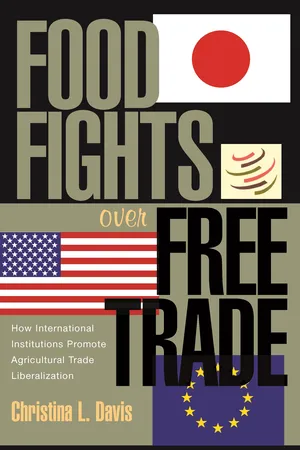
eBook - ePub
Food Fights over Free Trade
How International Institutions Promote Agricultural Trade Liberalization
- 416 pages
- English
- ePUB (mobile friendly)
- Available on iOS & Android
eBook - ePub
Food Fights over Free Trade
How International Institutions Promote Agricultural Trade Liberalization
About this book
Information
Publisher
Princeton University PressYear
2011Print ISBN
9780691122540
9780691115054
eBook ISBN
9781400841394
Table of contents
- Cover
- Title Page
- Copyright
- Dedication
- Contents
- List of Figures
- List of Tables
- Acknowledgments
- Abbreviations
- 1 Introduction
- I Negotiation Structure and Trade Liberalization
- II U.S.-Japan Trade Negotiations
- III U.S.-EU Trade Negotiations
- IV Conclusion
- Appendix: Descriptive Statistics
- Bibliography
- Index
Trusted by 375,005 students
Access to over 1.5 million titles for a fair monthly price.
Study more efficiently using our study tools.
Frequently asked questions
Yes, you can cancel anytime from the Subscription tab in your account settings on the Perlego website. Your subscription will stay active until the end of your current billing period. Learn how to cancel your subscription
No, books cannot be downloaded as external files, such as PDFs, for use outside of Perlego. However, you can download books within the Perlego app for offline reading on mobile or tablet. Learn how to download books offline
Perlego offers two plans: Essential and Complete
- Essential is ideal for learners and professionals who enjoy exploring a wide range of subjects. Access the Essential Library with 800,000+ trusted titles and best-sellers across business, personal growth, and the humanities. Includes unlimited reading time and Standard Read Aloud voice.
- Complete: Perfect for advanced learners and researchers needing full, unrestricted access. Unlock 1.5M+ books across hundreds of subjects, including academic and specialized titles. The Complete Plan also includes advanced features like Premium Read Aloud and Research Assistant.
We are an online textbook subscription service, where you can get access to an entire online library for less than the price of a single book per month. With over 1.5 million books across 990+ topics, we’ve got you covered! Learn about our mission
Look out for the read-aloud symbol on your next book to see if you can listen to it. The read-aloud tool reads text aloud for you, highlighting the text as it is being read. You can pause it, speed it up and slow it down. Learn more about Read Aloud
Yes! You can use the Perlego app on both iOS and Android devices to read anytime, anywhere — even offline. Perfect for commutes or when you’re on the go.
Please note we cannot support devices running on iOS 13 and Android 7 or earlier. Learn more about using the app
Please note we cannot support devices running on iOS 13 and Android 7 or earlier. Learn more about using the app
Yes, you can access Food Fights over Free Trade by Christina L. Davis in PDF and/or ePUB format, as well as other popular books in Politics & International Relations & International Business. We have over 1.5 million books available in our catalogue for you to explore.