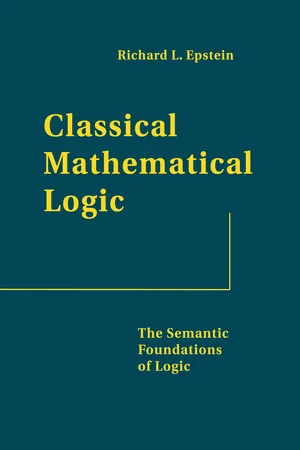
In Classical Mathematical Logic, Richard L. Epstein relates the systems of mathematical logic to their original motivations to formalize reasoning in mathematics. The book also shows how mathematical logic can be used to formalize particular systems of mathematics. It sets out the formalization not only of arithmetic, but also of group theory, field theory, and linear orderings. These lead to the formalization of the real numbers and Euclidean plane geometry. The scope and limitations of modern logic are made clear in these formalizations.
The book provides detailed explanations of all proofs and the insights behind the proofs, as well as detailed and nontrivial examples and problems. The book has more than 550 exercises. It can be used in advanced undergraduate or graduate courses and for self-study and reference.
Classical Mathematical Logic presents a unified treatment of material that until now has been available only by consulting many different books and research articles, written with various notation systems and axiomatizations.
- 544 pages
- English
- ePUB (mobile friendly)
- Available on iOS & Android
eBook - ePub
About this book
Information
XIX | Two-Dimensional Euclidean Geometry |
in collaboration with Leslaw Szczerba |
A. The Axiom System E2
• Exercises for Section A
B. Deriving Geometric Notions
1. Basic properties of the primitive notions
2. Lines
3. One-dimensional geometry and point symmetries
4. Line symmetry
5. Perpendicular lines
6. Parallel lines
• Exercises for Sections B.1–B.6
7. Parallel projection
8. The Pappus-Pascal theorem
9. Multiplication of points
C. Betweenness and Congruence Expressed Algebraically
D. Ordered Fields and Cartesian Planes
E. The Real Numbers
• Exercises for Sections C–E
Historical Remarks
A. The Axiom System E2
In this chapter we'll continue our geometric analysis of the real numbers by formalizing the geometry of flat surfaces. Our goal is to give a theory that is equivalent to the theory of real numbers presented in Chapter XVII.
Our axiomatization of two-dimensional geometry will use the same primitives as for one-dimension: points and the relations of betweenness and congruence. Lines and other geometric figures and relations, which others often take as primitive, will be definable. Roughly, since two points determine a line, we can define a line as all those points lying in the betweenness relation with respect to two given points. Then we can quantify over lines as “pseudo-variables” by quantifying over pairs of points.
So, as in Chapter XVIII, our formal language will be L( = ; P03, P04), which again we can write as L(=; B, = ) with the sam...
Table of contents
- Cover Page
- Title Page
- Copyright Page
- Dedication Page
- Contents
- Preface
- Acknowledgments
- Introduction
- I: Classical Propositional Logic
- II: Abstracting and Axiomatizing Classical Propositional Logic
- III: The Language of Predicate Logic
- IV: The Semantics of Classical Predicate Logic
- V: Substitutions and Equivalences
- VI: Equality
- VII: Examples of Formalization
- VIII: Functions
- IX: The Abstraction of Models
- X: Axiomatizing Classical Predicate Logic
- XI: The Number of Objects in the Universe of a Model
- XII: Formalizing Group Theory
- XIII: Linear Orderings
- XIV: Second-Order Classical Predicate Logic
- XV: The Natural Numbers
- XVI: The Integers and Rationals
- XVII: The Real Numbers
- XVIII: One-Dimensional Geometry: In Collaboration with Leslaw Szczerba
- XIX: Two-Dimensional Euclidean Geometry: In Collaboration with Leslaw Szczerba
- XX: Translations Within Classical Predicate Logic
- XXI: Classical Predicate Logic with Non-Referring Names
- XXII: The Liar Paradox
- XXIII: On Mathematical Logic and Mathematics
- Appendix: The Completeness of Classical Predicate Logic Proved by Gödel’s Method
- Summary of Formal Systems
- Bibliography
- Index of Notation
- Index
Trusted by 375,005 students
Access to over 1.5 million titles for a fair monthly price.
Study more efficiently using our study tools.
Frequently asked questions
Yes, you can cancel anytime from the Subscription tab in your account settings on the Perlego website. Your subscription will stay active until the end of your current billing period. Learn how to cancel your subscription
No, books cannot be downloaded as external files, such as PDFs, for use outside of Perlego. However, you can download books within the Perlego app for offline reading on mobile or tablet. Learn how to download books offline
Perlego offers two plans: Essential and Complete
- Essential is ideal for learners and professionals who enjoy exploring a wide range of subjects. Access the Essential Library with 800,000+ trusted titles and best-sellers across business, personal growth, and the humanities. Includes unlimited reading time and Standard Read Aloud voice.
- Complete: Perfect for advanced learners and researchers needing full, unrestricted access. Unlock 1.5M+ books across hundreds of subjects, including academic and specialized titles. The Complete Plan also includes advanced features like Premium Read Aloud and Research Assistant.
We are an online textbook subscription service, where you can get access to an entire online library for less than the price of a single book per month. With over 1.5 million books across 990+ topics, we’ve got you covered! Learn about our mission
Look out for the read-aloud symbol on your next book to see if you can listen to it. The read-aloud tool reads text aloud for you, highlighting the text as it is being read. You can pause it, speed it up and slow it down. Learn more about Read Aloud
Yes! You can use the Perlego app on both iOS and Android devices to read anytime, anywhere — even offline. Perfect for commutes or when you’re on the go.
Please note we cannot support devices running on iOS 13 and Android 7 or earlier. Learn more about using the app
Please note we cannot support devices running on iOS 13 and Android 7 or earlier. Learn more about using the app
Yes, you can access Classical Mathematical Logic by Richard L. Epstein in PDF and/or ePUB format, as well as other popular books in Mathematics & Logic in Mathematics. We have over 1.5 million books available in our catalogue for you to explore.