Japan and the United States became close political allies so quickly after the end of World War II, that it seemed as though the two countries had easily forgotten the war they had fought. Here Yoshikuni Igarashi offers a provocative look at how Japanese postwar society struggled to understand its war loss and the resulting national trauma, even as forces within the society sought to suppress these memories. Igarashi argues that Japan's nationhood survived the war's destruction in part through a popular culture that expressed memories of loss and devastation more readily than political discourse ever could. He shows how the desire to represent the past motivated Japan's cultural productions in the first twenty-five years of the postwar period.
Japanese war experiences were often described through narrative devices that downplayed the war's disruptive effects on Japan's history. Rather than treat these narratives as obstacles to historical inquiry, Igarashi reads them along with counter-narratives that attempted to register the original impact of the war. He traces the tensions between remembering and forgetting by focusing on the body as the central site for Japan's production of the past. This approach leads to fascinating discussions of such diverse topics as the use of the atomic bomb, hygiene policies under the U.S. occupation, the monstrous body of Godzilla, the first Western professional wrestling matches in Japan, the transformation of Tokyo and the athletic body for the 1964 Tokyo Olympics, and the writer Yukio Mishima's dramatic suicide, while providing a fresh critical perspective on the war legacy of Japan.
eBook - PDF
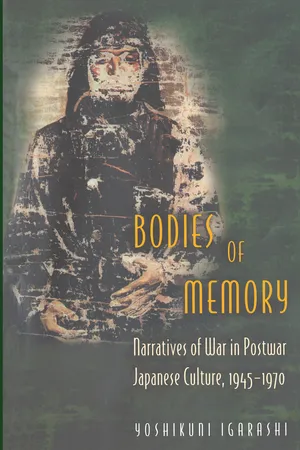
Bodies of Memory
Narratives of War in Postwar Japanese Culture, 1945-1970
- 295 pages
- English
- PDF
- Available on iOS & Android
eBook - PDF
About this book
Information
Publisher
Princeton University PressYear
2012Print ISBN
9780691049120
9780691049113
eBook ISBN
9781400842988
Table of contents
- Cover
- Title Page
- Copyright Page
- Table of Contents
- Acknowledgments
- Introduction
- Chapter I. The Bomb
- Chapter II. The Age of the Body
- Chapter III. A Nation That Never Is: Cultural Discourse on Japanese Uniqueness
- Chapter IV. Naming the Unnameable
- Chapter V. From the Anti–Security Treaty Movement to the Tokyo Olympics: Transforming the Body, the Metropolis, and Memory
- Chapter VI. Re-presenting Trauma In Late-1960s Japan
- Conclusion
- Notes
- Bibliography
- Index
Trusted by 375,005 students
Access to over 1.5 million titles for a fair monthly price.
Study more efficiently using our study tools.
Frequently asked questions
Yes, you can cancel anytime from the Subscription tab in your account settings on the Perlego website. Your subscription will stay active until the end of your current billing period. Learn how to cancel your subscription
No, books cannot be downloaded as external files, such as PDFs, for use outside of Perlego. However, you can download books within the Perlego app for offline reading on mobile or tablet. Learn how to download books offline
Perlego offers two plans: Essential and Complete
- Essential is ideal for learners and professionals who enjoy exploring a wide range of subjects. Access the Essential Library with 800,000+ trusted titles and best-sellers across business, personal growth, and the humanities. Includes unlimited reading time and Standard Read Aloud voice.
- Complete: Perfect for advanced learners and researchers needing full, unrestricted access. Unlock 1.5M+ books across hundreds of subjects, including academic and specialized titles. The Complete Plan also includes advanced features like Premium Read Aloud and Research Assistant.
We are an online textbook subscription service, where you can get access to an entire online library for less than the price of a single book per month. With over 1.5 million books across 990+ topics, we’ve got you covered! Learn about our mission
Look out for the read-aloud symbol on your next book to see if you can listen to it. The read-aloud tool reads text aloud for you, highlighting the text as it is being read. You can pause it, speed it up and slow it down. Learn more about Read Aloud
Yes! You can use the Perlego app on both iOS and Android devices to read anytime, anywhere — even offline. Perfect for commutes or when you’re on the go.
Please note we cannot support devices running on iOS 13 and Android 7 or earlier. Learn more about using the app
Please note we cannot support devices running on iOS 13 and Android 7 or earlier. Learn more about using the app
Yes, you can access Bodies of Memory by Yoshikuni Igarashi in PDF and/or ePUB format, as well as other popular books in History & Japanese History. We have over 1.5 million books available in our catalogue for you to explore.