To date, the world can lay claim to little more than 190 sovereign independent entities recognized as nation-states, while by some estimates there may be up to eight hundred more nation-state projects underway and seven to eight thousand potential projects. Why do a few such endeavors come to fruition while most fail? Standard explanations have pointed to national awakenings, nationalist mobilizations, economic efficiency, military prowess, or intervention by the great powers. Where Nation-States Come From provides a compelling alternative account, one that incorporates an in-depth examination of the Russian Empire, the Soviet Union, and their successor states.
Philip Roeder argues that almost all successful nation-state projects have been associated with a particular political institution prior to independence: the segment-state, a jurisdiction defined by both human and territorial boundaries. Independence represents an administrative upgrade of a segment-state. Before independence, segmental institutions shape politics on the periphery of an existing sovereign state. Leaders of segment-states are thus better positioned than other proponents of nation-state endeavors to forge locally hegemonic national identities. Before independence, segmental institutions also shape the politics between the periphery and center of existing states. Leaders of segment-states are hence also more able to challenge the status quo and to induce the leaders of the existing state to concede independence. Roeder clarifies the mechanisms that link such institutions to outcomes, and demonstrates that these relationships have prevailed around the world through most of the age of nationalism.
eBook - PDF
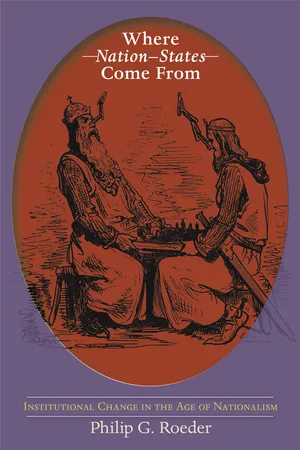
Where Nation-States Come From
Institutional Change in the Age of Nationalism
- 430 pages
- English
- PDF
- Available on iOS & Android
eBook - PDF
About this book
Information
Publisher
Princeton University PressYear
2012Print ISBN
9780691134673
9780691127286
eBook ISBN
9781400842964
Table of contents
- Cover
- Title Page
- Copyright Page
- Table of Contents
- List of Figures
- List of Tables
- Acknowledgments
- Part One: The Institutional Origins of Nation-States
- Chapter One: Who Gets a State of Their Own?
- Chapter Two: Varieties of Segmented States
- Part Two: Processes: Forging Political-Identity Hegemonies
- Chapter Three: Hegemonies and Segment-State Machines
- Chapter Four: Creating Identity Hegemony
- Chapter Five: Conditions for Political-Identity Hegemony
- Part Three: Processes: Escalation to Nation-State Crises
- Chapter Six: The Dynamics of Nation-State Crises
- Chapter Seven: The Segmental Agenda and Escalation of Stakes
- Chapter Eight: Escalation of Means in Nation-State Crises
- Part Four: Outcomes: Crises and Independence
- Chapter Nine: Which Nation-State Projects Create Crises?
- Chapter Ten: Which Segment-States Become Nation-States?
- Chapter Eleven: Nation-States and the International System
- Appendix: Segment-States, 1901–2000
- References
- Index
Trusted by 375,005 students
Access to over 1.5 million titles for a fair monthly price.
Study more efficiently using our study tools.
Frequently asked questions
Yes, you can cancel anytime from the Subscription tab in your account settings on the Perlego website. Your subscription will stay active until the end of your current billing period. Learn how to cancel your subscription
No, books cannot be downloaded as external files, such as PDFs, for use outside of Perlego. However, you can download books within the Perlego app for offline reading on mobile or tablet. Learn how to download books offline
Perlego offers two plans: Essential and Complete
- Essential is ideal for learners and professionals who enjoy exploring a wide range of subjects. Access the Essential Library with 800,000+ trusted titles and best-sellers across business, personal growth, and the humanities. Includes unlimited reading time and Standard Read Aloud voice.
- Complete: Perfect for advanced learners and researchers needing full, unrestricted access. Unlock 1.5M+ books across hundreds of subjects, including academic and specialized titles. The Complete Plan also includes advanced features like Premium Read Aloud and Research Assistant.
We are an online textbook subscription service, where you can get access to an entire online library for less than the price of a single book per month. With over 1.5 million books across 990+ topics, we’ve got you covered! Learn about our mission
Look out for the read-aloud symbol on your next book to see if you can listen to it. The read-aloud tool reads text aloud for you, highlighting the text as it is being read. You can pause it, speed it up and slow it down. Learn more about Read Aloud
Yes! You can use the Perlego app on both iOS and Android devices to read anytime, anywhere — even offline. Perfect for commutes or when you’re on the go.
Please note we cannot support devices running on iOS 13 and Android 7 or earlier. Learn more about using the app
Please note we cannot support devices running on iOS 13 and Android 7 or earlier. Learn more about using the app
Yes, you can access Where Nation-States Come From by Philip G. Roeder in PDF and/or ePUB format, as well as other popular books in Politique et relations internationales & Histoire de la Russie. We have over 1.5 million books available in our catalogue for you to explore.