The mathematics behind today's most widely used rating and ranking methods
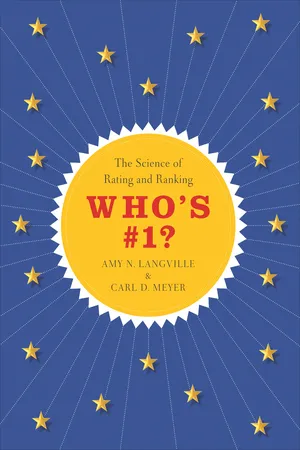
A website's ranking on Google can spell the difference between success and failure for a new business. NCAA football ratings determine which schools get to play for the big money in postseason bowl games. Product ratings influence everything from the clothes we wear to the movies we select on Netflix. Ratings and rankings are everywhere, but how exactly do they work? Who's #1? offers an engaging and accessible account of how scientific rating and ranking methods are created and applied to a variety of uses.
Amy Langville and Carl Meyer provide the first comprehensive overview of the mathematical algorithms and methods used to rate and rank sports teams, political candidates, products, Web pages, and more. In a series of interesting asides, Langville and Meyer provide fascinating insights into the ingenious contributions of many of the field's pioneers. They survey and compare the different methods employed today, showing why their strengths and weaknesses depend on the underlying goal, and explaining why and when a given method should be considered. Langville and Meyer also describe what can and can't be expected from the most widely used systems.
The science of rating and ranking touches virtually every facet of our lives, and now you don't need to be an expert to understand how it really works. Who's #1? is the definitive introduction to the subject. It features easy-to-understand examples and interesting trivia and historical facts, and much of the required mathematics is included.
- 272 pages
- English
- ePUB (mobile friendly)
- Available on iOS & Android
eBook - ePub
About this book
Information
Publisher
Princeton University PressYear
2012Print ISBN
9780691162317
9780691154220
eBook ISBN
9781400841677
Table of contents
- Cover
- Half title
- Title
- Copyright
- Contents
- Preface
- Chapter 1. Introduction to Ranking
- Chapter 2. Massey’s Method
- Chapter 3. Colley’s Method
- Chapter 4. Keener’s Method
- Chapter 5. Elo’s System
- Chapter 6. The Markov Method
- Chapter 7. The Offense–Defense Rating Method
- Chapter 8. Ranking by Reordering Methods
- Chapter 9. Point Spreads
- Chapter 10. User Preference Ratings
- Chapter 11. Handling Ties
- Chapter 12. Incorporating Weights
- Chapter 13. “What If . . .” Scenarios and Sensitivity
- Chapter 14. Rank Aggregation–Part 1
- Chapter 15. Rank Aggregation–Part 2
- Chapter 16. Methods of Comparison
- Chapter 17. Data
- Chapter 18. Epilogue
- Glossary
- Bibliography
- Index
Trusted by 375,005 students
Access to over 1.5 million titles for a fair monthly price.
Study more efficiently using our study tools.
Frequently asked questions
Yes, you can cancel anytime from the Subscription tab in your account settings on the Perlego website. Your subscription will stay active until the end of your current billing period. Learn how to cancel your subscription
No, books cannot be downloaded as external files, such as PDFs, for use outside of Perlego. However, you can download books within the Perlego app for offline reading on mobile or tablet. Learn how to download books offline
Perlego offers two plans: Essential and Complete
- Essential is ideal for learners and professionals who enjoy exploring a wide range of subjects. Access the Essential Library with 800,000+ trusted titles and best-sellers across business, personal growth, and the humanities. Includes unlimited reading time and Standard Read Aloud voice.
- Complete: Perfect for advanced learners and researchers needing full, unrestricted access. Unlock 1.5M+ books across hundreds of subjects, including academic and specialized titles. The Complete Plan also includes advanced features like Premium Read Aloud and Research Assistant.
We are an online textbook subscription service, where you can get access to an entire online library for less than the price of a single book per month. With over 1.5 million books across 990+ topics, we’ve got you covered! Learn about our mission
Look out for the read-aloud symbol on your next book to see if you can listen to it. The read-aloud tool reads text aloud for you, highlighting the text as it is being read. You can pause it, speed it up and slow it down. Learn more about Read Aloud
Yes! You can use the Perlego app on both iOS and Android devices to read anytime, anywhere — even offline. Perfect for commutes or when you’re on the go.
Please note we cannot support devices running on iOS 13 and Android 7 or earlier. Learn more about using the app
Please note we cannot support devices running on iOS 13 and Android 7 or earlier. Learn more about using the app
Yes, you can access Who's #1? by Amy N. Langville,Carl D. Meyer in PDF and/or ePUB format, as well as other popular books in Computer Science & Computer Science General. We have over 1.5 million books available in our catalogue for you to explore.