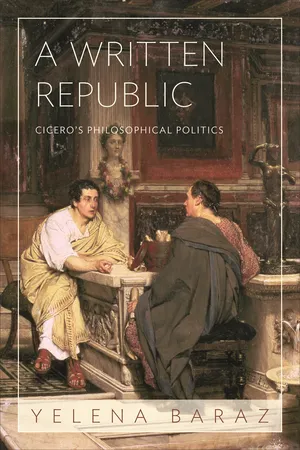
In the 40s BCE, during his forced retirement from politics under Caesar's dictatorship, Cicero turned to philosophy, producing a massive and important body of work. As he was acutely aware, this was an unusual undertaking for a Roman statesman because Romans were often hostile to philosophy, perceiving it as foreign and incompatible with fulfilling one's duty as a citizen. How, then, are we to understand Cicero's decision to pursue philosophy in the context of the political, intellectual, and cultural life of the late Roman republic? In A Written Republic, Yelena Baraz takes up this question and makes the case that philosophy for Cicero was not a retreat from politics but a continuation of politics by other means, an alternative way of living a political life and serving the state under newly restricted conditions.
Baraz examines the rhetorical battle that Cicero stages in his philosophical prefaces--a battle between the forces that would oppose or support his project. He presents his philosophy as intimately connected to the new political circumstances and his exclusion from politics. His goal--to benefit the state by providing new moral resources for the Roman elite--was traditional, even if his method of translating Greek philosophical knowledge into Latin and combining Greek sources with Roman heritage was unorthodox.
A Written Republic provides a new perspective on Cicero's conception of his philosophical project while also adding to the broader picture of late-Roman political, intellectual, and cultural life.
- 272 pages
- English
- ePUB (mobile friendly)
- Available on iOS & Android
eBook - ePub
About this book
Information
Publisher
Princeton University PressYear
2012Print ISBN
9780691264820
9780691153322
eBook ISBN
9781400842162
Topic
FilosofíaSubtopic
Historia antigua romanaCHAPTER ONE
Otiose Otium
THE STATUS OF INTELLECTUAL ACTIVITY IN LATE REPUBLICAN PREFACES
. . . once you know what leisure is, you still may not want it. Leisure requires a sacrifice. This conclusion will doubtless disappoint many persons.
Work is an antonym of free time. But not of leisure.
Sebastian de Grazia, Of Time, Work, and Leisure
CICERO BEGINS HIS PREFACE to book one of De Finibus by saying that the work will inevitably be subject to much criticism. As he proceeds to set out the individual features of the work that he expects will provoke criticism from different quarters, he in effect identifies for us those aspects of writing philosophy that the Roman public could find objectionable. The list of potential critics and their particular preoccupations can, therefore, be read as a list of the various anxieties that Cicero feels he must allay in his readers in order for his project to be successful. The first group, to which he says he responded at length in the lost Hortensius, objects to philosophy altogether.1 The second approves of it, but only if practiced in a limited way, remissius. The third objects to writing philosophy in Latin, rather than in its “native tongue,” Greek, and the last finds that a different literary genre would be preferable to philosophy, because the latter is not compatible with the author’s high social standing, his dignitas.2 Yet, since Cicero is the one voicing these objections for his imaginary critics, it is legitimate to ask to what extent they are concerns unique to Cicero’s perception and presentation of his project and its likely reception. Are the anxieties that surface in this list shared by other authors and do they reflect the way in which works of the same general type as Cicero’s treatises were expected to be received? In this chapter I examine texts, both within and outside of Cicero’s corpus, that indicate that the criticisms he ventriloquises in the preface to book one of De Finibus indeed represent real social and cultural pressures. They form part of a discourse shared with other roughly contemporary works that attempt to broaden the field of socially acceptable intellectual inquiry. Thus, I begin my investigation of Cicero’s philosophica by looking at the cultural context within, and against which he is positioning his project. Such perspective will lead to a better understanding of the pressures under which he labors and the forces that stand behind them.
For the moment I will set aside the issue of writing in Latin as opposed to Greek, which will be the subject of chapter 3. The rest of the critics’ concerns can be expanded into three broad categories: those having to do with intellectual activity in general, and writing in particular, those regarding the degree of commitment proper to such an activity, and those that result from the conviction that there is a mismatch between the activity and the status of the practitioner. In addition, an anxiety that all the imagined critics and the authors discussed in this chapter seem to share centers on the place of the given intellectual activity in the practitioner’s life. Intellectual pursuits are felt to be more appropriate when they are limited to the sphere of otium, time free from the important business of the state that is expected to occupy most of the time of the elite Roman man.3 Thus, as we shall see, the author of the Rhetorica ad Herennium states emphatically that his writing takes place in a rare and limited space free from regular negotia, while both Sallust and Cicero, who can claim no public negotia of their own at the time of their writing, are engaged in constructing their intellectual occupation as a new type of negotium, functionally similar to the traditional ones, and just as valuable.4 The three authors discussed in this chapter all deal with the same potential objections, because they are writing works that are designed to present to the reading public the fruits of their intellectual activity. Their respective subjects make the task more or less difficult. Cicero’s task as he introduces works arising from a severely marginalized discipline is more difficult than that of historians or rhetoricians, who work in fields that fit more readily within the traditional Roman framework. Yet, despite the differences, the shared apologetic impulse that finds expression in their writings will allow them to illuminate each other’s self-justificatory strategies and, at the same time, will expose the concerns the awareness of which puts them on the defensive.
CICERO’S ENNIUS, OR ANXIETY ABOUT TOO MUCH PHILOSOPHY
One of the earliest and most important texts that encapsulates Roman reservations concerning the practice of philosophy is transmitted to us by Cicero himself:
Neoptolemus quidem apud Ennium philosophari sibi ait necesse esse, sed paucis; nam omnino haud placere: ego autem, Brute, necesse mihi quidem esse arbitror philosophari—nam quid possum, praesertim nihil agens, agere melius?—sed non paucis, ut ille. (Tusc. 2.1)
Neoptolemus in Ennius’ play certainly says that it is necessary for him to engage in philosophy, but in a limited way; for it is not pleasing to do so fully. I, however, Brutus, think that for me it is certainly necessary to practice philosophy; for what better thing can I do, especially since I am doing nothing? But not in a limited way, as that one did.
This quotation from Ennius expresses well the basic Roman perception of philosophy, a perception that, despite Cicero’s efforts, which are the subject of this study, remained largely unchanged for centuries to come.5 The essence of this view is that philosophy can be an acceptable and even occasionally useful pastime as long as it is kept on the periphery of one’s life.6 At the bottom of this attitude lies the assumption that philosophy is ultimately incompatible with public life and, if practiced too seriously, will cause the practitioner to abandon his duties as an (elite) Roman.7 It is this view that is the main obstacle to the success of any philosophical undertaking in Rome. All the negative perceptions that Cicero sets out to overturn in all of his prefaces have their origins in it. Thus, in order to gain approval for his philosophical project as a substitute for regular civic activity, he must convince his readership that this view is erroneous. Cicero’s awareness that this attitude is likely to color any Roman reader’s reception of his work is present throughout the apologetic passages of the prefaces, but it is fitting to begin this discussion at a place where Cicero acknowledges and confronts the prevailing opinion most explicitly.8
The use of an Ennian character as the mouthpiece for this view indicates that Cicero is willing to take the position that he is opposing quite seriously.9 On other occasions he shows a tendency to choose a clearly inferior opponent, an easy target, as a representative of whatever view or school of thought he wants to dismiss. He then uses that representative’s obvious shortcomings to make the entire group and its beliefs look ridiculous.10 The present passage takes the opposite approach, and with good reason. The opinion that Cicero wants to overturn here is not that of some fairly marginal group; it is a widely held and respected one. In order to succeed in convincing his readers, many of whom are likely to share this view, to change or at least open their minds, it is wise to treat the view (and by extension, those who share it) with respect.
A further difficulty in opposing this position is due to the fact that Cicero himself had approved several versions of the view that philosophy is of limited utility, both in his speeches11 and in his earlier treatises, whose emphasis was on rhetoric (De Oratore) or statecraft (De Re Publica, De Legibus). Thus, when he argues for a more open attitude towards the adoption of philosophy, he is also arguing against his earlier position. This extra dimension of his argument is underlined by his choice of the Ennian line. Cicero had used it twice before, to a rather different end. In the other two instances, in De Oratore and De Re Publica,12 written in the fifties, the words of Neoptolemus appear in arguments urging a modest role for philosophy in contrast to the outright hostility of Pacuvius’ Zethus,13 whereas in the passage from the Tusculans Neoptolemus’ sentiments serve as a foil for Cicero’s appeal, in his own voice, for a holistic approach to the discipline.14
A couple of details further indicate that this passage is one where the author expects a particularly strong engagement on the part of the reader. The use of quidem in the first and autem in the second sentence indicates that Cicero positions his view in opposition to the one expressed in the first sentence through the words of Neoptolemus.15 The fact that the second sentence undoubtedly expresses Cicero’s own view (ego autem), leads to the question of who is the focalizer of the previous sentiment; that is, who does Cicero imagine as thinking of the Ennius quotation in the context of the Tusculans. The most obvious candidate is Brutus, the dedicatee, and thus the implied interlocutor of the preface, who is explicitly addressed in the second sentence. Yet we know enough of Brutus’ own engagement with philosophy, often cited in Cicero’s very prefaces,16 to know that, while it may not qualify for the description of omnino, it certainly went far beyond paucis:17 Brutus was the author of a philosophical work himself. It is natural then to assume that the focalizer of the sentiment is the anonymous reader of the work: both the general acceptance of the opinion and Cicero’s tendency to relate to the reader through the dedicatee, which I will discuss in detail in chapter 5, point in this direction. Thus, it appears that Cicero here voices the reader’s potential objection, and in the strongest possible terms—by invoking the Roman literary tradition—because doing so gives him an opportunity to address and refute it as fully as he can.
Quidem in the first sentence further adds to the reader’s sense of involvement in the passage. At the same time as it anticipates a contrast, it can also look backwards with an adversative force, signposting a response meant to contradict a previously expressed opposing view.18 However, in our passage nothing of the sort has been explicitly expressed: quidem is located in the very first sentence of book two of the Tusculans. I suggest that quidem does nevertheless have adversative force here. Cicero, in his attempt to carefully manage the reader’s reaction, imagines him respo...
Table of contents
- Cover
- Half Title
- Title
- Copyright
- Dedication
- Contents
- Acknowledgments
- Abbreviations and Translations
- Introduction
- Chapter One Otiose Otium: The Status of Intellectual Activity in Late Republican Prefaces
- Chapter Two On a More Personal Note: Philosophy in the Letters
- Chapter Three The Gift of Philosophy: The Treatises as Translations
- Chapter Four With the Same Voice: Oratory as a Transitional Space
- Chapter Five Reading a Ciceronian Preface: Strategies of Reader Management
- Chapter Six Philosophy after Caesar: The New Direction
- Bibliography
- Index Locorum
- General Index
Trusted by 375,005 students
Access to over 1.5 million titles for a fair monthly price.
Study more efficiently using our study tools.
Frequently asked questions
Yes, you can cancel anytime from the Subscription tab in your account settings on the Perlego website. Your subscription will stay active until the end of your current billing period. Learn how to cancel your subscription
No, books cannot be downloaded as external files, such as PDFs, for use outside of Perlego. However, you can download books within the Perlego app for offline reading on mobile or tablet. Learn how to download books offline
Perlego offers two plans: Essential and Complete
- Essential is ideal for learners and professionals who enjoy exploring a wide range of subjects. Access the Essential Library with 800,000+ trusted titles and best-sellers across business, personal growth, and the humanities. Includes unlimited reading time and Standard Read Aloud voice.
- Complete: Perfect for advanced learners and researchers needing full, unrestricted access. Unlock 1.5M+ books across hundreds of subjects, including academic and specialized titles. The Complete Plan also includes advanced features like Premium Read Aloud and Research Assistant.
We are an online textbook subscription service, where you can get access to an entire online library for less than the price of a single book per month. With over 1.5 million books across 990+ topics, we’ve got you covered! Learn about our mission
Look out for the read-aloud symbol on your next book to see if you can listen to it. The read-aloud tool reads text aloud for you, highlighting the text as it is being read. You can pause it, speed it up and slow it down. Learn more about Read Aloud
Yes! You can use the Perlego app on both iOS and Android devices to read anytime, anywhere — even offline. Perfect for commutes or when you’re on the go.
Please note we cannot support devices running on iOS 13 and Android 7 or earlier. Learn more about using the app
Please note we cannot support devices running on iOS 13 and Android 7 or earlier. Learn more about using the app
Yes, you can access A Written Republic by Yelena Baraz in PDF and/or ePUB format, as well as other popular books in Filosofía & Historia antigua romana. We have over 1.5 million books available in our catalogue for you to explore.