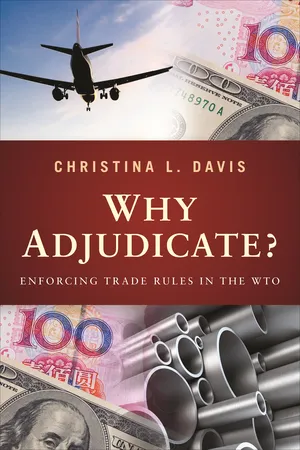
The World Trade Organization (WTO) oversees the negotiation and enforcement of formal rules governing international trade. Why do countries choose to adjudicate their trade disputes in the WTO rather than settling their differences on their own? In Why Adjudicate?, Christina Davis investigates the domestic politics behind the filing of WTO complaints and reveals why formal dispute settlement creates better outcomes for governments and their citizens.
Davis demonstrates that industry lobbying, legislative demands, and international politics influence which countries and cases appear before the WTO. Democratic checks and balances bias the trade policy process toward public lawsuits and away from informal settlements. Trade officials use legal complaints to manage domestic politics and defend trade interests. WTO dispute settlement enables states and domestic groups to signal resolve more effectively, thereby enhancing the information available to policymakers and reducing the risk of a trade war. Davis establishes her argument with data on trade disputes and landmark cases, including the Boeing-Airbus controversy over aircraft subsidies, disagreement over Chinese intellectual property rights, and Japan's repeated challenges of U.S. steel industry protection. In her analysis of foreign trade barriers against U.S. exports, Davis explains why the United States gains better outcomes for cases taken to formal dispute settlement than for those negotiated. Case studies of Peru and Vietnam show that legal action can also benefit developing countries.
- 320 pages
- English
- ePUB (mobile friendly)
- Available on iOS & Android
eBook - ePub
About this book
Information
Publisher
Princeton University PressYear
2012Print ISBN
9780691152769
9780691152752
eBook ISBN
9781400842513
Table of contents
- Cover
- Half title
- Title
- Copyright
- Dedication
- Contents
- List of Figures
- List of Tables
- Acknowledgments
- List of Abbreviations
- 1. Introduction
- 2. Domestic Constraints and Active Enforcement
- 3. The Democratic Propensity for Adjudication
- 4. The Litigious State: U.S. Trade Policy
- 5. The Reluctant Litigant: Japanese Trade Policy
- 6. Conflict Management: Evaluating the Effectiveness of Adjudication
- 7. Level Playing Field? Adjudication by Developing Countries
- 8. Conclusion
- Bibliography
- Index
Trusted by 375,005 students
Access to over 1.5 million titles for a fair monthly price.
Study more efficiently using our study tools.
Frequently asked questions
Yes, you can cancel anytime from the Subscription tab in your account settings on the Perlego website. Your subscription will stay active until the end of your current billing period. Learn how to cancel your subscription
No, books cannot be downloaded as external files, such as PDFs, for use outside of Perlego. However, you can download books within the Perlego app for offline reading on mobile or tablet. Learn how to download books offline
Perlego offers two plans: Essential and Complete
- Essential is ideal for learners and professionals who enjoy exploring a wide range of subjects. Access the Essential Library with 800,000+ trusted titles and best-sellers across business, personal growth, and the humanities. Includes unlimited reading time and Standard Read Aloud voice.
- Complete: Perfect for advanced learners and researchers needing full, unrestricted access. Unlock 1.5M+ books across hundreds of subjects, including academic and specialized titles. The Complete Plan also includes advanced features like Premium Read Aloud and Research Assistant.
We are an online textbook subscription service, where you can get access to an entire online library for less than the price of a single book per month. With over 1.5 million books across 990+ topics, we’ve got you covered! Learn about our mission
Look out for the read-aloud symbol on your next book to see if you can listen to it. The read-aloud tool reads text aloud for you, highlighting the text as it is being read. You can pause it, speed it up and slow it down. Learn more about Read Aloud
Yes! You can use the Perlego app on both iOS and Android devices to read anytime, anywhere — even offline. Perfect for commutes or when you’re on the go.
Please note we cannot support devices running on iOS 13 and Android 7 or earlier. Learn more about using the app
Please note we cannot support devices running on iOS 13 and Android 7 or earlier. Learn more about using the app
Yes, you can access Why Adjudicate? by Christina L. Davis in PDF and/or ePUB format, as well as other popular books in Politics & International Relations & Trade & Tariffs. We have over 1.5 million books available in our catalogue for you to explore.