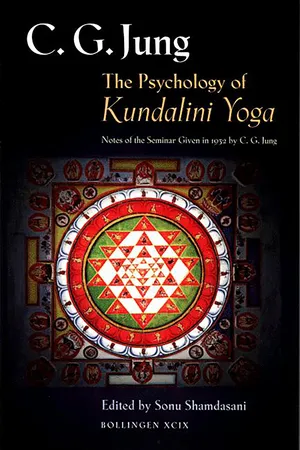
"Kundalini yoga presented Jung with a model of something that was almost completely lacking in Western psychology--an account of the development phases of higher consciousness.... Jung's insistence on the psychogenic and symbolic significance of such states is even more timely now than then. As R. D. Laing stated... 'It was Jung who broke the ground here, but few followed him.'"--From the introduction by Sonu Shamdasani
Jung's seminar on Kundalini yoga, presented to the Psychological Club in Zurich in 1932, has been widely regarded as a milestone in the psychological understanding of Eastern thought and of the symbolic transformations of inner experience. Kundalini yoga presented Jung with a model for the developmental phases of higher consciousness, and he interpreted its symbols in terms of the process of individuation. With sensitivity toward a new generation's interest in alternative religions and psychological exploration, Sonu Shamdasani has brought together the lectures and discussions from this seminar. In this volume, he re-creates for today's reader the fascination with which many intellectuals of prewar Europe regarded Eastern spirituality as they discovered more and more of its resources, from yoga to tantric texts. Reconstructing this seminar through new documentation, Shamdasani explains, in his introduction, why Jung thought that the comprehension of Eastern thought was essential if Western psychology was to develop. He goes on to orient today's audience toward an appreciation of some of the questions that stirred the minds of Jung and his seminar group: What is the relation between Eastern schools of liberation and Western psychotherapy? What connection is there between esoteric religious traditions and spontaneous individual experience? What light do the symbols of Kundalini yoga shed on conditions diagnosed as psychotic? Not only were these questions important to analysts in the 1930s but, as Shamdasani stresses, they continue to have psychological relevance for readers on the threshold of the twenty-first century. This volume also offers newly translated material from Jung's German language seminars, a seminar by the indologist Wilhelm Hauer presented in conjunction with that of Jung, illustrations of the cakras, and Sir John Woodroffe's classic translation of the tantric text, the Sat-cakra Nirupana. ?
Dr. Jung: Ladies and gentlemen, we have just had a seminar about tantric yoga,1 and as there are always misunderstandings in the wake of such an event, I am devoting some time to the discussion and elucidation of any questions that you may have. Even those who were not there will be interested, I suppose, because I have spoken of the cakras before.2 Moreover, in the pursuit of our visions we have now reached the stage where symbols analogous to those of tantric yoga are beginning to operate. You remember, we have seen how our patient’s visions in their natural and quite uninfluenced development brought the first mandala. In the last hour of our spring seminar I showed you a mandala that created itself, the mandala of the child within the circles, and the patient’s attempts to unite with the child.3 That is entering the mandala, and there already the symbolism of tantra yoga begins. So it is not irrelevant that we discuss this subject now; it fits in well with what we have done here. As a matter of fact, our former seminar has led us up to the psychology of tantric yoga, what I have hitherto called mandala psychology.
I shall take first this question by Mrs. Bailward: “I understand that the kleśa asmitā ‘contains the germ of being a personality’ and the kleśa dve
a ‘the wish to be two,’ or hatred.4 Does Professor Hauer mean personality or individuality here? When it has built up the individuality, how would hatred be torn out by the roots?”
Well, there is the kleśa of dividing and discrimination, of becoming a personality, an ego, where there is also the aspect of hatred. The kleśas are urges, a natural instinctive form in which libido first appears out of the unconscious; that is the psychological energy, or libido, in its simplest form of manifestation.5 Now, according to tantric teaching, there is an urge to produce a personality, something that is centered, and divided from other beings, and that would be the kleśa of discrimination. It is what one would describe in Western philosophical terms as an urge or instinct of individuation.
The instinct of individuation is found everywhere in life, for there is no life on earth that is not individual. Each form of life is manifested in a differentiated being naturally, otherwise life could not exist. An innate urge of life is to produce an individual as complete as possible. For instance, a bird with all its feathers and colors and the size that belongs to that particular species. So the entelechia, the urge of realization, naturally pushes man to be himself. Given a chance to be himself, he would most certainly grow into his own form, if there were not obstacles and inhibitions of many descriptions that hinder him from becoming what he is really meant to be. So the kleśa that contains the germ of personality can be called just as well the kleśa of individuation, because what we call personality is an aspect of individuation. Even if you don’t become a complete realization of yourself, you become at least a person; you have a certain conscious form. Of course, it is not a totality; it is only a part, perhaps, and your true individuality is still behind the screen—yet what is manifested on the surface is surely a unit. One is not necessarily conscious of the totality, and perhaps other people see more clearly who you are than you do yourself. So individuality is always. It is everywhere. Everything that has life is individual—a dog, a plant, everything living—but of course it is far from being conscious of its individuality. A dog has probably an exceedingly limited idea of himself as compared with the sum total of his individuality. As most people, no matter how much they think of themselves, are egos, yet at the same time they are individuals, almost as if they were individuated. For they are in a way individuated from the very beginning of their lives, yet they are not conscious of it. Individuation only takes place when you are conscious of it, but individuality is always there from the beginning of your existence.
Mrs. Baynes: I did not get where the hate, dve
a, came in.
Dr. Jung: Hatred is the thing that divides, the force which discriminates. It is so when two people fall in love; they are at first almost identical. There is a great deal of participation mystique, so they need hatred in order to separate themselves. After a while the whole thing turns into a wild hatred; they get resistances against one another in order to force each other off—otherwise they remain in a common unconsciousness which they simply cannot stand. One sees that also in analysis. In the case of an exaggerated transference, after a while there are corresponding resistances. This too is a certain hatred.
The old Greek put phobos, fear, instead of hatred. They said that the firstborn thing was either Eros or phobos; some say Eros and others phobos, according to their temperaments. There are optimists who say the real thing is love, and pessimists who say the real thing is phobos. Phobos separates more than hatred, because fear causes one to run away, to remove oneself from the place of danger.
I was once asked a philosophical question by a Hindu: “Does a man who loves God need more or fewer incarnations to reach his final salvation than a man who hates God?” Now, what would you answer? I gave it up naturally. And he said: “A man who loves God will need seven incarnations to become perfect, and a man who hates God only three, because he certainly will think of him and cling to him very much more than the man who loves God.” That, in a way, is true; hatred is a tremendous cement. So for us the Greek formulation phobos is perhaps better than hatred as the principle of separation. There has been, and is still, more participation mystique in India than in Greece, and the West has certainly a more discriminating mind than the East. Therefore, as our civilization largely depends upon the Greek genius, with us it would be fear and not hatred.
Mrs. Crowley: Yet in the cakras apparently the most important gesture is that of dispelling fear.
Dr. Jung: Yes, but the gods are always carrying weapons also, and weapons are not an expression of any particular love.
Miss Wolff: I have my notes here, and I think I see what caused Mrs. Bailward’s confusion. Professor Hauer said in German hasserfüllte Zweiung, but it does not mean to become two, exactly; it means to become a subject against an object—there are two things.6 The English translation is not so clear.
Dr. Jung: Entzweiung means separation. Now the rest of the question?
Mrs. Bailward: I mean, would the yogi consider the state of hatred a necessary condition in building up individuality?
Dr. Jung: Yes, he cannot help considering it so, for the whole yoga process, whether classical or Kundalini yoga, naturally has a tendency to make the individual one, even as the god is one, like brahman, an existing nonexisting oneness.
The question continues: “And when it had built up the individuality, how would hatred be torn out by the roots?”
Miss Wolff: Professor Hauer spoke of the two aspects of the kleśa.7 In the imperfect condition—the sthūla aspect—the urge to be a subject over against an object is mingled with hatred. But in the sūk
ma aspect the same urge is the power to become a personality.
Dr. Jung: Yes, it is an important and very bewildering thing in this whole terminology that one always must make the distinction between the sthūla and sūk
ma aspects.8 I do not speak of the parā aspect because that is what Professor Hauer calls the metaphysical. I must confess that there the mist begins for me—I do not risk myself there. The sthūla aspect is simply things as we see them. The sūk
ma aspect is what we guess about them, or the abstractions or philosophical conclusions we draw from observed facts. When we see people who make efforts to consolidate themselves, to be egos, and therefore resist and hate one another, we see the sthūla aspect, and we are only aware of the kleśa...
Table of contents
Cover
Half title
Title
Copyright
Dedication
Table of Contents
List of Illustrations
Preface
Acknowledgments
Members of the Seminar
List of Abbreviations
Introduction: Jung’s Journey to the East
Lecture 1: 12 October 1932
Lecture 2: 19 October 1932
Lecture 3: 26 October 1932
Lecture 4: 2 November 1932
Appendix 1: Indian Parallels, 11 October 1930
Appendix 2: Jung’s Comments in Hauer’s German Lectures, 5–8 October 1932
Appendix 3: Hauer’s English Lecture, 8 October 1932
Appendix 4: Sat-cakra-nirūpana
Index
Trusted by 375,005 students
Access to over 1.5 million titles for a fair monthly price.
Study more efficiently using our study tools.
Frequently asked questions
Yes, you can cancel anytime from the Subscription tab in your account settings on the Perlego website. Your subscription will stay active until the end of your current billing period. Learn how to cancel your subscription
No, books cannot be downloaded as external files, such as PDFs, for use outside of Perlego. However, you can download books within the Perlego app for offline reading on mobile or tablet. Learn how to download books offline
Perlego offers two plans: Essential and Complete
Essential is ideal for learners and professionals who enjoy exploring a wide range of subjects. Access the Essential Library with 800,000+ trusted titles and best-sellers across business, personal growth, and the humanities. Includes unlimited reading time and Standard Read Aloud voice.
Complete: Perfect for advanced learners and researchers needing full, unrestricted access. Unlock 1.5M+ books across hundreds of subjects, including academic and specialized titles. The Complete Plan also includes advanced features like Premium Read Aloud and Research Assistant.
Both plans are available with monthly, semester, or annual billing cycles.
We are an online textbook subscription service, where you can get access to an entire online library for less than the price of a single book per month. With over 1.5 million books across 990+ topics, we’ve got you covered! Learn about our mission
Look out for the read-aloud symbol on your next book to see if you can listen to it. The read-aloud tool reads text aloud for you, highlighting the text as it is being read. You can pause it, speed it up and slow it down. Learn more about Read Aloud
Yes! You can use the Perlego app on both iOS and Android devices to read anytime, anywhere — even offline. Perfect for commutes or when you’re on the go. Please note we cannot support devices running on iOS 13 and Android 7 or earlier. Learn more about using the app
Yes, you can access The Psychology of Kundalini Yoga by C. G. Jung, Sonu Shamdasani in PDF and/or ePUB format, as well as other popular books in Psychology & Psychoanalysis. We have over 1.5 million books available in our catalogue for you to explore.