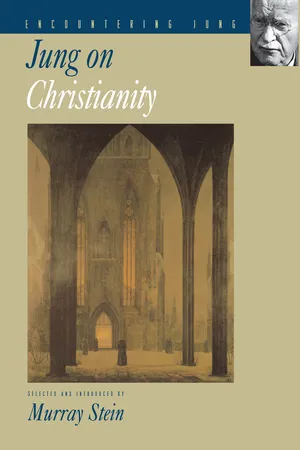
C. G. Jung, son of a Swiss Reformed pastor, used his Christian background throughout his career to illuminate the psychological roots of all religions. Jung believed religion was a profound, psychological response to the unknown--both the inner self and the outer worlds--and he understood Christianity to be a profound meditation on the meaning of the life of Jesus of Nazareth within the context of Hebrew spirituality and the Biblical worldview.
Murray Stein's introduction relates Jung's personal relationship with Christianity to his psychological views on religion in general, his hermeneutic of religious thought, and his therapeutic attitude toward Christianity. This volume includes extensive selections from Psychological Approach to the Dogma of the Trinity," "Christ as a Symbol of the Self," from Aion, "Answer to Job," letters to Father Vincent White from Letters, and many more.
- 296 pages
- English
- ePUB (mobile friendly)
- Available on iOS & Android
eBook - ePub
Jung on Christianity
About this book
Information
PART I
JUNG’S RELATIONSHIP TO CHRISTIANITY
1
A FATHER’S UNFINISHED WORK
From Memories, Dreams, Reflections, pp. 52–63
With my father it was quite different. I would have liked to lay my religious difficulties before him and ask him for advice, but I did not do so because it seemed to me that I knew in advance what he would be obliged to reply out of respect for his office. How right I was in this assumption was demonstrated to me soon afterward. My father personally gave me my instruction for confirmation. It bored me to death. One day I was leafing through the catechism, hoping to find something besides the sentimental-sounding and usually incomprehensible as well as uninteresting expatiations on Lord Jesus. I came across the paragraph on the Trinity. Here was something that challenged my interest: a oneness which was simultaneously a threeness. This was a problem that fascinated me because of its inner contradiction. I waited longingly for the moment when we would reach this question. But when we got that far, my father said, “We now come to the Trinity, but we’ll skip that, for I really understand nothing of it myself.” I admired my father’s honesty, but on the other hand I was profoundly disappointed and said to myself, “There we have it; they know nothing about it and don’t give it a thought. Then how can I talk about my secret?”
I made vain, tentative attempts with certain of my schoolfellows who struck me as reflective. I awakened no response, but, on the contrary, a stupefaction that warned me off.
In spite of the boredom, I made every effort to believe without understanding—an attitude which seemed to correspond with my father’s—and prepared myself for Communion, on which I had set my last hopes. This was, I thought, merely a memorial meal, a kind of anniversary celebration for Lord Jesus who had died 1890—30 = 1860 years ago. But still, he had let fall certain hints such as, “Take, eat, this is my body,” meaning that we should eat the Communion bread as if it were his body, which after all had originally been flesh. Likewise we were to drink the wine which had originally been blood. It was clear to me that in this fashion we were to incorporate him into ourselves. This seemed to me so preposterous an impossibility that I was sure some great mystery must lie behind it, and that I would participate in this mystery in the course of Communion, on which my father seemed to place so high a value.
As was customary, a member of the church committee stood godfather to me. He was a nice, taciturn old man, a wheelwright in whose workshop I had often stood, watching his skill with lathe and adze. Now he came, solemnly transformed by frock coat and top hat, and took me to church, where my father in his familiar robes stood behind the altar and read prayers from the liturgy. On the white cloth covering the altar lay large trays filled with small pieces of bread. I could see that the bread came from our baker, whose baked goods were generally poor and flat in taste. From a pewter jug, wine was poured into a pewter cup. My father ate a piece of the bread, took a swallow of the wine—I knew the tavern from which it had come—and passed the cup to one of the old men. All were stiff, solemn, and, it seemed to me, uninterested. I looked on in suspense, but could not see or guess whether anything unusual was going on inside the old men. The atmosphere was the same as that of all other performances in church—baptisms, funerals, and so on. I had the impression that something was being performed here in the traditionally correct manner. My father, too, seemed to be chiefly concerned with going through it all according to rule, and it was part of this rule that the appropriate words were read or spoken with emphasis. There was no mention of the fact that it was now 1860 years since Jesus had died, whereas in all other memorial services the date was stressed. I saw no sadness and no joy, and felt that the feast was meager in every respect, considering the extraordinary importance of the person whose memory was being celebrated. It did not compare at all with secular festivals.
Suddenly my turn came. I ate the bread; it tasted flat, as I had expected. The wine, of which I took only the smallest sip, was thin and rather sour, plainly not of the best. Then came the final prayer, and the people went out, neither depressed nor illumined with joy, but with faces that said, “So that’s that.”
I walked home with my father, intensely conscious that I was wearing a new black felt hat and a new black suit which was already beginning to turn into a frock coat. It was a kind of lengthened jacket that spread out into two little wings over the seat, and between these was a slit with a pocket into which I could tuck a handkerchief—which seemed to me a grown-up, manly gesture. I felt socially elevated and by implication accepted into the society of men. That day, too, Sunday dinner was an unusually good one. I would be able to stroll about in my new suit all day. But otherwise I was empty and did not know what I was feeling.
Only gradually, in the course of the following days, did it dawn on me that nothing had happened. I had reached the pinnacle of religious initiation, had expected something—I knew not what—to happen, and nothing at all had happened. I knew that God could do stupendous things to me, things of fire and unearthly light; but this ceremony contained no trace of God—not for me, at any rate. To be sure, there had been talk about Him, but it had all amounted to no more than words. Among the others I had noticed nothing of the vast despair, the overpowering elation and outpouring of grace which for me constituted the essence of God. I had observed no sign of “communion,” of “union, becoming one with . . .” With whom? With Jesus? Yet he was only a man who had died 1860 years ago. Why should a person become one with him? He was called the “Son of God”—a demigod, therefore, like the Greek heroes: how then could an ordinary person become one with him? This was called the “Christian religion,” but none of it had anything to do with God as I had experienced Him. On the other hand it was quite clear that Jesus, the man, did have to do with God; he had despaired in Gethsemane and on the cross, after having taught that God was a kind and loving father. He too, then, must have seen the fearfulness of God. That I could understand, but what was the purpose of this wretched memorial service with the flat bread and the sour wine? Slowly I came to understand that this Communion had been a fatal experience for me. It had proved hollow; more than that, it had proved to be a total loss. I knew that I would never again be able to participate in this ceremony. “Why, that is not religion at all,” I thought. “It is an absence of God; the church is a place I should not go to. It is not life which is there, but death.”
I was seized with the most vehement pity for my father. All at once I understood the tragedy of his profession and his life. He was struggling with a death whose existence he could not admit. An abyss had opened between him and me, and I saw no possibility of ever bridging it, for it was infinite in extent. I could not plunge my dear and generous father, who in so many matters left me to myself and had never tyrannized over me, into that despair and sacrilege which were necessary for an experience of divine grace. Only God could do that. I had no right to; it would be inhuman. God is not human, I thought; that is His greatness, that nothing human impinges on Him. He is kind and terrible—both at once—and is therefore a great peril from which everyone naturally tries to save himself. People cling one-sidedly to His love and goodness, for fear they will fall victim to the tempter and destroyer. Jesus, too, had noticed that, and had therefore taught: “Lead us not into temptation.”
My sense of union with the Church and with the human world, so far as I knew it, was shattered. I had, so it seemed to me, suffered the greatest defeat of my life. The religious outlook which I imagined constituted my sole meaningful relation with the universe had disintegrated; I could no longer participate in the general faith, but found myself involved in something inexpressible, in my secret, which I could share with no one. It was terrible and—this was the worst of it—vulgar and ridiculous also, a diabolical mockery.
I began to ponder: What must one think of God? I had not invented that thought about God and the cathedral, still less the dream that had befallen me at the age of three. A stronger will than mine had imposed both on me. Had nature been responsible? But nature was nothing other than the will of the Creator. Nor did it help to accuse the devil, for he too was a creature of God. God alone was real—an annihilating fire and an indescribable grace.
What about the failure of Communion to affect me? Was that my own failure? I had prepared for it in all earnestness, had hoped for an experience of grace and illumination, and nothing had happened. God had been absent. For God’s sake I now found myself cut off from the Church and from my father’s and everybody else’s faith. Insofar as they all represented the Christian religion, I was an outsider. This knowledge filled me with a sadness which was to overshadow all the years until the time I entered the university.
I began looking in my father’s relatively modest library—which in those days seemed impressive to me—for books that would tell me what was known about God. At first I found only the traditional conceptions, but not what I was seeking—a writer who thought independently. At last I hit upon Biedermann’s Christliche Dogmatik, published in 1869. Here, apparently, was a man who thought for himself, who worked out his own views. I learned from him that religion was “a spiritual act consisting in man’s establishing his own relationship to God.” I disagreed with that, for I understood religion as something that God did to me; it was an act on His part, to which I must simply yield, for He was the stronger. My “religion” recognized no human relationship to God, for how could anyone relate to something so little known as God? I must know more about God in order to establish a relationship to him. In Biedermann’s chapter on “The Nature of God” I found that God showed Himself to be a “personality to be conceived after the analogy of the human ego: the unique, utterly supramundane ego who embraces the entire cosmos.”
As far as I knew the Bible, this definition seemed to fit. God has a personality and is the ego of the universe, just as I myself am the ego of my psychic and physical being. But here I encountered a formidable obstacle. Personality, after all, surely signifies character. Now, character is one thing and not another; that is to say, it involves certain specific attributes. But if God is everything, how can He still possess a distinguishable character? On the other hand, if He does have a character, He can only be the ego of a subjective, limited world. Moreover, what kind of character or what kind of personality does He have? Everything depends on that, for unless one knows the answer one cannot establish a relationship to Him.
I felt the strongest resistances to imagining God by analogy with my own ego. That seemed to me boundlessly arrogant, if not downright blasphemous. My ego was, in any case, difficult enough for me to grasp. In the first place, I was aware that it consisted of two contradictory aspects: No. 1 and No. 2. Second, in both its aspects my ego was extremely limited, subject to all possible self-deceptions and errors, moods, emotions, passions, and sins. It suffered far more defeats than triumphs, was childish, vain, self-seeking, defiant, in need of love, covetous, unjust, sensitive, lazy, irresponsible, and so on. To my sorrow it lacked many of the virtues and talents I admired and envied in others. How could this be the analogy according to which we were to imagine the nature of God?
Eagerly I looked up the other characteristics of God, and found them all listed in the way familiar to me from my instruction for confirmation. I found that according to Article 172, “the most immediate expression of the supramundane nature of God is 1) negative: His invisibility to men,” etc., “and 2) positive: His dwelling in Heaven,” etc. This was disastrous, for at once there rushed to my mind the blasphemous vision which God directly or indirectly (i.e., via the devil) had imposed on my will.
Article 183 informed me that “God’s supramundane nature with regard to the moral world” consists in His “justice,” which is not merely “judicial” but is also “an expression of His holy being.” I had hoped that this paragraph would say something about God’s dark aspects which were giving me so much trouble: His vindictiveness, His dangerous wrathfulness, His incomprehensible conduct toward the creatures His omnipotence had made, whose inadequacies He must know by virtue of that same omnipotence, and whom moreover it pleased Him to lead astray, or at least to test, even though He knew in advance the outcome of His experiments. What, indeed, was God’s character? What would we say of a human personality who behaved in this manner? I did not dare to think this question out to its conclusion. And then I read that God, “although sufficient unto Himself and needing nothing outside Himself,” had created the world “out of His satisfaction,” and “as a natural world has filled it with His goodness and as a moral world desires to fill it with His love.”
At first I pondered over the perplexing word “satisfaction.” Satisfaction with what or with whom? Obviously with the world, for He had looked upon His work and called it good. But it was just this that I had never understood. Certainly the world is immeasurably beautiful, but it is quite as horrible. In a small village in the country, where there are few people and nothing much happens, “old age, disease, and death” are experienced more intensely, in greater detail, and more nakedly than elsewhere. Although I was not yet sixteen years old I had seen a great deal of the reality of the life of man and beast, and in church and school I had heard enough of the sufferings and corruption of the world. God could at most have felt “satisfaction” with paradise, but then He Himself had taken good care that the glory of paradise should not last too long by planting in it that poisonous serpent, the devil. Had He taken satisfaction in that too? I felt certain that Biedermann did not mean this, but was simply babbling on in that mindless way that characterized religious instruction, not even aware that he was writing nonsense. As I saw it, it was not at all unreasonable to suppose that God, for all that He probably did not feel any such cruel satisfaction in the unmerited sufferings of man and beast, had nevertheless intended to create a world of contradictions in which one creature devoured another and life meant simply being born to die. The “wonderful harmonies” of natural law looked to me more like a chaos tamed by fearful effort, and the “eternal” starry firmament with its predetermined orbits seemed plainly an accumulation of random bodies without order or meaning. For no one could really see the constellations people spoke about. They were mere arbitrary configurations.
I either did not see or gravely doubted that God filled the natural world with His goodness. This, apparently, was another of those points which must not be reasoned about but must be believed. In fact, if God is the highest good, why is the world, His creation, so imperfect, so corrupt, so pitiable? “Obviously it has been infected and thrown into confusion by the devil,” I thought. But the devil, too, was a creature of God. I had to read up on the devil. He seemed to be highly important after al...
Table of contents
- Cover
- Half title
- Title
- Copyright
- Contents
- Introduction
- Part I. Jung’s Relationship to Christianity
- Part II. Jung’s Psychological Approach to Christian Doctrine, Ritual, and Symbol
- Part III. Jung’s Interpretation of Christian History and Its Future
- Index
Trusted by 375,005 students
Access to over 1.5 million titles for a fair monthly price.
Study more efficiently using our study tools.
Frequently asked questions
Yes, you can cancel anytime from the Subscription tab in your account settings on the Perlego website. Your subscription will stay active until the end of your current billing period. Learn how to cancel your subscription
No, books cannot be downloaded as external files, such as PDFs, for use outside of Perlego. However, you can download books within the Perlego app for offline reading on mobile or tablet. Learn how to download books offline
Perlego offers two plans: Essential and Complete
- Essential is ideal for learners and professionals who enjoy exploring a wide range of subjects. Access the Essential Library with 800,000+ trusted titles and best-sellers across business, personal growth, and the humanities. Includes unlimited reading time and Standard Read Aloud voice.
- Complete: Perfect for advanced learners and researchers needing full, unrestricted access. Unlock 1.5M+ books across hundreds of subjects, including academic and specialized titles. The Complete Plan also includes advanced features like Premium Read Aloud and Research Assistant.
We are an online textbook subscription service, where you can get access to an entire online library for less than the price of a single book per month. With over 1.5 million books across 990+ topics, we’ve got you covered! Learn about our mission
Look out for the read-aloud symbol on your next book to see if you can listen to it. The read-aloud tool reads text aloud for you, highlighting the text as it is being read. You can pause it, speed it up and slow it down. Learn more about Read Aloud
Yes! You can use the Perlego app on both iOS and Android devices to read anytime, anywhere — even offline. Perfect for commutes or when you’re on the go.
Please note we cannot support devices running on iOS 13 and Android 7 or earlier. Learn more about using the app
Please note we cannot support devices running on iOS 13 and Android 7 or earlier. Learn more about using the app
Yes, you can access Jung on Christianity by C. G. Jung, Murray Stein in PDF and/or ePUB format, as well as other popular books in Psychology & Psychoanalysis. We have over 1.5 million books available in our catalogue for you to explore.