A groundbreaking look at Western and Eastern social development from the end of the ice age to today
In the past thirty years, there have been fierce debates over how civilizations develop and why the West became so powerful. The Measure of Civilization presents a brand-new way of investigating these questions and provides new tools for assessing the long-term growth of societies. Using a groundbreaking numerical index of social development that compares societies in different times and places, award-winning author Ian Morris sets forth a sweeping examination of Eastern and Western development across 15,000 years since the end of the last ice age. He offers surprising conclusions about when and why the West came to dominate the world and fresh perspectives for thinking about the twenty-first century.
Adapting the United Nations' approach for measuring human development, Morris's index breaks social development into four traits—energy capture per capita, organization, information technology, and war-making capacity—and he uses archaeological, historical, and current government data to quantify patterns. Morris reveals that for 90 percent of the time since the last ice age, the world's most advanced region has been at the western end of Eurasia, but contrary to what many historians once believed, there were roughly 1,200 years—from about 550 to 1750 CE—when an East Asian region was more advanced. Only in the late eighteenth century CE, when northwest Europeans tapped into the energy trapped in fossil fuels, did the West leap ahead.
Resolving some of the biggest debates in global history, The Measure of Civilization puts forth innovative tools for determining past, present, and future economic and social trends.
eBook - ePub
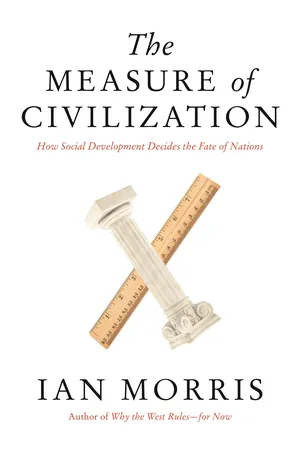
The Measure of Civilization
How Social Development Decides the Fate of Nations
- 400 pages
- English
- ePUB (mobile friendly)
- Available on iOS & Android
eBook - ePub
About this book
Information
Publisher
Princeton University PressYear
2013Print ISBN
9780691160863
9780691155685
eBook ISBN
9781400844760
CHAPTER 1

INTRODUCTION: QUANTIFYING SOCIAL DEVELOPMENT
THE PROBLEM
A quarter of a millennium ago, intellectuals in Western Europe discovered that they had a problem. As problems went, theirs was not a bad one: they appeared to be taking over the world, but did not know why. The explanations that eighteenth-century theorists came up with varied wildly, although the most popular ideas all held that since time immemorial, something had made the West different from the rest and determined that Europe would one day dominate the world.
In the early twenty-first century, these ideas are still with us, albeit in heavily modified forms. The most influential argument, now as in the eighteenth century, is probably the theory that Europeans are the heirs to a distinctive and superior cultural tradition.1 The roots of this Western civilization are most often traced back to the ancient Greeks and Romans, although other advocates identify prehistoric Indo-Europeans, ancient Germans, or medieval Europeans as the founders.2
A second strand of eighteenth-century thought credited environment and climate with making Europeans more energetic and creative than other people, and this too has plenty of modern champions.3 Some scholars combine the ecological and cultural ideas, arguing that it was the back-and-forth between the two that sent early modern Europe down a new path.4 Even the idea that Europeans are biologically superior to other humans has been revamped: some economists claim that since the thirteenth century natural selection has made Europeans thriftier and more industrious than anyone else,5 while a handful of paleoanthropologists suggest that divergent genetic evolution in the ten thousand years since the origin of farming has made Europeans and their descendants more dynamic and inventive than other populations.6
These theories all took shape in the eighteenth century, when the explosion of European wealth and power cried out for explanation; and it was only in the later twentieth century, when East Asia was experiencing a similar explosion, that serious challenges emerged. As Japan, the Asian Tigers, and China developed into major economic powers, more and more scholars concluded that theories explaining West’s success through long-term cultural, environmental, or racial causes simply could not be right. The big story in world history, they began suggesting, was not the long-term, inexorable rise of the West; it was the tale of a multipolar world, which the West had only recently, temporarily, and perhaps even accidentally come to dominate.
These new ideas are even more varied than the old long-term lock-in theories. The most extreme versions argue that the eighteenth-century theorists got things exactly back to front. According to the new theories, it was in fact China that had a long-term lock-in on global dominance, and only a bizarre series of accidents briefly tipped things in Europe’s favor.7 Most versions, however, reject long-term explanations altogether, arguing that the complex societies of Asia and Europe developed down roughly parallel tracks until the eighteenth or even the nineteenth century, when small differences in state structure, natural endowments, physical and political geography, or intellectual trends gave Europe the lead.8
The argument over the causes and consequences of Western power has attracted enormous interest, but the champions of the different theories often seem to be talking past one another. They regularly define key terms in different ways, use different kinds of evidence, and apply different standards of proof. As a result, the antagonists rarely agree on exactly what they are trying to explain, let alone how to do the explaining.
As I see it, the real question at issue is about what I would call social development, by which I mean social groups’ abilities to master their physical and intellectual environments and get things done in the world. Defenders of the new versions of the eighteenth-century theories tend to argue that Western social development has been higher than that in other parts of the world for hundreds or even thousands of years; their critics tend to argue that Western development pulled ahead only in the past half dozen generations. It seems to me that if we really want to explain why the West rules, we need to measure social development and compare it across time and space. Only when we have established the basic pattern of the history of social development can we start asking why it takes the form it does.
Quantification does not necessarily make debates more objective, but it does normally make them more explicit, forcing rivals to spell out exactly what they mean by the terms they use and to explain why they assign specific numerical values to these differences. Anyone who disagrees with another scholar’s judgments will then be able to focus on the evidence and methods being used to calculate the scores, instead of trading vague, undertheorized generalizations. Under one name or another, numerical indices of concepts similar to social development are well established in anthropology, archaeology, economics, finance, policy making, and sociology, and there is an obvious model for such a yardstick in the United Nations’ Human Development Index.9
In the 1960s and 1970s, some historians began applying similar methods to the past, addressing big questions by mustering vast amounts of statistical data. The classic case was probably Robert Fogel and Stanley Engerman’s Time on the Cross, which brought together data from thousands of plantation records to work out just how profitable slavery was in the nineteenth-century American South and just what the physical experience had been like for the slaves themselves.10
Time on the Cross provided a successful model for quantitative history. The study appeared two volumes, the first providing a broad overview and set of interpretations aimed as much at a general readership interested in American history as at professional scholars, while the second volume detailed the statistical techniques and sources that Fogel and Engerman had used.
The Measure of Civilization follows this format. It is a companion volume to my earlier book Why the West Rules—For Now: The Patterns of History, and What They Reveal about the Future. When I was writing Why the West Rules—For Now, my editors and I decided to post supporting materials on a website rather than producing a second print volume in print, but since then it has become clear that there is some interest in having a revised and expanded version of this material available in print.11
I have two main goals in The Measure of Civilization. First, I want to provide critics of Why the West Rules—For Now with the ammunition they need to subject the conclusions I reached in that book to systematic analysis. While I naturally hope that my thesis withstands such attempts at falsification, the next-best outcome would be to see explicit debate over my own analysis lead to improved versions of the social development index and a stronger explanation of the rise of Western power and wealth.
My second goal in setting out a full account of the social development index is to contribute to making comparative history more explicit and quantitative. “The history of science is emphatic,” the biologist-turned-historian Peter Turchin has pointed out: “a discipline usually matures only after it has developed mathematical theory.”12 There will never be such a thing as a one-size-fits-all numerical index that answers every question that any comparative social scientist might want to ask, but one of the best ways to turn comparative history into such a mature discipline may be through the design of multiple indices, each crafted to solve a particular problem.
I begin by setting out, very briefly, a formal definition of what I have in mind when I speak of “social development.” I follow up this brief definition with an overview of the ideas it draws on and the objections that have been raised to them across the past fifty years. In chapter 2, I try to distill from these criticisms the key challenges facing a social development index, and then explain how I have tried to address these challenges. In the main part of the book (chapters 3–6) I set out the evidence behind the scores in my four traits of energy capture, organization, war making, and information technology. In the final chapter, I consider some of the ways an index of social development might contribute to other debates within the social sciences.
SOCIAL DEVELOPMENT: A DEFINITION
Social development, as I use the expression, is a measure of communities’ abilities to get things done in the world. I label this property “social development” because it seems to me to have much in common with the central ideas of development economics.13 The historian Kenneth Pomeranz has suggested that it might be better to call the concept “social power,” but I am not convinced, not least because the concept is sufficiently different from previous influential uses of the label social power (particularly the version developed by the sociologist Michael Mann) that this terminology would probably introduce unnecessary confusion.14
Social development is an important concept because the major reasons that the West (another key concept in need of definition: see chapter 2, “Units of Analysis”) has dominated the world in the past two hundred years are that (a) its social development has reached higher levels than that of any other part of the planet and (b) these levels have risen so high that the West has been able to project its power globally.
“Communities’ abilities to get things done in the world” is what we might call a minimal definition of social development. It is handy but imprecise, and, like all minimal definitions, it is framed at such a high level of abstraction that it is difficult to operationalize (that is, it is not obvious what we would need to do on the ground to put such a vague formulation to use).
Consequently, social scientists often follow up a minimal definition with an “ideal-type” definition, one that “aims for a collection of attributes that is maximal—that is, including all (nonidiosyncratic) characteristics that help to define the concept in its purest, most ‘ideal’ (and perhaps its most extreme) form.”15
Putting matters more formally, social development is the bundle of technological, subsistence, organizational, and cultural accomplishments through which people feed, clothe, house, and reproduce themselves, explain the world around them, resolve disputes within their communities, extend their power at the expense of other communities, and defend themselves against others’ attempts to extend power.16
Social development is—in principle—something we can measure and compare through time and space. If Western social development has been higher than that in the rest of the world since time immemorial, the answer to the why-the-West-rules question must lie very deep in the past, as the champions of biological or environmental theories of Western supremacy hold. If, however, Western social development surged ahead of that in other regions during the first millennium BCE, we might conclude that advocates of the importance of Greece and Rome in fact got things right. But if it should turn out that Western social development outstripped that of other civilizations only in very modern times, we will be forced to conclude that these old theories are wrong, and must seek explanations elsewhere.
I want to emphasize that social development is a measure of communities’ abilities to get things done in the world, not an explanation of communities’ abilities to get things done. Social development shows us the pattern that we need to explain.
Social development is also not a measure of the worth of different societies. For instance, twenty-first-century Japan is a land of air conditioning, computerized factories, and bustling cities. It has cars and planes, libraries and museums, high-tech health care and a literate population. The contemporary Japanese have mastered their physical and intellectual environment far more thoroughly than their ancestors a thousand years ago, who had none of these things. It therefore makes sense to say that modern Japan has higher levels of social development than medieval Japan. Yet this implies nothing about whether the people of modern Japan are smarter, worthier, or luckier (let alone happier) than the Japanese of t...
Table of contents
- Cover Page
- Title Page
- Copyright Page
- Dedication Page
- Contents
- List of Illustrations
- List of Tables
- Preface
- 1 Introduction: Quantifying Social Development
- 2 Methods and Assumptions
- 3 Energy Capture
- 4 Social Organization
- 5 War-Making Capacity
- 6 Information Technology
- 7 Discussion: The Limits and Potential of Measuring Development
- Notes
- References
- Index
Trusted by 375,005 students
Access to over 1.5 million titles for a fair monthly price.
Study more efficiently using our study tools.
Frequently asked questions
Yes, you can cancel anytime from the Subscription tab in your account settings on the Perlego website. Your subscription will stay active until the end of your current billing period. Learn how to cancel your subscription
No, books cannot be downloaded as external files, such as PDFs, for use outside of Perlego. However, you can download books within the Perlego app for offline reading on mobile or tablet. Learn how to download books offline
Perlego offers two plans: Essential and Complete
- Essential is ideal for learners and professionals who enjoy exploring a wide range of subjects. Access the Essential Library with 800,000+ trusted titles and best-sellers across business, personal growth, and the humanities. Includes unlimited reading time and Standard Read Aloud voice.
- Complete: Perfect for advanced learners and researchers needing full, unrestricted access. Unlock 1.5M+ books across hundreds of subjects, including academic and specialized titles. The Complete Plan also includes advanced features like Premium Read Aloud and Research Assistant.
We are an online textbook subscription service, where you can get access to an entire online library for less than the price of a single book per month. With over 1.5 million books across 990+ topics, we’ve got you covered! Learn about our mission
Look out for the read-aloud symbol on your next book to see if you can listen to it. The read-aloud tool reads text aloud for you, highlighting the text as it is being read. You can pause it, speed it up and slow it down. Learn more about Read Aloud
Yes! You can use the Perlego app on both iOS and Android devices to read anytime, anywhere — even offline. Perfect for commutes or when you’re on the go.
Please note we cannot support devices running on iOS 13 and Android 7 or earlier. Learn more about using the app
Please note we cannot support devices running on iOS 13 and Android 7 or earlier. Learn more about using the app
Yes, you can access The Measure of Civilization by Ian Morris in PDF and/or ePUB format, as well as other popular books in Social Sciences & Economic History. We have over 1.5 million books available in our catalogue for you to explore.