The first English translation of correspondence tracing the development of Jung's theory of psychological types
In 1915, C. G. Jung and his psychiatrist colleague, Hans Schmid-Guisan, began a correspondence through which they hoped to codify fundamental individual differences of attention and consciousness. Their ambitious dialogue, focused on the opposition of extraversion and introversion, demonstrated the difficulty of reaching a shared awareness of differences even as it introduced concepts that would eventually enable Jung to create his landmark 1921 statement of the theory of psychological types. That theory, the basis of the widely used Myers-Briggs Type Indicator and similar personality assessment tools, continues to inform not only personality psychology but also such diverse fields as marriage and career counseling and human resource management.
This correspondence reveals Jung fielding keen theoretical challenges from one of his most sensitive and perceptive colleagues, and provides a useful historical grounding for all those who work with, or are interested in, Jungian psychology and psychological typology.
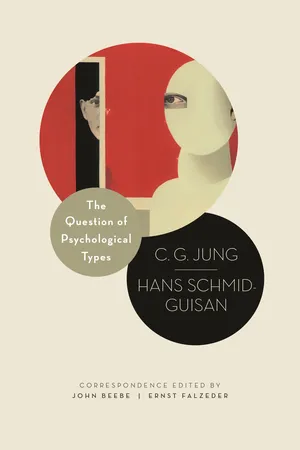
eBook - ePub
The Question of Psychological Types
The Correspondence of C. G. Jung and Hans Schmid-Guisan, 1915–1916
- 200 pages
- English
- ePUB (mobile friendly)
- Available on iOS & Android
eBook - ePub
The Question of Psychological Types
The Correspondence of C. G. Jung and Hans Schmid-Guisan, 1915–1916
About this book
Information
Publisher
Princeton University PressYear
2012Print ISBN
9780691169729
9780691155616
eBook ISBN
9781400844814
Correspondence
1 J
[4 June 1915]
Dear Friend,
As you know from our previous talks, for the past few years I have occupied myself with the question of psychological types,40 a problem as difficult as it is interesting. What originally led me to that problem were not intellectual presuppositions, but actual difficulties in my daily analytical work with my patients, as well as experiences I have had in my personal relations with other people. You remember that our earlier discussions about certain controversial points of analytical psychology,41 too, seemed to point, in our view, to the existence of two diametrically opposed types.42 At the time we took great pains to put the typical differences into words and, in so doing, discovered not only the extraordinary difficulty of such a project but also its tremendous importance for the psychology of human relations in general. Step by step, we realized that the scope of this problem took on extraordinary dimensions, so that, as is always the case in such situations, we somewhat lost courage and the hope that the problem could be dealt with at all.
For one thing we saw very clearly: the problem is not so much the intellectual difficulty of formulating the differences between the types in a logical way, but rather the acceptance of a viewpoint that is diametrically opposed to our own, and which essentially forces the problem of the existence of two kinds of truth upon us.43 Thus we arrived at a critical point of the greatest order, because we had to ask ourselves, in all seriousness, whether the existence of two kinds of truth is conceivable at all. Since we are both not professional philosophers, but at best mere dilettantes44 (and, being dilettantes, we love philosophy, in contrast to the professionals who practice it), this was a nearly hopeless problem for us, because viewing the world in the light of two truths seemed at least a highly daring acrobatic feat to us, for which our brains, insufficiently trained in this specialty, were hardly adequate.
I do not know how you have tried to come to terms with this. I would guess that you, true to your character, have simply gone ahead with your life, assuming that everybody can have his own personal views, views that can freely lead their own separate existence without disturbing the harmony of the world mechanism, even if they are not in accordance with other views. But as I am one of those people who must a priori always have a viewpoint before being able to enter into something, I could not be reassured by simply going ahead in my personal relations; to allay my concerns, I needed the points of view provided by the pragmatic movement in modern philosophy. Although I make no secret of my highest esteem for someone like Schiller45 or William James,46 I also have to confess that pragmatism leaves me with a somewhat stale feeling. I cannot help it: it is a bit “business-like.”47 It is a bit like my feelings concerning the saying, ubi bene, ibi patria,48 which I have never much liked either. As I belong to that category of people who never take the element of feeling sufficiently into account, as opposed to the intellect, it was necessary that I should not neglect to also ask my feeling for its opinion in this matter. A man of your kind, however, who is as much devoted to feeling as I am to the intellect, comes to the help, not of the intellect, but of the feeling in the other. And that is why it is to a thinker who probably belongs to your type—namely, the romantic, as Ostwald49 called him—to whom I owe a notion that freed me from that certain staleness of pragmatism. It was Bergson who gave me the notion of the irrational.50 What I like is the unmistakable hypostasization51 of this notion. As a consequence we get two intimately connected, mutually dependent principles: the rational and the irrational.52 It gives me pleasure to think of them as hypostatic, because then I can acknowledge their existence also morally. I think you will understand that I do not practice philosophy here but rather make psychological confessions to you, which cannot hurt even the specialist, because in psychology thoughts are toll free, being psychology themselves. We have long ceased to pride ourselves that we could rise above psychology by thinking. This latter viewpoint is one of the medieval privileges of our academies, hallowed by their venerable age. The Archimedean point outside of psychology, with the help of which we would be able to unhinge psychology, is hardly likely to be found.53
So (naturally) I called my viewpoint rational, and the viewpoint opposed to mine irrational. Thus, your viewpoint fell into the category of the irrational. As the irrational cannot be further understood at all, I came to the conclusion that one truth must remain unintelligible to the other. With this, I drew a thick line between you and me, because I also said to myself: you are as irrational to me as I am irrational to you. This would create a definitive but hopeless situation, satisfying for the intellect but depressing for the feeling. In this situation, I remembered that we are in possession of a very nice analytical method, which we use every day with our patients, and the excellent results of which basically consist in bringing together and balancing the antagonistic forces in the human soul, so that even the antagonism, which previously had an inhibiting effect, becomes a step leading one up in life.
Thus, when one of my patients dreams of a Herr Müller and then tells me during the analysis that this Herr Müller is a very disagreeable person, cantankerous in his moods and mudslinging, that he has always meddled with the patient’s life in a most annoying way, just like his father, who, overzealously concerned about his education, used to come between the patient and his wishes—I would say: “Sure it’s like that. You see, there are lots of people who do not achieve self-realization but always unload their demands and their own fantasies and fantasized wishes onto others, and get on their nerves, instead of minding their own business. Herr Müller is a good example of this kind, and so is your father, bless his soul. But why are you still irritated by this? After all, you are not married to Herr Müller, and your father has been dwelling in Elysium for nearly twenty years, from where he can hardly be expected to exert an annoying influence on the upper world. Unless, that is, his imago,54 the image of his memory in your fantasy, is still active. This effect is strongly reminiscent of that of a posthypnotic suggestion. But do you know which suggestions are most effective? Precisely those that suit us, even though we don’t always like to admit it. If suggestions, simply as such, were effective, as many people believe, the suggestion therapy of neuroses would really be a panacea. We have learned that this is not so, however. So both the imago and Herr Müller suit you very well, which is indeed annoying. In other words: they are apt expressions of one side of your personality, which you do not want to see. That is why you are irritated by the mote in your brother’s eye but not by the beam in your own eye.”55
As you know, we call this second viewpoint the interpretation of a dream on the subjective plane, while the first viewpoint, as outlined above, corresponds to an interpretation on the objective plane.56 Both viewpoints are in accord with the truth. Actually these are two truths, two different, but equally true, perceptions of one and the same situation. One truth says: it is he, while the other says: it is also I (but I do not want to see it).
I wrote above: you are irrational. But if I think analytically, I will say: and so am I (but I do not want to see it). For the rational is what is given in my consciousness, and what is comprehensible, while the irrational is what is present in my unconscious, and what is incomprehensible. Insofar as you, in accordance with your character, represent the feeling standpoint, while I call your standpoint irrational, I am actually projecting a judgement, which holds true only for me. You regard your feeling standpoint as rational; I regard my thinking standpoint as rational. But as I hold the thinking standpoint, I am not at the same time consciously holding the feeling standpoint, which for me, as a consequence, does not fall into the category of the rational but is of necessity irrational. For the same reasons, for you the thinking standpoint falls into the category of the irrational, because for you rationality is tied to the feeling standpoint. As is easily imaginable, the greatest misunderstandings may arise out of this situation, and, as you know, they actually did arise, and how! These are instructive experiences for those whose friendship withstands the heaviest blows, but sources of bitterness for those who are never able to yield to a different standpoint but always just accuse the others of not being able to yield themselves.
You will perhaps find it strangely intellectual when I tell you that I got rid of these difficulties by viewing things on the subjective plane. In this way I was able to realize that a different standpoint, which I cannot but call irrational, seems to be irrational only because this same standpoint is irrational in myself. For you it may be absolutely rational, however. I think this fact can be explained as follows: a person with intellectual abilities instinctively prefers to adjust to the object by way of thinking (abstraction), whereas a person whose feeling exceeds his intellectual abilities prefers to adjust to the object by way of feeling himself into57 the object. This results in the rational quality of thinking in the former, and the rational quality of feeling in the latter. Owing to the preference of thinking, feeling-into will remain in a relatively undeveloped state and will thus function in an irregular, unpredictable, and uncontrollable way—in one word, irrationally.58 Naturally man, ever mindful of his role as Homo sapiens, tries to tame and control the irrational with the rational. As a consequence, the thinking person wants to force his feeling to serve his thinking, and the feeling person his thinking to serve his feeling. When I see this done by other people, it strikes me as completely absurd, because the other person does the very thing that most runs counter to my ideal. I call it childish and twisted. It is nearly impossible for me not to moralize about it. The stronger my ideal is, and the more I cherish it, the more I actually have to condemn the other, because he acts contrary to my ideal—which I naturally consider to be the ideal. After all, I want to purge my thinking of all that is erratic and unaccountable, of all pleasure and unpleasure caused by personal feeling, and raise it to the height of justness and the crystal-clear purity of the universally valid idea, way beyond anything connected with mere feeling. You, on the contrary, want to put your feeling above your personal thinking, and to free it from all the fantasized and infantile thoughts that might impede its development. That is why the thinking person represses his all-embracing feeling, and the feeling person his all-embracing thinking. But the thinking person accepts feelings that correspond to his thinking, and the feeling person accepts thoughts that correspond to his feeling.
The two of them speak different languages, so that they often cannot understand each other at all. I even suspect that the thinking person speaks of feeling when he is actually thinking, and the feeling person of thinking when he is feeling. It is certain, however, that what the feeling person calls thinking is just a representation59 but not an abstraction. His approach to thinking is therefore extraordinarily concretistic, and it is immediately noticeable that it cannot turn into an abstraction. Vice versa, the feeling of the thinking person is not at all what the feeling person would call feeling, but is really a sensation,60 as a rule of a reactive nature, and thus very concretistic, if not to say “physiological.”
I am leaving out here something we will have to discuss later.
With best regards,
your Jung
your Jung
40 On the development of Jung’s thoughts on the question of psychological types prior to this correspondence, see the introduction.
41 On “analytical psychology,” see the introduction, note 22.
42 It is unclear when exactly these earlier discussions had taken place. They probably played a role in Schmid’s analysis with Jung (see the introduction and below).
43 This goes beyond Jung (1913a), where he had asserted only that in psychology these two types had led to the two different theories of Freud and Adler.
44 Manuscript [MS]: Dilettanten. Here used in a nonpejorative sense, that is, referring to amateurs, not professionally ...
Table of contents
- Cover Page
- Title Page
- Copyright Page
- Contents
- Acknowledgments
- Illustration of First Page of 7 J, 4 September 1915
- Introduction
- Translator’s Note
- Correspondence
- Appendix
- Bibliography
- Index
Trusted by 375,005 students
Access to over 1.5 million titles for a fair monthly price.
Study more efficiently using our study tools.
Frequently asked questions
Yes, you can cancel anytime from the Subscription tab in your account settings on the Perlego website. Your subscription will stay active until the end of your current billing period. Learn how to cancel your subscription
No, books cannot be downloaded as external files, such as PDFs, for use outside of Perlego. However, you can download books within the Perlego app for offline reading on mobile or tablet. Learn how to download books offline
Perlego offers two plans: Essential and Complete
- Essential is ideal for learners and professionals who enjoy exploring a wide range of subjects. Access the Essential Library with 800,000+ trusted titles and best-sellers across business, personal growth, and the humanities. Includes unlimited reading time and Standard Read Aloud voice.
- Complete: Perfect for advanced learners and researchers needing full, unrestricted access. Unlock 1.5M+ books across hundreds of subjects, including academic and specialized titles. The Complete Plan also includes advanced features like Premium Read Aloud and Research Assistant.
We are an online textbook subscription service, where you can get access to an entire online library for less than the price of a single book per month. With over 1.5 million books across 990+ topics, we’ve got you covered! Learn about our mission
Look out for the read-aloud symbol on your next book to see if you can listen to it. The read-aloud tool reads text aloud for you, highlighting the text as it is being read. You can pause it, speed it up and slow it down. Learn more about Read Aloud
Yes! You can use the Perlego app on both iOS and Android devices to read anytime, anywhere — even offline. Perfect for commutes or when you’re on the go.
Please note we cannot support devices running on iOS 13 and Android 7 or earlier. Learn more about using the app
Please note we cannot support devices running on iOS 13 and Android 7 or earlier. Learn more about using the app
Yes, you can access The Question of Psychological Types by C. G. Jung,Hans Schmid-Guisan, John Beebe, Ernst Falzeder in PDF and/or ePUB format, as well as other popular books in Psychology & Applied Psychology. We have over 1.5 million books available in our catalogue for you to explore.