What a Confucian constitutional government might look like in China's political future
As China continues to transform itself, many assume that the nation will eventually move beyond communism and adopt a Western-style democracy. But could China develop a unique form of government based on its own distinct traditions? Jiang Qing—China's most original, provocative, and controversial Confucian political thinker—says yes. In this book, he sets out a vision for a Confucian constitutional order that offers a compelling alternative to both the status quo in China and to a Western-style liberal democracy. A Confucian Constitutional Order is the most detailed and systematic work on Confucian constitutionalism to date.
Jiang argues against the democratic view that the consent of the people is the main source of political legitimacy. Instead, he presents a comprehensive way to achieve humane authority based on three sources of political legitimacy, and he derives and defends a proposal for a tricameral legislature that would best represent the Confucian political ideal. He also puts forward proposals for an institution that would curb the power of parliamentarians and for a symbolic monarch who would embody the historical and transgenerational identity of the state. In the latter section of the book, four leading liberal and socialist Chinese critics—Joseph Chan, Chenyang Li, Wang Shaoguang, and Bai Tongdong—critically evaluate Jiang's theories and Jiang gives detailed responses to their views.
A Confucian Constitutional Order provides a new standard for evaluating political progress in China and enriches the dialogue of possibilities available to this rapidly evolving nation. This book will fascinate students and scholars of Chinese politics, and is essential reading for anyone concerned about China's political future.
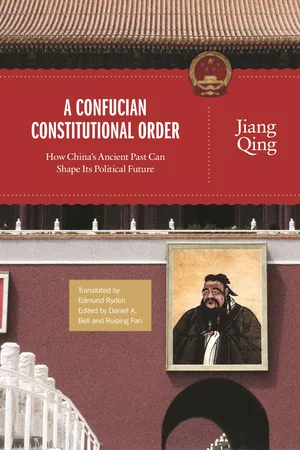
eBook - ePub
A Confucian Constitutional Order
How China's Ancient Past Can Shape Its Political Future
- 272 pages
- English
- ePUB (mobile friendly)
- Available on iOS & Android
eBook - ePub
A Confucian Constitutional Order
How China's Ancient Past Can Shape Its Political Future
About this book
Information
Publisher
Princeton University PressYear
2012Print ISBN
9780691173573
9780691154602
eBook ISBN
9781400844845
PART I
A Confucian Constitutional Order
CHAPTER 1

The Way of the Humane Authority
THE THEORETICAL BASIS FOR CONFUCIAN CONSTITUTIONALISM AND A TRICAMERAL PARLIAMENT
The way ahead for China’s political development is the Way of the Humane Authority and not democracy.1 This is the only way in which Chinese culture can respond to the challenge of Western culture. However, in recent years China’s political development has begun to go astray. Every current of political thought in China assumes that democracy is the way ahead for China. This goes without saying for liberal democracy’s Western-style “genuine democracy,” or for the pursuit of a “socialist democracy” by socialism that is supposed to differ from “capitalist democracy.” It even includes the neo-Confucians who exalt Chinese culture and make democracy the “new kingship” derived from the Confucian way of the sage.2 A glance over China’s current world of thought shows that Chinese people have already lost their ability to think independently about political questions. In other words, Chinese people are no longer able to use patterns of thought inherent in their own culture—Chinese culture—to think about China’s current political development. This is a great tragedy for the world of Chinese thought! It is, therefore, necessary to go back to the inherent patterns of Chinese culture to ground the development of Chinese political thought, rather than simply following the Western trends and forgetting our own culture. By the “inherent pattern of Chinese culture” I refer to the “politics of the Way of the Humane Authority.” The politics of the Way of the Humane Authority is the way ahead for China.
THE POLITICS OF THE WAY OF THE HUMANE AUTHORITY
At the heart of the Way of the Humane Authority lies the question of three forms of political legitimacy. Legitimacy is the deciding factor in determining whether a ruler has the right to rule. The Gongyang Commentary to the Spring and Autumn Annals says that to rule one must “share in the realms of heaven, earth and human beings,” or that “the Way of the Humane Authority links three spheres,” which means that political power must have three kinds of legitimacy, that of heaven, earth, and the human, for it to be legal and justified.3 The legitimacy of “heaven” refers to transcendent, sacred legitimacy. In Chinese culture “heaven” has both the character of a ruling will, personal yet hidden, and a transcendent, sacred sense of natural morality. The legitimacy of “earth” refers to the legitimacy that comes from history and culture because cultures are formed through history in particular places. The legitimacy of the “human” refers to the legitimacy of the will of the people because conformity to the will of the people directly determines whether or not people will obey political authorities.
The State of Equilibrium and Harmony says, “He who attains to the sovereignty of all the kingdom attach due importance to three points.” The first is “he sets (his institutions) up before heaven and earth, and there is nothing in them contrary (their mode of operation). He presents himself with them before Spiritual Beings, and no doubts about them arise.” This refers to sacred legitimacy. The second is “he examines (his institutions) by comparison with those of the founders of the three dynasties,4 and finds them without mistake. . . . He is prepared to wait for the rise of a sage a hundred ages hence, and has no misgivings.” This refers to cultural legitimacy. The third is “rooted in his own character and conduct, and attested by the multitudes of the people.”5 This is the legitimacy of the popular will.
The politics of the Way of the Humane Authority states that legitimacy comes from recognition and representation of the Way of heaven, history, and the popular will. It can ensure that the ruler’s authority and the people’s obedience are seen, respectively, as right and duty. Should the political authority simultaneously lack legitimacy in the three spheres, it will be obliged to constantly make bargains and will never win the full loyalty and acknowledgment of the people. The result could easily be a crisis of political authority. Political order will constantly be on the brink of falling into chaos. Hence, the Way of the Humane Authority of Confucianism seeks to fully and wholly resolve the question of the legitimacy of political power, and to establish a political order that is stable and harmonious over a long time. As we say in Chinese, we want to found a political order that is stable and long-lasting and that is “in accordance with the Way, with reality, with law and with the present situation.”
In the terminology of Chinese politics, the Way of the Humane Authority deals with “legitimizing the Way” (zheng Dao) and not with “implementing the Way” (zhi Dao).6 By “legitimizing the Way” we mean the legitimacy of political power, while by “implementing the Way” we mean the way in which legitimate political power is implemented and exercised, as well as the methods and art of using legitimate power. Hence legitimizing the Way is superior, and prior to, implementing the Way. And the legitimacy of political power is the basis and goal of every political system, method, order, and art of politics. Without it, no political reality has any meaning or value.
In China today the biggest and most urgent question that politics faces is the legitimacy of the political order. If this question is not first dealt with, the lesser questions of implementation cannot be properly managed. Therefore, the mission of contemporary Confucianism is to establish a complete and integral legitimacy for the future of Chinese politics. The Way of the Humane Authority can lay the foundations for the legitimacy of China’s political order and so repair the failure to resolve this question and make up for the deficit of legitimacy that has been around for the past hundred years.
The Way of the Humane Authority seeks not only to determine the three forms of legitimacy but also to ensure that the three are properly balanced. Western democracy is built on the separation of powers, but from the view of the Way of the Humane Authority, the separation of powers is a matter of implementation and not of legitimization. Western democratic legitimacy is based on the sovereignty of the people. This is said to be unique, supreme, absolute, exclusive, and inalienable. From a political point of view there is nothing that can keep it in check. The Way of the Humane Authority is different. It holds that equilibrium is an issue not only in implementation but also in legitimization. It is not only to be used in the structure and working of political power but also to be used in determining the basic meaning and legal structure of political legitimacy itself. In the Way of the Humane Authority, no one form of legitimacy should be allowed to become sovereign over the others, for this will lead to political bias and failings.
Should transcendent legitimacy be overemphasized, it will quench a correct expression of human needs and the popular will. Examples of this can be seen in the religious politics of Christianity in the Middle Ages in the West, or in that of Islamic fundamentalism today. On the other hand, if popular legitimacy is overemphasized, it will deny the value of the sacred and lead to extreme secularization and pandering to human desires. Contemporary Western democracy is an example of this. Thus, the best thing is that legitimacy be balanced, so that no one form of legitimacy excludes the others and they will work together in harmony. Each will have its own proper place, playing its own role and not interfering with the others.
But the equilibrium of the three forms of legitimacy is not one of mere equality. It is not a two-dimensional, flat equality but a three-dimensional one, a hierarchy. Heaven generates the myriad things from above, and the myriad things depend on the determination of heaven and earth. Their multiplicity comes from the one principle of heaven, as Cheng Yi says: “principle is one; its manifestations many.” Thus, the sacred legitimacy of the way of heaven is prior to both the cultural legitimacy of the way of earth and that of the popular will of the human way. The basic relationship of heaven to earth and the human is given in the Book of Changes as the way of the Qian (heaven) hexagram, which is “great harmony are preserved in union” and “everything obtains it correct nature as appointed [by the mind of heaven].”7 It is the sovereign, and so the three forms are not equal or on the same plane. Hence, the three forms of legitimacy have a three-dimensional relationship as well as having a horizontal relationship of distinctive identity. As a result, the harmony of the legitimacies of the Way of the Humane Authority is a three-dimensional rather than a flat harmony.
The reason why the Way of the Humane Authority stresses the three-dimensional harmony has to do with Chinese ways of thinking. The influence of the Book of Changes and of the Spring and Autumn Annals means that China does not think in terms of either one or the other. Rather, the world is seen three-dimensionally in a structure that embraces many ways of thinking. To look at the question of legitimacy from the point of view of the three elements of heaven, earth, and the human brings out the tri-dimensionality of legitimacy and the separation of its constituent parts. It is one whole but multiform; priority and equilibrium both have a place. The Western idea of sovereignty of the people is the product of a Western way of thinking in straight lines, rather like the “supreme being” of Greek philosophy, which does not allow for multiplicity. The current Western notion of sovereignty of the people is simply the result of a rejection of the medieval sovereignty of God. In the Christian Middle Ages political authority came from God. God was the ultimate source of the legitimacy of secular power. God is unique, absolute, self-sufficient, exclusive, and the supreme essence, and so was what derived from God. The only difference between the sovereignty of God and that of the people lies in the content itself. In both the form and the way in which legitimacy is thought of, the two are exactly alike. Both come from a tendency to think in terms of absolutes, and so neither can admit any other form of legitimacy. In fact, the sovereignty of the people is simply the secular equivalent of the sovereignty of God. In contemporary Western politics, the people play the role that God played in the Middle Ages. Precisely for this reason, democratic politics asserts the sole legitimacy of the will of the people and cannot imagine any other form of legitimacy.
THE WAY OF THE HUMANE AUTHORITY IN THEORY AND HISTORY
The Way of the Humane Authority is the theoretical model by which Confucianism establishes a way of solving the question of legitimization on the basis of the historical archetype of the sage kings of the three dynasties (Xia/Shang/Zhou). Hence, the Way of the Humane Authority is grounded both in real history and in quasi-history. It is both an ideal and also an ideal that is not purely formal because it has been fashioned through history and is erected on a historical basis. This is very different from democratic politics. When faced with the question of legitimacy, democracy places its theoretical foundation in social contract theory. The idea of the social contract is one that uses reason or, better, concepts to posit the origin of the state and then to construct political legitimacy. The legitimacy of a democracy is a product of pure reason and speculation that lacks an authentic historical background.
The Way of the Humane Authority is a theoretical model constructed on the basis of historical facts. There are two features that determine the Way of the Humane Authority. Firstly, the Way of the Humane Authority was implemented in history, unlike the pure mystique that democracy is.8 Secondly, the Way of the Humane Authority is an ideal model, which implies that in history it has only been gradually and partially realized. Its full implementation requires a long and slow historical process. In the course of Chinese history the Way of the Humane Authority has been implemented in only a fragmentary fashion; there is still a significant gap between the Way of the Humane Authority and the political realities of Chinese history.
The concrete way in which the Way of the Humane Authority has been implemented in Chinese history is that of monarchy. In the view of the Way of the Humane Authority, the legitimacy of the monarch is conditional upon benevolent and virtuous governance. Lack of benevolence and virtue entails a loss of legitimacy. Above we noted that the political order is part of “implementation” while “legitimization” is a theoretical model. Although “legitimization” appears in history, once it appears it is able to transcend concrete history and has everlasting value. “Implementation,” on the other hand, is the concrete historical means by which legitimization is realized. Hence, for the Way of the Humane Authority, legitimization does not change, whereas implementation may. Monarchy is in the realm of implementation. It was the only natural choice in the long course of Chinese history and carries the necessity and rationality of history. Historically speaking, it is the legitimate form of politics in China.
Yet monarchy is not the sole, unwavering choice of Confucianism, nor is it the unchanging and fixed form in which the Way of the Humane Authority can exist. Changes in historical circumstances may necessitate changes in the form of rule. Hence, the given state of implementation of the legitimacy of the Way of the Humane Authority is valid only for that particular period in history. As an ideal, the three-dimensional harmony of the three forms of legitimacy is one that can be universalized. It is creative and transcendent and can go beyond monarchy to establish other forms of rule. The various forms of government that have appeared in history—monarchy, aristocracy, democracy—are limited and partial implementations of the values of the Way of the Humane Authority in history. But history has also shown that no historical form of government fully implements all the legitimacy we might expect from the Way of the Humane Authority. It should, then, be possible to bring together some of the ways in which human beings have imagined and created political systems into a new system and by this new system fully implement the threefold legitimacy of the Way of the Humane Authority. The way in which Confucius brought together the wisdom of the three dynasties is precisely the wisdom that we must study for the Way of the Humane Authority today. The sage kings have already established an unchanging standard of legitimization. Our task today is to use this standard of legitimization to construct a new policy of implementation. This mission is not incumbent only on contemporary Confucian scholars. It also falls to everyone who is concerned about the political future of China.
THE LEGITIMACY OF DEMOCRACY
In the End of History, Fukuyama says that since the end of the Cold War, democracy has become the only possible form of government.9 The fundamental roots of democracy have already been planted. The political problems that contemporary human beings have to face are only a matter of unrealized or only partially realized democracy. The types and the principles of human politics cannot develop any further. Hence, human history has come to an end; there is no hope left for politics. We might ask if this is true. Fukuyama writes from the point of view of Western culture, a culture that has taken the road of democracy, a culture that is proud and self-centered. Naturally, he is unable to see that other cultures have their own political principles and contexts. It is certain that what Fukuyama says does not apply to China. Indeed, democracy itself already suffers from serious problems and is by no means the only formula for humanity. Democracy is merely part of Western culture. That democracy will not develop further does not mean that politics cannot develop further because democracy is not the final form of politics. Political history does not end just because democracy has come to an end. According to the Book of Changes, history never ends. Politics will certainly continue to develop, but that development need not be in democracy. Rather, it could be beyond, or above, democracy. It will develop into a superior form in a political civilization other than that of democracy. This is where the Way of the Humane Authority of Chinese culture comes into play. It is the new starting point for politics and the new hope for human history.
To appreciate the value of the Way of the Humane Authority, we must first of all understand the flaws of democracy. The major flaw of democracy is the uniqueness of the legitimacy of the popular will. The exaggerated importance given to the will of the people leads to extreme secularization, contractualism, utilitarianism, selfishness, commercialism, capitalization, vulgarization, hedonism, mediocritization, this-worldliness, lack of ecology, lack of history, and lack of morality. The legitimacy of the popular will has its proper place in dealing with the question of legitimization, but to use it exclusively is to exclude other forms of legitimacy and to leave it uncorrected by those other types of legitimacy. The result is that it is inflated without restraint, bringing about many political problems.
For instance, by only stressing the legitimacy of the popular will, we exclude sacred legitimacy. Even the balance...
Table of contents
- Cover
- Title
- Copyright
- Contents
- Acknowledgments
- Introduction
- Part I: A Confucian Constitutional Order
- Part II: Comments
- Part III: Response to the Commentators
- Notes
- Bibliography
- Contributors
- Index
Trusted by 375,005 students
Access to over 1.5 million titles for a fair monthly price.
Study more efficiently using our study tools.
Frequently asked questions
Yes, you can cancel anytime from the Subscription tab in your account settings on the Perlego website. Your subscription will stay active until the end of your current billing period. Learn how to cancel your subscription
No, books cannot be downloaded as external files, such as PDFs, for use outside of Perlego. However, you can download books within the Perlego app for offline reading on mobile or tablet. Learn how to download books offline
Perlego offers two plans: Essential and Complete
- Essential is ideal for learners and professionals who enjoy exploring a wide range of subjects. Access the Essential Library with 800,000+ trusted titles and best-sellers across business, personal growth, and the humanities. Includes unlimited reading time and Standard Read Aloud voice.
- Complete: Perfect for advanced learners and researchers needing full, unrestricted access. Unlock 1.5M+ books across hundreds of subjects, including academic and specialized titles. The Complete Plan also includes advanced features like Premium Read Aloud and Research Assistant.
We are an online textbook subscription service, where you can get access to an entire online library for less than the price of a single book per month. With over 1.5 million books across 990+ topics, we’ve got you covered! Learn about our mission
Look out for the read-aloud symbol on your next book to see if you can listen to it. The read-aloud tool reads text aloud for you, highlighting the text as it is being read. You can pause it, speed it up and slow it down. Learn more about Read Aloud
Yes! You can use the Perlego app on both iOS and Android devices to read anytime, anywhere — even offline. Perfect for commutes or when you’re on the go.
Please note we cannot support devices running on iOS 13 and Android 7 or earlier. Learn more about using the app
Please note we cannot support devices running on iOS 13 and Android 7 or earlier. Learn more about using the app
Yes, you can access A Confucian Constitutional Order by Jiang Qing, Daniel A. Bell,Ruiping Fan, Edmund Ryden in PDF and/or ePUB format, as well as other popular books in Politics & International Relations & Comparative Politics. We have over 1.5 million books available in our catalogue for you to explore.