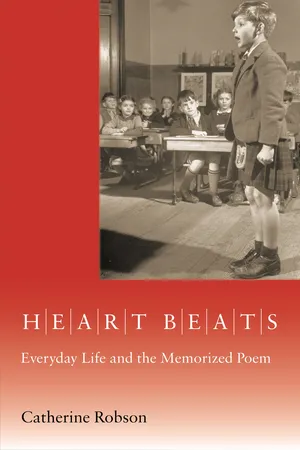
Many people in Great Britain and the United States can recall elderly relatives who remembered long stretches of verse learned at school decades earlier, yet most of us were never required to recite in class. Heart Beats is the first book to examine how poetry recitation came to assume a central place in past curricular programs, and to investigate when and why the once-mandatory exercise declined. Telling the story of a lost pedagogical practice and its wide-ranging effects on two sides of the Atlantic, Catherine Robson explores how recitation altered the ordinary people who committed poems to heart, and changed the worlds in which they lived.
Heart Beats begins by investigating recitation's progress within British and American public educational systems over the course of the nineteenth and twentieth centuries, and weighs the factors that influenced which poems were most frequently assigned. Robson then scrutinizes the recitational fortunes of three short works that were once classroom classics: Felicia Hemans's "Casabianca," Thomas Gray's "Elegy Written in a Country Churchyard," and Charles Wolfe's "Burial of Sir John Moore after Corunna." To conclude, the book considers W. E. Henley's "Invictus" and Rudyard Kipling's "If--," asking why the idea of the memorized poem arouses such different responses in the United States and Great Britain today.
Focusing on vital connections between poems, individuals, and their communities, Heart Beats is an important study of the history and power of memorized poetry.
- 312 pages
- English
- ePUB (mobile friendly)
- Available on iOS & Android
eBook - ePub
About this book
Information
Publisher
Princeton University PressYear
2012Print ISBN
9780691163376
9780691119366
eBook ISBN
9781400845156
Topic
LiteraturaSubtopic
Historia de la educaciónPART I
THE MEMORIZED POEM IN BRITISH AND AMERICAN PUBLIC EDUCATION
It is a Friday afternoon, some time in 1910. Elsie Hernsbusher, the blacksmith’s daughter, puts down her book and walks to the recitation bench. Both of Elsie’s grandfathers were born in Germany, but she and her parents are all natives of the United States, and the family speaks English at home. Now, in front of her schoolmates in the small town of Darien, Wisconsin (pop. 1,249), the twelve-year-old girl prepares to break the silence. On another afternoon in the same year, nearly four thousand miles away in Yorkshire, a boy named Charles William Bond is also on the brink of saying his piece. Charles’s father drives a delivery wagon for a local manufacturer of commercial lubricants; just like Elsie, Charles was born in 1898, but unlike her, he is not an only child. On the contrary: he lives (in a village in Mirfield—pop. around 11,000 at this date, but long since part of the West Riding’s sprawling conurbation of industrial towns) with one older brother, three half-brothers, and two half-sisters, his five younger siblings the children of his stepmother, Ada. In a year’s time, Charles will start work in the local coal-mine as a hurrier; six years after that, he will die on October 9, one of that day’s 10,000 Allied casualties at Passchendaele, and his body will never be found. Today, though, he is standing at his desk in Battyeford National School, the long low building on Nab Lane that lies just a short walk away from his family’s home.
The information about the two individuals in the paragraph above, plucked from U.S. and British census data and the Imperial War Graves Commission’s archive, represents the sum total of all I know for certain about Elsie and Charles. What follows in the next few pages is a series of conjectures about the preparations for the performances that are about to begin in these two widely separated classrooms; thereafter, the bulk of the chapter will conduct a detailed examination of how it was that such behaviors came to form an unexceptional part of huge numbers of lives. Accounting for this process will require the investigation of numerous histories and topics that may at first glance seem to bear tenuous connections to “poetry” or “recitation” per se; only by reconstructing a diverse matrix of preconditions will it be possible to understand how poetry recitation eventually found its apparently natural home in public education. My best guesses about the nature and content of two fabricated scenes in Wisconsin and Yorkshire aim to provide glimpses of everyday practice at the zenith of the memorized poem’s heyday, visions of experience from the period of classroom recitation’s most fully achieved state. We begin, in other words, with our journey’s ultimate destination.
And what is Elsie going to recite at the bench in Darien? Here is the section of the 1910 Manual of the Elementary Course of Study for the Common Schools of Wisconsin that sets out the list of poems deemed appropriate for the middle and upper forms, which is to say, for children in their fifth to seventh years of study.
147. Poems Suitable for the Middle Form
O Farewell. Night. The Skylark. Boy’s Song. Morning. To a Butterfly. The Huskers. The Bugle Song. Song of the Fairy. Four Leaf Clover. Autumn. Charge of the Light Brigade. The Night Before Waterloo. Written in March. Under the Greenwood Tree. To the Fringed Gentian.
—The Listening Child, Lucy W. Thacher.
The Sandpiper. The Old Oaken Bucket. Abou Ben Adhem. The Voice of Spring. Herve Riel. To America. The “Three Bells” of Glasgow.
—Poems Every Child Should Know, Mary E. Burt.
The Flight of the Birds. The Beautiful Snow. The Wind in a Frolic. April, Ever Frail and Fair. November. The Bees. Break, Break, Break. The New Year. When Icicles Hang by the Wall.
—Poetry of the Seasons, Mary I. Lovejoy.
148. Poems Suitable for the Upper Form: (Many of the following poems should be committed to memory.)
Selections from Hiawatha | Longfellow. | |
The Blue and the Gray | Finch. | |
My Country ’Tis of Thee | Smith. | |
Death of the Flowers | Bryant. | |
Breathes There a Man With Soul so Dead | Scott. | |
The Builders | Longfellow. | |
The Quality of Mercy is Not Strained | Shakespeare. | |
The Planting of the Apple-Tree | Bryant. | |
To a Skylark | Shelley. | |
October | Bryant. | |
What Constitutes a State | Jones. | |
Concord Fight | Emerson. | |
The Chambered Nautilus | Holmes. | |
Honest Poverty | Burns. | |
Address at Gettysburg | Lincoln. | |
Pippa’s Song | Browning. | |
Crossing the Bar | Tennyson. | |
Recessional | Kipling. | |
March | Wordsworth. | |
Selections from Snow-Bound | Whittier. | |
Selections from Sir Launfal | Lowell. | |
Selections from Evangeline | Longfellow. | |
(Cary, 105) |
Let us assume that Elsie’s teacher is a diligent and responsible instructor, who is both fond of poetry and keen to follow the directions in the manual for its most effective presentation in the classroom—as far as is practicable, that is. She intends to get through a good number of the poems in the list with her upper-form students, but will only set them one work to memorize (Cary, 19). This came as no surprise to Elsie; each of her previous five years at school has had its designated poem, and she can easily recite any and all of these works when required to do so, as indeed she has been at the end of each academic year to demonstrate the successful completion of her course of study. (Her favorite is the ditty she learned when she was seven, “Good-Night and Good-Morning”—although she tends to think of it not by its title, but its first line: “A fair little girl sat under a tree …”).1 The teacher—Miss Holland, who is twenty-four years old—began working on this year’s poem for Elsie and her fellow sixth-years a couple of months ago. Miss Holland has chosen Longfellow’s “The Builders.” It is not an old friend, not one of the poems she herself learned at school (although quite a few on the list are), but she is rather taken with its seriousness, and thinks it will serve as a fine extension to the morally improving “Memory Gems” that she regularly requires her charges to get by heart (she has a stock of these stored in her head, and the manual provides over forty more snippets in its appendix). Up to now the full-length works her students have memorized have mostly been fairly gentle poems about nature; “The Builders,” she feels, will give them a bit more backbone.
As the manual suggested, Miss Holland spent considerable time preparing so that she was “thoroughly at home with the selection” and could “be perfectly at ease before her class” when she read the poem “expressively” to them (103). She had followed that performance with “thought analysis,” hoping “to get the pupils to see clearly the pictures suggested by the poem” (103). If you talked to her students, you would probably decide that Miss Holland has done a satisfactory job in this respect. Elsie, for instance, may not like this poem all that much, but she does have two images in her mind’s eye when she thinks about it—one of a tumbledown house, with “yawning gaps” and “broken stairways,” and the other more like an illustration she remembers from her fourth-year reading book, of a castle solidly constructed of massive and regular stone blocks. Truth be told, though, this is about as far as it goes for either Elsie or her classmates. Miss Holland was unsure how much further she should press with her questions; the manual had said she should “encourage her pupils to abandon themselves to the selection and respond to its beautiful thoughts and music” once she had ensured that they were reading each line with “sufficient expression,” so she did not to quiz them directly about the poem’s meaning nor exert much energy on explanations of its use of analogy (104). Now she readies herself to listen carefully to Elsie’s recitation, to make sure that she is word-perfect throughout each of the poem’s thirty-six lines, and that her inflections and emphases fall in the right places. In a few weeks time, after all the children in Elsie’s year have demonstrated on multiple occasions that the poem is firmly committed to memory, Miss Holland will have them perform it together. She agrees with the manual’s assertion that “there is nothing more inspiring than the recitation of a soul-stirring poem by a class reciting in concert”; she is confident that the piece will provide an excellent and uplifting finale to the school concert at the end of the year (103).
“ ‘The Builders,’ by Henry Wadsworth Longfellow. ‘All are architects of faith …’ ” As Elsie Hernsbusher begins to speak, let us now travel to Charles William Bond’s British classroom. Three years ago, his headmaster (a Mr. G. Greenwood) was sent an inspection copy of W. and R. Chambers’s Poetic Gems: A Selection of Good Poetry for Young Readers, the preface of which explained that Part I “will be found suitable for children of ten or eleven,” Part II for “those of eleven and twelve,” and so forth.2 The table of contents runs as follows:3
PART I.
| The Brook | Alfred, Lord Tennyson | |
| In a Garden | A. C. Swinburne | |
| Vitai Lampada | Henry Newbolt | |
| The Coming of Spring | Mary Howitt | |
| Little Golden-Hair | Will Carleton | |
| Lady Clare | Alfred, Lord Tennyson | |
| The Baby’s Kiss | G. R. Emerson | |
| Robert of Lincoln | William C. Bryant | |
| The Forest Fire | Charles G. D. Roberts | |
| The Voice of Spring | Mrs Hemans | |
| The Slave’s Dream | Henry W. Longfellow | |
| The Angel of Patience | John G. Whittier | |
| John Gilpin | William Cowper |
PART II.
| The Charge of the Light Brigade | Alfred, Lord Tennyson | |
| To a Skylark | William Wordsworth | |
| The Burial March of Dundee | William E. Aytoun | |
| To a Cuckoo | M. Bruce or J. Logan | |
| The Soldier’s Dream | Thomas Campbell | |
| The Landing of the Pilgrim Fathers | Mrs Hemans | |
| The Frost Spirit | John G. Whittier | |
| Young Lochinvar | Sir Walter Scott | |
| To the Cuckoo | William Wordsworth | |
| Edinburgh after Flodden | William E. Aytoun | |
| The Skylark | James Hogg | |
| Lament of the Irish Emigrant | Lady Dufferin | |
| The Daffodils | William Wordsworth | |
| Douglas and Marmion | Sir Walter Scott | |
| One by One | Adelaide Ann Procter | |
| Fidelity | William Wordsworth | |
| I am Monarch of all I Survey | William Cowper | |
| The Green Linnet | William Wordsworth | |
| Horatius at the Bridge | Lord Macaulay |
PART III.
| The Coming of the Snow | James Thomson | |
| A Man’s a Man for a’ That | Robert Burns | |
| Battle of the Baltic | Thomas Campbell | |
| The Cloud | Percy Bysshe Shelley | |
| The Pied Piper of Hamelin | Robert Browning | |
| The Home of Evangeline | Henry W. Longfellow | |
| A Day in June | James Russell Lowell | |
| The Stag Hunt | Sir Walter Scott | |
| To a Waterfowl | William C. Bryant | |
| Hiawatha’s Canoe | Henry W. Longfellow | |
| My Native Land | Sir Walter Scott | |
| To a Daisy | Robert Burns | |
| The Heavens and their Creator | Joseph Addison | |
| The Eve of Quatre Bras | Lord Byron | |
| Morte d’Arthur | Alfred, Lord Tennyson |
PART IV.
| Recessional | Rudyard Kipling | |
| Sir Galahad | Alfred, Lord Tennyson | |
| The Combat | Sir Walter Scott | |
| On the Receipt of my Mother’s Picture | William Cowper | |
| To Autumn | John Keats | |
| The Village Preacher | Oliver Goldsmith | |
| The Armada | Lord Macaulay | |
| Gradatim | Josiah Gilbert Holland | |
| The Chambered Nautilus | Oliver Wendell Holmes | |
| England, with all thy Faults | William Cowper | |
| Elegy Written in a Country Churchyard | Thomas Gray | |
| Introduction to “Endymion” | John Keats | |
| To a Skylark | Percy Bysshe Shelley | |
| King Robert of Sicily | Henry W. Longfellow | |
| The Fall of Wolsey | William Shakespeare | |
| A Father’s Advice to his Son | William Shakespeare | |
| The Quality of Mercy | William Shakespeare | |
| Life as a Drama | William Shakespeare | |
| A Lesson from the Bees | William Shakespeare | |
| Lancaster’s Dying Speech | William Shakespeare |
I choose here to hypothesize that Mr. Greenwood liked the volume so much that he ordered separate paper-bound sets of its constituent parts for the school’s top four classes. Charles is one of the older students in Standard V, and thus has temporary ownership of a copy of Part II. Somewhat against the inclinations of Miss Robertshaw, his teacher, the pupils in Charles’s class have each been allowed to choose which poem they will memorize and recite. Miss Robertshaw is forty years old; when she herself was in Standard V back in 1882, she had been required to recite 100 lines of verse in front of an inspector to pass the year’s examination, and to her mind, this is still the right number of lines for a twelve-year-old child—indeed, as she well remembers, that stipulation was part of the Elementary Code until just ten years ago. But she is thoroughly familiar with the document that has taken the code’s place—the Handbook of Suggestions for the Considerations of Teachers—and she knows that there are new ways of thinking about recitation. For one thing, it is now believed that “[t]here is no necessity for every child to learn the same passages (for a passage never makes the same appeal to all children) or the same number of lines” (33). In Miss Robertshaw’s opinion this creates a great deal of extra and unnecessary work. But she has done what she can to direct her pupils’ choices, and is pleased that although the girls are by and large favoring the poems by Hemans, Procter, and Wordsworth, most of the boys—Charles included—have opted for Macaulay’s “Horatius at the Bridge.” Their book provides two hundred lines from the Lays of Ancient Rome, but she has told them they need memorize no further than “But will ye dare to follow / If Astur clears the way?” Which is a shame, in some ways, as this breaks the story off at an exciting point, but she has read the complete extract to the whole class several times and is confident that they have an understanding of what the handbook calls “the general scope of the poem” (34). She is aware that it then goes on to suggest that “with the older children some of the distinctions in diction and form between prose and poetry might be considered,” but there really isn’t enough time to explore these matters, and in any case, it also states that it “is better to do nothing in this direction than to attempt too much, for the unskilled or irreverent dissection of a poem is destructive to the sense of beauty” (34). She has, however, written the definitions of Macaulay’s more difficult words on the blackboard and given the boys plenty of help with their pronunciations (“Herminius” is a particular problem).
Given that such large numbers of the children are preparing this poem, Miss Robertshaw thinks it a pity that the handbook is so set against recitation in unison (“Such a device is the merest mechanical drill, and destroys any value recitation may have” [33]). But she knows that the many occasions on which the boys hear their classmates recite “Horatius” play a helpful part in drumming the lines into their heads—and, if some of them are still shaky on the sequence of the stanzas in the run-up to the end of term when Mr. Greenwood will mark each child’s performance out of ten for their reports, she may well revert to a few sessions of group recitation as a remedial measure. Today, however, she has just called on Charles with confidence; if his past performances are anything to go by, he will require only a few promptings to make it all the way through (“Come on, lad: ‘Meanwhile, the Tuscan army …’ ”). And Charles is quite looking forward to his moment in the sun. He has always been good at repetition, and is pleased to have a decent poem this year (the worst time was in Standard I, when the teacher made them all do “A fair little girl sat under a tree”—although he does remember how useful it was, when he practiced at home, that his stepmother already knew the soppy thing off by heart).4 This time around, though, he has worked on his lines alone; he really likes the way the beats of the poem fit the stride of his steps as he marches along the village lanes. But there won’t be any moving around in the next few minutes; Charles takes a deep breath, puts his arms straight by his sides, and dives in.
The simplest explanation for the huge success of the memorized poem runs as follows: rote memorization long constituted the dominant method for teaching both reading and other subjects in Britain and the United States, and poetic material worked especially well...
Table of contents
- Cover
- Title Page
- Copyright
- Dedication
- Contents
- List of Figures
- Acknowledgments
- Introduction
- Part I: The Memorized Poem in British and American Public Education
- Part II: Case Studies
- Afterword
- Appendixes
- Notes
- Works Cited
- Index
Trusted by 375,005 students
Access to over 1.5 million titles for a fair monthly price.
Study more efficiently using our study tools.
Frequently asked questions
Yes, you can cancel anytime from the Subscription tab in your account settings on the Perlego website. Your subscription will stay active until the end of your current billing period. Learn how to cancel your subscription
No, books cannot be downloaded as external files, such as PDFs, for use outside of Perlego. However, you can download books within the Perlego app for offline reading on mobile or tablet. Learn how to download books offline
We are an online textbook subscription service, where you can get access to an entire online library for less than the price of a single book per month. With over 1.5 million books across 990+ topics, we’ve got you covered! Learn about our mission
Look out for the read-aloud symbol on your next book to see if you can listen to it. The read-aloud tool reads text aloud for you, highlighting the text as it is being read. You can pause it, speed it up and slow it down. Learn more about Read Aloud
Yes! You can use the Perlego app on both iOS and Android devices to read anytime, anywhere — even offline. Perfect for commutes or when you’re on the go.
Please note we cannot support devices running on iOS 13 and Android 7 or earlier. Learn more about using the app
Please note we cannot support devices running on iOS 13 and Android 7 or earlier. Learn more about using the app
Yes, you can access Heart Beats by Catherine Robson in PDF and/or ePUB format, as well as other popular books in Literatura & Historia de la educación. We have over 1.5 million books available in our catalogue for you to explore.