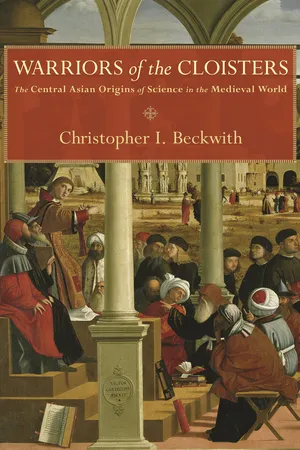
How science in medieval Europe originated in Buddhist Asia
Warriors of the Cloisters tells how key cultural innovations from Central Asia revolutionized medieval Europe and gave rise to the culture of science in the West. Medieval scholars rarely performed scientific experiments, but instead contested issues in natural science, philosophy, and theology using the recursive argument method. This highly distinctive and unusual method of disputation was a core feature of medieval science, the predecessor of modern science. We know that the foundations of science were imported to Western Europe from the Islamic world, but until now the origins of such key elements of Islamic culture have been a mystery.
In this provocative book, Christopher I. Beckwith traces how the recursive argument method was first developed by Buddhist scholars and was spread by them throughout ancient Central Asia. He shows how the method was adopted by Islamic Central Asian natural philosophers—most importantly by Avicenna, one of the most brilliant of all medieval thinkers—and transmitted to the West when Avicenna's works were translated into Latin in Spain in the twelfth century by the Jewish philosopher Ibn Da'ud and others. During the same period the institution of the college was also borrowed from the Islamic world. The college was where most of the disputations were held, and became the most important component of medieval Europe's newly formed universities. As Beckwith demonstrates, the Islamic college also originated in Buddhist Central Asia.
Using in-depth analysis of ancient Buddhist, Classical Arabic, and Medieval Latin writings, Warriors of the Cloisters transforms our understanding of the origins of medieval scientific culture.
THE RECURSIVE ARGUMENT method was “the basic vehicle for the analysis of problems in natural philosophy and theology”1 from the medieval intellectual revolution to the scientific revolution. It was the actual medieval “scientific method,” and it is apparently the source of what may be called the “ideal” modern literary scientific method. The origin of the recursive argument method has long been a mystery. Those who have tried to solve it have sought to explain it as an outgrowth of one or more earlier European traditions, but their proposals do not answer the most important questions, so the problem has remained unsolved. The same is true for the history of the college.2
This book shows how the recursive argument method, the actual medieval scientific method, was transmitted along with the college to medieval Western Europe from Classical Arabic civilization, and how the Central Asian Muslims had earlier adopted both from Buddhist Central Asian civilization. The recursive argument method is analyzed in detail, and examples are given showing its formation and development at each stage and in each of the relevant languages.
The present chapter attempts to place this topic and related issues, especially the college, in the context of the full scientific culture that developed in medieval Western Europe in connection with the transmission of these two cultural elements.
The difficulty of understanding a complex problem as a whole is well summed up in the folk expression, “You can’t see the forest for the trees.” It means that one needs to actually leave the forest and stand some distance away from it in order to understand it as a discrete entity—a forest—composed most saliently of trees, and to see that it is different from other discrete entities such as a city, or a mountain range, which similarly are understood as entities from an external vantage point. A complex entity with many constituent elements, whether diverse or homogeneous, cannot be comprehended as a whole from the inside; it is necessary to step outside it. Similarly, understanding the scientific culture that developed in medieval Western Europe requires a perspective from which it can be seen as a discrete entity. In this particular case, the culture in question was similar to other medieval cultures that had some science of one kind or another, but it was different from them in one essential way: the others did not develop a full scientific culture. It is only by comparison with them that the distinctiveness of the Western European development is apparent. This chapter examines the appearance of a full scientific culture in thirteenth-century Western Europe from the external, holistic viewpoint gained by study of the contrasting “control” cases, which are examined one by one in chapter 7.
The Constituent Elements of a Full Scientific Culture
Western Europeans came into intensive, long-lasting contact with the Islamic world in a very direct and personal way from the beginning of the Crusades in 1096 onward. Leaving aside the purely military aspects of this contact, countless thousands of civilians traveled to the Islamic world as merchants or pilgrims, or both. During this period Western Europeans copied practically every significant nonreligious cultural element of Islamic civilization that they encountered, including Classical Arabic science (the Classical Arabic version of largely Aristotelian “natural philosophy”), Arab-Indian mathematics, the poetry and music of Islamic Spain, and much else. All this is well known.3
However, it has long been asserted that the recursive argument method developed independently in medieval Western Europe, although it is unattested in any text composed in Latin before the early thirteenth century. It is traditionally known as the “scholastic method,” or quaestiones disputatae ‘disputed questions’ method, and was used in major works of “natural philosophy” (medieval science) and theology by Albert the Great, Thomas Aquinas, Roger Bacon, and many others.4 The recursive argument method is the “scientific method” of the Middle Ages and Renaissance, when science was mostly not done by experiments—so that one can hardly speak of a regular “experimental method,” which did not come to the fore until the scientific revolution—but by public oral or literary disputation. As shown below, the earliest examples of the recursive argument method in Latin are actually found in some of the most famous, important, and influential texts translated into Latin in the mid-twelfth century in Spain from Arabic originals written a century earlier.5
Similarly, it has been asserted that the highly distinctive college developed independently in medieval Western Europe, despite the fact that no one has ever been able to find any convincing native roots for the college in earlier medieval Europe or classical antiquity. Yet it is unquestioned that the first college in Western Europe was founded in Paris by a man who had just returned from Jerusalem, a landlocked city. That means he had necessarily traveled overland through some area of the Near East—which already was overwhelmingly Islamic—in order to get to Jerusalem. Most pilgrims and warriors traversed at least part of Syria, where an absolutely identical Islamic institution, the madrasa, was widespread by that time. It is also well known in Islamic studies that this institution had first apppeared several centuries earlier in Islamic Central Asia. And it has long been known that an identical institution, with identical functions and the same highly distinctive architectural form, existed already in pre-Islamic times in Buddhist Central Asia, having developed there slowly and organically out of earlier local forms.6
That these two cultural elements—the recursive argument method and the college—appeared at the same time in Western Europe, amid a great deal of acknowledged borrowing from the Islamic world during the period of the Crusades, would seem to be sufficient cause for scholars to look to borrowing as their source, too. However, with very few exceptions, that has not been the case, and the Islamic world has been resolutely ignored in connection with them.
The path that other major constituent elements of science followed before their transmission from the Islamic world to medieval Western Europe has also been muddied for a very long time. Moreover, it is remarkable that the Central Asian origin of most of the leading natural philosophers of the great age of Classical Arabic civilization has been generally overlooked.
Similar unclarity is widespread in Islamic studies. From the early Middle Ages onward it has been continuously known that the major works of Indian science were translated into Classical Arabic in the late eighth century, well before the flood of translations from Classical Greek began.7 Indian (and Buddhist Central Asian) thought had a formative influence on early Islamic civilization. Why then do Islamicists continue to argue that Classical Arabic intellectual civilization developed almost exclusively under Graeco-Roman influence?
Medievalists have known for at least a century that the recursive argument method first appears in Latin texts at the very beginning of the thirteenth century, having no known antecedent in earlier Latin or Greek literature. So why do so many medievalists, ignoring the data and the scholarship on these topics, continue to assert that these elements of medieval science developed purely internally in Europe?
Similarly, it has been known for many decades, from literary and archaeological sources, that the Islamic college, or madrasa, is simply a “converted” Buddhist college, or vih
ra. Why then do Islamicists continue to argue that the madrasa developed purely internally, under Graeco-Roman or even Persian influence, in the Islamic world?
As remarked above, it is well known that medieval Western Europe came under massive cultural influence from Classical Arabic civilization during the period of the Crusades, and that Europeans borrowed all of the other essential elements of a full scientific culture, along with many other things, from the Islamic world, mostly via Spain. So why did Europeans not borrow the recursive argument method and the college too? Those who advocate a native European origin for the college and the recursive argument method would have us believe that Western Europeans eagerly borrowed everything else from Classical Arabic civilization, but not these two particular elements, which are the key elements of a full scientific culture. Well, why not? Since they existed in the Islamic world, with which Western Europe was then in intensive contact, the usual argument forces us to imagine medieval Western Europeans saying to themselves triumphantly, “We see that the Muslims have the recursive argument method and the college, but we shall not copy them! We shall brilliantly invent precisely the same complex cultural constructs all by ourselves! It will be a pure coincidence!” Since all of the other significant elements of a full scientific culture were borrowed from Classical Arabic civilization, it goes far beyond reasonable doubt to expect any sensible person to believe that medieval Western Europeans just happened to suddenly and independently invent complex cultural constructs that were purely coincidentally precisely the same as the earlier recursive argument method and college long possessed by the neighboring culture. Surely historians, above all, should hesitate to believe in so many miraculous coincidences and other marvelous exceptions to the normal course of events in the world.
The late George Makdisi, a medievalist knowledgeable in both Arabic and Latin sources, courageously proposed that both the “scholastic method” and the college were borrowed from the Islamic world. Unfortunately, despite some convincing arguments, he was unable to support either proposal well enough to gain acceptance. Nevertheless, some decades ago the origin of the Islamic madrasa ‘college’ itself became firmly known from archaeology, and a few years ago the present writer found actual textual evidence of the transmission of the recursive argument method from the Islamic world to Western Europe.8
As shown in this book, the recursive argument method was neither a native European invention nor an isolated borrowing. It came in from the Islamic world along with the college, translations of Classical Arabic scientific works, and translations of Classical Arabic commentaries on Aristotle and works in the tradition of Aristotelian natural philosophy. The method was immediately integrated into the existing Western European tradition of Sentences or Questions, literary argument formats that list different positions on problems in theology, law, and other fields.
The sudden influx of cultural borrowing from the Islamic world was fundamental to the development of science in Medieval Latin civilization. Rega Wood writes that “James of Venice’s translations [directly from the Greek] had been available since about 1150, but Aristotelian analytics, metaphysics, and natural philosophy” had very little impact in Western Europe until after “the Michael Scot translations [which were accompanied by Arabic commentaries] became available around 1225.” Th...
Table of contents
Cover
Title Page
Copyright
Contents
Preface
Acknowledgments
Abbreviations and Transcription of Foreign Languages
Chapter One: Introduction
Chapter Two: The Recursive Argument Method of Medieval Science
Chapter Three: From College and Universitas to University
Chapter Four: Buddhist Central Asian Invention of the Method
Chapter Five: Islamization in Classical Arabic Central Asia
Chapter Six: Transmission to Medieval Western Europe
Chapter Seven: India, Tibet, China, Byzantium, and Other Control Cases
Chapter Eight: Conclusion
Appendix A: On the Latin Translations of Avicenna’s Works
Appendix B: On Peter of Poitiers
Appendix C: The Charter of the Collège des Dix-huit
References
Index
Trusted by 375,005 students
Access to over 1.5 million titles for a fair monthly price.
Study more efficiently using our study tools.
Frequently asked questions
Yes, you can cancel anytime from the Subscription tab in your account settings on the Perlego website. Your subscription will stay active until the end of your current billing period. Learn how to cancel your subscription
No, books cannot be downloaded as external files, such as PDFs, for use outside of Perlego. However, you can download books within the Perlego app for offline reading on mobile or tablet. Learn how to download books offline
Perlego offers two plans: Essential and Complete
Essential is ideal for learners and professionals who enjoy exploring a wide range of subjects. Access the Essential Library with 800,000+ trusted titles and best-sellers across business, personal growth, and the humanities. Includes unlimited reading time and Standard Read Aloud voice.
Complete: Perfect for advanced learners and researchers needing full, unrestricted access. Unlock 1.5M+ books across hundreds of subjects, including academic and specialized titles. The Complete Plan also includes advanced features like Premium Read Aloud and Research Assistant.
Both plans are available with monthly, semester, or annual billing cycles.
We are an online textbook subscription service, where you can get access to an entire online library for less than the price of a single book per month. With over 1.5 million books across 990+ topics, we’ve got you covered! Learn about our mission
Look out for the read-aloud symbol on your next book to see if you can listen to it. The read-aloud tool reads text aloud for you, highlighting the text as it is being read. You can pause it, speed it up and slow it down. Learn more about Read Aloud
Yes! You can use the Perlego app on both iOS and Android devices to read anytime, anywhere — even offline. Perfect for commutes or when you’re on the go. Please note we cannot support devices running on iOS 13 and Android 7 or earlier. Learn more about using the app
Yes, you can access Warriors of the Cloisters by Christopher I. Beckwith in PDF and/or ePUB format, as well as other popular books in History & History of Education. We have over 1.5 million books available in our catalogue for you to explore.