This volume explores the political, cultural, and ecclesiastical forces that linked the metropolis of Byzantium to the margins of its far-flung empire. Focusing on the provincial region of Hellas and Peloponnesos in central and southern Greece, Judith Herrin shows how the prestige of Constantinople was reflected in the military, civilian, and ecclesiastical officials sent out to govern the provinces. She evokes the ideology and culture of the center by examining different aspects of the imperial court, including diplomacy, ceremony, intellectual life, and relations with the church. Particular topics treat the transmission of mathematical manuscripts, the burning of offensive material, and the church's role in distributing philanthropy.
Herrin contrasts life in the capital with provincial life, tracing the adaptation of a largely rural population to rule by Constantinople from the early medieval period onward. The letters of Michael Choniates, archbishop of Athens from 1182 to 1205, offer a detailed account of how this highly educated cleric coped with life in an imperial backwater, and demonstrate a synthesis of ancient Greek culture and medieval Christianity that was characteristic of the Byzantine elite.
This collection of essays spans the entirety of Herrin's influential career and draws together a significant body of scholarship on problems of empire. It features a general introduction, two previously unpublished essays, and a concise introduction to each essay that describes how it came to be written and how it fits into her broader analysis of the unusual brilliance and longevity of Byzantium.
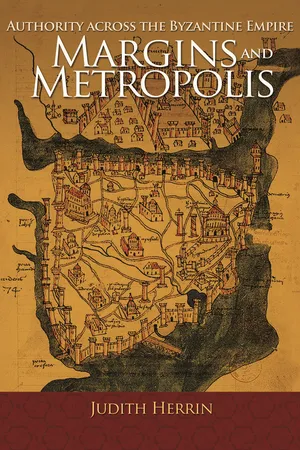
- 392 pages
- English
- ePUB (mobile friendly)
- Available on iOS & Android
eBook - ePub
About this book
Information
Publisher
Princeton University PressYear
2013Print ISBN
9780691166629
9780691153018
eBook ISBN
9781400845224
METROPOLIS

7
BYZANTIUM
THE PALACE AND THE CITY
An invitation to participate in a conference on the role of the sovereign in East and West prompted the first version of this study in French (published in the Belgian periodical Byzantion 41, 1991). The editors, Jean-Marie Sansterre and Alain Dierkens, organized a series of events devoted to the study of Byzantium in a comparative perspective, so I was particularly glad to contribute. By contrasting the imperial system with other medieval styles of government, the specificity of each becomes much clearer. My interest in the role of the Great Palace within the city of Constantinople grew out of a seminar on the Parastaseis syntomoi chronikai (Brief Historical Notes) directed by Alan and Averil Cameron. The exciting process of working on this anonymous text that survives in only one eleventh-century manuscript sparked a greater attention to its contribution to the study of medieval Constantinople, which was disputed. This encouraged me to focus on the imperial center, the court of Constantinople, and its departments of government that ruled the empire, moving my attention from margins to the metropolis.
Constantine’s foundation of a new capital on the site of ancient Byzantion gave rise to a series of epithets for the metropolis: the Queen City, or ruling city, basileuontas polis, as it became known, or simply “the city.” These reflected the emperor’s intention that his city should replace Old Rome; its destiny was to rule the Roman world. While it took some time for Constantinople to grow into this role, by the sixth century when Justinian rebuilt the center dominated by the great church of Holy Wisdom (Hagia Sophia), the founder’s ambition was clearly being realized. And despite a later decline, the roots of this ruling identity were so deeply embedded that no other city could challenge it. Constantinople and the Great Palace within it remained unrivalled until the early thirteenth century.
In this chapter I explore some of the relations between the imperial court within the palace and the local population who proudly called themselves “Byzantines,” reflecting their claim to have lived in the ancient Greek colony of Byzantion. As the original inhabitants of the city they cultivated a special affinity with the ruling family in power, being closest to the palace and thus in a position to congratulate the emperor on the birth of a son or to criticize his ministers. In spite of very limited access, they found ways to make their views known. When an urban mob marched toward the palace, those inside condemned the demokratia (rule by the demos, crowd, sometimes a group of Hippodrome fans known by their colors, Green or Blue). Such a term had no place in a well-ordered empire where monarchy authorized by divine approval had attained an all-powerful, if not god-like power. Yet the population could, in certain circumstances, have influence, and rulers who ignored popular feeling within the ruling city could lose their office. On such occasions the people confronted the emperor in the Hippodrome, which always remained the site of potential discord as well as shared exhilaration—both were equally devoted to the races.
IN THE EAST ROMAN EMPIRE the words “palace” and “city” generally had only one meaning—the Great Palace of the emperors in the city of Constantine, inaugurated in 330 AD and named Constantinople after him. Although it took many years for this dominance to take hold, by the Middle Ages there were no rivals and no equivalents in the West. The imperial capital contained the largest concentration of population in the medieval world (though a few Asian cities were larger, and during the tenth century Baghdad would overtake it). But this ruling city, the Queen City, was far larger than any city of medieval Europe. Even in the twelfth century, the crusaders who were familiar with Paris, Rome, Lyons, were astonished by the area within the walls, as well as the wealth of Constantinople. A city sans pareille, it sustained urban traditions and incorporated and elaborated ancient histories and myths. Heir to a Greek world stretching back over a thousand years, though it developed from a small Greek colony rather than a famous city like Athens or Ephesos, it was also called New Rome from the fourth century.
This name, New Rome, indicates Constantine’s determination to create a rival, even a replacement, for Old Rome in the West. New Rome was said to have followed the older model, however, being built on seven hills with fourteen districts; and the palace of the emperors was based on the Palatine overlooking the Circus Maximus, where rulers presided over the races, entertainment, victory parades, and so on. In Constantinople the plan of Old Rome was adapted to new terrain, with public buildings, state monuments, and grand squares, all decorated with ancient statuary, and linked by avenues bordered by colonnades and defended by a great land wall formed of three lines of fortification.1 After the Nika riot of January 532, Justinian I cleared the central area and rebuilt in appropriately grander style, with the massive doomed church of Holy Wisdom replacing an earlier basilica, new public buildings like the Senate House, and additional cisterns to increase water supplies. Under his patronage New Rome flourished, while Old Rome on the Tiber never recovered from several devastating sacks in the fifth and sixth centuries.
Constantinople was the only imperial foundation that survived the decline of the urban traditions of Antiquity.2 And even Constantinople experienced a catastrophic reduction in its population after the attacks of pestilence, which continued from the sixth into the eighth century. This decline can be gauged from the fact that the city survived the destruction of the aqueduct in 626 by besieging Avar forces, and managed with reduced water storage capacity until 766 when Constantine V repaired the structure.3 The restoration suggests that a growing population required larger supplies, and the emperor now found the means to rebuild and protect the long impressive aqueduct that carried water nearly 250 kilometers from the Belgrade forest into the city.
From this point on the city began to witness an expansion. For a variety of reasons, merchants, clerics, intellectuals, adventurers, and all those who believed the stories of streets paved with gold came to look for work in the Queen City. The striking case of the future emperor Basil I in the ninth century must be one of the many instances, which remain unrecorded because they did not document the career of a new ruler.4 The city’s healing shrines had always generated pilgrims hoping for a miraculous cure, and as the city’s collection of relics and wonder-working icons grew, so did the number of visitors. Some provincial families sent their children to Constantinople, intending boys to acquire a better education and hoping that castrated boys and young girls could find work in the imperial court, as eunuchs and ladies-in-waiting. In these ways Constantinople retained and deepened its position as metropolis of the Christian universe and attracted people from the four corners of the world.
Even during the darkest times, the idea of urban life always remained dominant. In Constantinople the Roman ideology of “bread and circuses” was adapted to medieval life.5 The emperor provided not only what was necessary for life, but also for the pleasures of the city: circus entertainments, public baths, the pomp and largess of the court in numerous processions and rituals outside the palace. The Hippodrome still served as the place where the people gathered to celebrate a military triumph or the anniversary of the foundation of the city with horse and chariot races, so warmly appreciated. Even more important, however, was the role of the Hippodrome as the site where emperor and people met: before the opening of the games and races, the people acclaimed him and the emperor blessed them. And these ritual exchanges demonstrate the structural relations between the palace and the city, which persisted throughout the middle Byzantine period.6
The presence of the people (laos or demos without a more specific name) was organized by the Prefect of the City (eparchos tes poleos) on official occasions, when they exercised their traditional role in imperial government: the acclamation of a new ruler.7 This ancient Roman right continued into the medieval period and might sometimes lead to unexpected consequences, when, for example, an urban crowd demanded to see the Empress Zoe, who had been illegally confined to a monastery by her consort Michael VI, or when they marched off to liberate her sister, Empress Theodora.8 The people were invited to go and meet all important visitors to the city, like Pope Constantine I when he traveled from Rome and was received at the seventh mile from the city, or the fiancée of Leo IV who arrived by sea from Athens.9 Sometimes the Prefect summoned them to the Forum of Constantine, to hear the news of the day.10 Military updates from the war zone might be announced together with instructions for the city’s defense. If a serious invasion was threatened, the population was expected to buy in sufficient food supplies for up to three years, or to leave the city at once.11 On other occasions, revelations of corruption by imperial officials, rumors of cowardice among military leaders or abuse of the rights of young emperors might rouse the inhabitants to more spontaneous and aggressive actions. Traditional reactions and resistance to injustice remained strong, now within the framework of a medieval and Christian civilization.
In this ancient city the pagan past left many traces. Nearly all the monuments were decorated with statues of the gods or pre-Christian emperors, and also with antique symbols such as tripods, Gorgon heads from Ephesos, or the great bronze horses installed at the entrance to the Hippodrome (now at the church of San Marco, Venice).12 In the West there was no comparable sense of an earlier pagan civilization, except possibly in Rome.13 Most western cities suffered a much more profound break between Antiquity and the Middle Ages and had lost their lived experience of urban customs. In Constantinople this was not the case, though its inhabitants were often uncertain about the individuals or stories commemorated in the antique statues or where they came from. They continued to be aware of them, partly because no one doubted that some had a certain force; they could even cause earthquakes.14 Others in the region of the Xerolophos, which was dominated by pagan statues, simply inspired prophecies, sacrifice, and astronomy.15 The emperor regularly made a procession there.
In Constantinople “the palace” refers to the “Great Palace,”16 even though there were many other palaces in the city and suburban region. Late Antique villas, known by the names of their founders (the Palace of Macrina or the Palace of Placidia, for example) were used for particular functions, such as the accommodation of the papal envoy, apocrisiarius, to the imperial court, or of dist...
Table of contents
- Cover Page
- Title Page
- Copyright Page
- Dedication Page
- Contents
- Abbreviations
- Introduction
- Margins
- Metropolis
- Index
Trusted by 375,005 students
Access to over 1.5 million titles for a fair monthly price.
Study more efficiently using our study tools.
Frequently asked questions
Yes, you can cancel anytime from the Subscription tab in your account settings on the Perlego website. Your subscription will stay active until the end of your current billing period. Learn how to cancel your subscription
No, books cannot be downloaded as external files, such as PDFs, for use outside of Perlego. However, you can download books within the Perlego app for offline reading on mobile or tablet. Learn how to download books offline
Perlego offers two plans: Essential and Complete
- Essential is ideal for learners and professionals who enjoy exploring a wide range of subjects. Access the Essential Library with 800,000+ trusted titles and best-sellers across business, personal growth, and the humanities. Includes unlimited reading time and Standard Read Aloud voice.
- Complete: Perfect for advanced learners and researchers needing full, unrestricted access. Unlock 1.5M+ books across hundreds of subjects, including academic and specialized titles. The Complete Plan also includes advanced features like Premium Read Aloud and Research Assistant.
We are an online textbook subscription service, where you can get access to an entire online library for less than the price of a single book per month. With over 1.5 million books across 990+ topics, we’ve got you covered! Learn about our mission
Look out for the read-aloud symbol on your next book to see if you can listen to it. The read-aloud tool reads text aloud for you, highlighting the text as it is being read. You can pause it, speed it up and slow it down. Learn more about Read Aloud
Yes! You can use the Perlego app on both iOS and Android devices to read anytime, anywhere — even offline. Perfect for commutes or when you’re on the go.
Please note we cannot support devices running on iOS 13 and Android 7 or earlier. Learn more about using the app
Please note we cannot support devices running on iOS 13 and Android 7 or earlier. Learn more about using the app
Yes, you can access Margins and Metropolis by Judith Herrin in PDF and/or ePUB format, as well as other popular books in History & European History. We have over 1.5 million books available in our catalogue for you to explore.