Religion and liberty are often thought to be mutual enemies: if religion has a natural ally, it is authoritarianism--not republicanism or democracy. But in this book, Maurizio Viroli, a leading historian of republican political thought, challenges this conventional wisdom. He argues that political emancipation and the defense of political liberty have always required the self-sacrifice of people with religious sentiments and a religious devotion to liberty. This is particularly the case when liberty is threatened by authoritarianism: the staunchest defenders of liberty are those who feel a deeply religious commitment to it.
Viroli makes his case by reconstructing, for the first time, the history of the Italian "religion of liberty," covering its entire span but focusing on three key examples of political emancipation: the free republics of the late Middle Ages, the Risorgimento of the nineteenth century, and the antifascist Resistenza of the twentieth century. In each example, Viroli shows, a religious spirit that regarded moral and political liberty as the highest goods of human life was fundamental to establishing and preserving liberty. He also shows that when this religious sentiment has been corrupted or suffocated, Italians have lost their liberty.
This book makes a powerful and provocative contribution to today's debates about the compatibility of religion and republicanism.
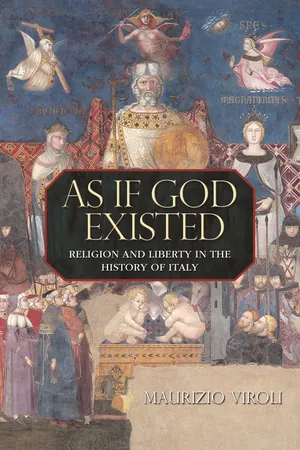
- 376 pages
- English
- ePUB (mobile friendly)
- Available on iOS & Android
eBook - ePub
About this book
Information
PART I
A Republican Christianity

1
REPUBLICS PROTECTED BY GOD
IN THE ELEVENTH AND TWELFTH centuries, the assemblies of citizens that gave birth to the communes in northern and central Italy gathered in churches. Even when public authorities built their own palaces, public council meetings were always preceded by religious ritual. Furthermore, the communes contributed to consecrating the city through paintings and sculptures of the saints, especially those patron saints who had defended the community from external or internal enemies, and hence had an explicitly civic meaning. The cities were religious, and so were the communes.
The religious dimension of the Italian communes was further reinforced by the shift from a government of consuls and podestà to the experiment of real popular governments—that is, governments held by the people’s councils. Whereas the first communal statutes, until the beginning of the twelfth century, contained few references to God, Christ, and the saints, the later ones offer plentiful mentions. In Vicenza, to cite but one example, the statutes of 1264 open with an oath invoking God, celebrating the divine creation that brought mankind into existence, and exalting the commune as the arrival point of God’s project in the world. The religious, military, and professional associations that constituted the people scrupulously retained as well as promoted both religious and civic dimensions, and held their meetings in churches, after mass, diligently attending to the worship of the patron saints. The communes’ religious identity and republicanism went hand in hand, and together engendered a republican religion.1
One can already find evidence of this in the treatises that explained the functions and duties of the podestà. These texts insist on the virtues that the podestà and other communal magistrates must possess so that the city can live in peace and flourish in liberty. Although these texts often have the character of practical handbooks that teach the podestà how to speak on various occasions, and how to behave at home and in the public palace, their authors also emphasize the religious significance of the supreme magistrate’s office and communal government. The most ancient of the handbooks for the podestà, the anonymous Oculus pastoralis, written around 1220, stresses the sacred dimension of the republican regime and the authority that administers justice. After quoting the canonical “There is no authority except from God” (Rom. 13:1), the author adds that such a principle also holds for the city’s governor. He then adapts the verse “A king enthroned on the judgment seat / with one look scatters all that is evil” (Prov. 20:8) to the republican podestà, and finally paraphrases Paul’s letter to the Romans, to argue that subjects must revere with sincere faith those who have been elected to govern.2 In his first speech, the podestà must invoke God’s grace to discharge the task that the citizens have entrusted to him, and that he gladly accepted. The handbook also recommends that at the end of the speech, the podestà should utter words of praise and reverence for “our Lord Jesus Christ, true son of God, and to his holy mother, Our Lady Saint Mary” as well as the revered saints of the city. The republican government comes from God, and to God, to his glory and praise, it must be primarily dedicated.3 If the city that the podestà is going to rule is lacerated by civil strife, as was often the case in thirteenth-century Italy, he must appeal to the Gospel in order to urge peace and concord, and cite the famous passage “Glory to God in the highest heaven, / and on earth peace for those he favors” (Luke 2:14).
The republic needs God’s help. Hoping to obtain it, the ruler must have a sincere fear of God and must observe the Catholic faith, remembering the scripture “But Yahweh’s face is set against those who do evil, / to cut off the memory of them from the earth” (Ps. 34:16). From the Bible, the author of the Oculus pastoralis draws the admonition that the council must deliberate the weightiest issues and, once a decision has been made, must execute it firmly, despite any popular uproar.4 Within the council, he who rules must above all heed the advice of the wise and elderly, as again the Bible teaches us: “Do not dismiss what the old people have to say, / for they too were taught by their parents; / from them you will learn how to think” (Sir. 8:9). The ruler must also always recollect that wisdom keeps cities free: “There was once a small town, with only a few inhabitants; a mighty king made war on it, laying siege to it and building great siege-works round it. But there was in that town a poverty-stricken sage who by his wisdom saved the town” (Eccles. 9:14–15). If instead the ruler mistakenly trusts foolish councillors, he will bitterly regret it, for “sand and salt and a lump of iron / are a lighter burden than a dolt” (Sir. 22:15). Finally, the ruler must always remind the magistrates appointed to the civil tribunals, in the words of the Book of Wisdom, to “love uprightness you who are rulers on earth” (Ws 1:1).5
One of the ruler’s most important duties is to address the people when soldiers die. On such sad occasions, the podestà must reemphasize to the citizens that man’s life on earth is composed of just conscript service (Job 7:1), and that it is men’s duty to fight against pride, vainglory, avarice, and envy. The podestà must then explain that the soldier who falls for the country emigrates from earth to God (ad Deum). In order to assuage the suffering, he must quote the Bible’s admonition that “everything goes to the same place, / everything comes from the dust, / everything returns to the dust” (Eccles. 3:20), and that man is “fleeting as a shadow, transient” (Job 14:2).6 Weeping is human, and Jesus himself wept before the suffering of Mary, Lazarus’s sister (John 11:33–35). But the ruler of a city must teach with humane words that persistent weeping will not make the beloved come to life again. It is wiser, once more, to ponder the Old Testament’s words: “Yahweh gave, Yahweh has taken back. Blessed be the name of Yahweh!” (Job 1:21).7 In public rites, an essential moment of republican religion, the Bible teaches the fittest words to instill within the citizenry both the courage and the wisdom indispensable to a life of freedom.
The work closes with an invective against bad rulers, who, longing for earthly glory, break human and divine laws, unmindful of the sacred principle of compassionate justice. Their bad conduct offends not only men but also God: it violates the principles of human justice and exemplifies a way of life antithetical to Christian principles. The ruler who oppresses his subjects out of an excessive desire for power instead spreads darkness on the earth, and extinguishes the love of God in his heart—the highest and most sacred good.
In a republican government justice must be sacred.8 Even in the most pragmatic of the handbooks on the podestà, the De regimine et sapientia potestatis, written in verse by the magistrate Orfino da Lodi (ca. 1195–1251), one finds precise religious dictates: that God and Christ teach chiefs and kings to “institute the laws”; and that not only wisdom and philosophy but also theology regulate the creation of civil laws. The first precept of the art of governing is that the podestà “fears God and observes the commandments of the law.” When the podestà sits as a judge in civil and penal proceedings, he must be a “sharp interpreter of the laws, following Heaven’s precepts.”9
Much more ambitious and refined, the Liber de regimine civitatum, written by Giovanni da Viterbo, probably in 1240, is another eloquent example of republican religion. The author begins his treatise with an invocation to God, and adds that he intends to address, with the help of divine grace, the topic of republican cities, government, and magistrates, with a special focus on their mores. When he explains what he means by “government,” he quotes, after Horace, the Psalms (124:1) to emphasize that only God can protect cities. To clarify what he means by “podestà,” he mentions, following Marcus Tullius Cicero’s De Officiis, the Gospel of John (19:11)—”You would have no power over me at all if it had not been given you from above”—as well as Old Testament sources that attest to the divine foundation of sovereign power. Aware of the sacred character of his office, the podestà must solemnly swear on the Gospels and invoke God’s help to honorably perform the difficult task that he has agreed to undertake.
Da Viterbo assures the podestà that he can count on God’s help, but only if he sincerely fears him. The Book of Wisdom affirms that “by me monarchs rule and princes decree what is right” (Prov. 8:15). If God did not help them, all men’s efforts would be vain. This concept, of the utmost significance for the republican ideology of the thirteenth and subsequent centuries, is drawn from the Bible: “If Yahweh does not guard a city / in vain does its guard keep watch” (Ps. 127:1). This implies that the podestà must have a sincere Catholic faith, must be religious, and must never forget that “like flowing water is a king’s heart in Yahweh’s hand” (Prov. 21:1). If the podestà is instead disloyal to God, he will forfeit righteous reason and fall slave to degrading passions (Rom. 1:26). Corrupt rulers, blinded by pride, seek glory, but do not realize that all they obtain is merely vainglory, which does not come from God.
After a lengthy treatment of the podestà’s virtues, da Viterbo makes it clear that the sovereign’s power, similar to that of the priest, is a gift from God, greatly elevating the condition of the one who receives it. He then explains that Christian, pagan, and Jewish authors all agree that sovereign power is good inasmuch as it comes from God, who is perfect goodness. The exercise of sovereign power, however, can be bad: “They have set up kings, / but without my consent, / and appointed princes, / but without my knowledge. / With their silver and gold, / they have made themselves idols, / but only to be destroyed” (Hosea 8:4). Leaving aside the tricky question of the obligation to obey corrupt sovereigns, da Viterbo strongly reaffirms that the podestà must always have God and justice before his eyes.
A widely distributed encyclopedia in the Middle Ages, the Livres dou Tresor (ca. 1260), written by the magistrate and master of rhetoric Brunetto Latini (ca. 1220 to 1294–95), contains what is perhaps the most influential treatment of republican religion. In the third book, Latini begins by invoking the Aristotelian idea that city governance “is the noblest and highest science, and the noblest occupation on earth,” and then cites Cicero’s definition: “the city is an association of men who live in the same place and in accordance with a single law.”10 As he goes on to explain the pillars of government, he relies on biblical sources to emphasize that “all dominions and dignities are conferred on us by our sovereign Father, who, in the sacred order of earthly things, wanted the cities’ government to be founded on three pillars, that is, justice, reverence, and love.” Justice, in particular, must be fixed in the ruler’s heart so firmly that he shall guarantee everyone’s right, and shall “turn neither to right nor to left” (Prov. 4:27). He then quotes the apostle to prescribe that our Lord should be loved, as reverence is “the only thing in the world that augments the faith’s merits and overcomes every sacrifice.”11
Among the ruler’s virtues, besides the political virtues of justice, fortitude, prudence, and temperance, Latini identifies the theological virtues of faith, hope, and charity. About faith, he observes that “God is well praised and glorified when he is believed in accordance with truth, and that only at that point can God be rightly entreated and prayed to.” Without faith, he adds, no one can please God. Faith must be translated into deeds, but many Christians, Latini laments, greatly depart from Christian truth in their lives. Man must trust that God will pardon him, but “must take great care not to persist in sin.” About charity, Latini writes that it is “lady and queen of all virtues and represents the bond of perfection, for it binds together the other virtues.” As the apostle Paul teaches us, a man has no virtues at all “if he lacks charity and love for men.” Charity means loving God and one’s neighbor. Jesus Christ, Latini remarks, “is God and man, and hence whoever hates man does not truly love Jesus Christ.”12
When Latini expounds on the qualities that the ruler must possess, he carefully stresses that the ruler “shall have pure faith in God and in men, for without faith and loyalty justice cannot be preserved.” Governing well is a task that offers great honors, but is also demanding: “Only Jesus Christ’s nobility makes man worthy of such offices.” Whoever agrees to govern in full liberty and awareness must confide in Christ and the sovereign father, must be religious, and must respect God and the holy church. The law also states that the judge is consecrated in God’s presence and “like a God” on earth. As soon as he arrives in the city, the ruler must address the magistrates and the citizens, and Latini urges that in his speech, he must not forget to invoke Jesus Christ, the glorious Virgin Mary, and Saint John, the city’s patron and guide. After having sworn to serve, he must go to church, hear Mass, and pray to God and t...
Table of contents
- Cover
- Half title
- Title
- Copyright
- Dedication
- Contents
- Preface to the English Edition
- Introduction
- Part I A Republican Christianity
- Part II Religious Rebirth and National Emancipation
- Part III They Got too Close to the Light
- Notes
- Index
Trusted by 375,005 students
Access to over 1.5 million titles for a fair monthly price.
Study more efficiently using our study tools.
Frequently asked questions
Yes, you can cancel anytime from the Subscription tab in your account settings on the Perlego website. Your subscription will stay active until the end of your current billing period. Learn how to cancel your subscription
No, books cannot be downloaded as external files, such as PDFs, for use outside of Perlego. However, you can download books within the Perlego app for offline reading on mobile or tablet. Learn how to download books offline
Perlego offers two plans: Essential and Complete
- Essential is ideal for learners and professionals who enjoy exploring a wide range of subjects. Access the Essential Library with 800,000+ trusted titles and best-sellers across business, personal growth, and the humanities. Includes unlimited reading time and Standard Read Aloud voice.
- Complete: Perfect for advanced learners and researchers needing full, unrestricted access. Unlock 1.5M+ books across hundreds of subjects, including academic and specialized titles. The Complete Plan also includes advanced features like Premium Read Aloud and Research Assistant.
We are an online textbook subscription service, where you can get access to an entire online library for less than the price of a single book per month. With over 1.5 million books across 990+ topics, we’ve got you covered! Learn about our mission
Look out for the read-aloud symbol on your next book to see if you can listen to it. The read-aloud tool reads text aloud for you, highlighting the text as it is being read. You can pause it, speed it up and slow it down. Learn more about Read Aloud
Yes! You can use the Perlego app on both iOS and Android devices to read anytime, anywhere — even offline. Perfect for commutes or when you’re on the go.
Please note we cannot support devices running on iOS 13 and Android 7 or earlier. Learn more about using the app
Please note we cannot support devices running on iOS 13 and Android 7 or earlier. Learn more about using the app
Yes, you can access As If God Existed by Maurizio Viroli in PDF and/or ePUB format, as well as other popular books in Politics & International Relations & Italian History. We have over 1.5 million books available in our catalogue for you to explore.